

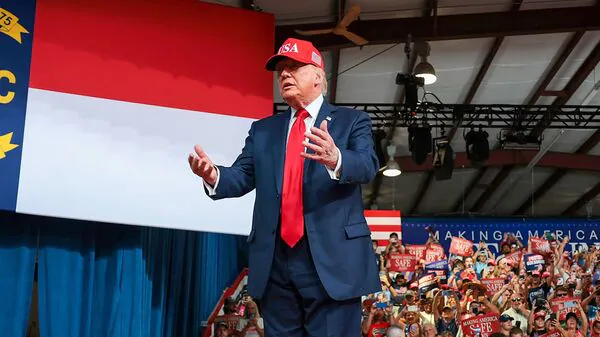
'1% Or Less': Trump Demands Rate Cut After US Fed Raises Interest Rates For First Time Since 2023


In a post on social media on Wednesday, Trump said US interest rates should be“1%, or less”, arguing that the American economy was attracting fresh investment and had strong credit credentials. He followed it with a demand for rates to be lowered“fast”.
Also Read | 'Will have disastrous impact on humanity': MicrosoftAI CEO flags Anthropics AI development model, says it will make alignment difficult Remark comes after Fed Reserve raised benchmarkTrump's remarks came shortly after the US Federal Reserve raised its benchmark federal funds rate by 25 basis points to a range of 3.75% to 4%. The decision was unanimous and marked the first rate increase since July 2023, Bloomberg reported.
Quick answers to key questions
.5 QUESTIONS1Why did Donald Trump call for a reduction in interest rates after the Fed's rate hike?⌵Trump argued that a dramatic reduction in interest rates, to 1% or less, would benefit the American economy, which he claimed was attracting investment and had strong credit credentials.
2What was the Federal Reserve's rationale for increasing interest rates?⌵The Federal Reserve raised interest rates to combat persistent inflationary pressures, emphasizing that inflation remained too high despite resilient economic activity and a stable labor market.
3How might higher interest rates affect American households?⌵Higher interest rates can lead to increased borrowing costs for mortgages, car loans, and credit cards, making it more expensive for households to finance their purchases.
4What impact could the Fed's rate hike have on gold prices?⌵The Fed's interest rate hike may pressure gold prices as higher rates make interest-bearing assets more attractive, potentially diverting investment away from non-yielding assets like gold.
5Should the Federal Reserve prioritize lowering interest rates despite inflation concerns?⌵This remains a contentious issue; while some, like Trump, advocate for lower rates to stimulate the economy, Fed officials maintain that controlling inflation is essential for long-term stability.
The move puts the central bank at odds with Trump's repeated calls for cheaper borrowing. It also puts renewed focus on his relationship with Fed Chair Kevin Warsh, whom Trump appointed earlier this year.
Also Read | Modi turns 76: How BJP marks PM's birthday todayWarsh defended the decision, pointing to persistent inflationary pressures. The Fed has indicated that price growth remains too high, while economic activity and the labour market have remained relatively resilient. Officials have also signalled that another increase could come later this year, Bloomberg reported.
The backdrop has become more complicated for US policymakers. Higher energy prices linked to the ongoing US-Israel conflict with Iran have added to inflationary pressures, while Trump's tariff policies have also contributed to uncertainty over the outlook for prices. Reuters reported that tariffs, the energy shock and strong capital spending linked to the artificial-intelligence boom have all kept price pressures elevated, the Bloomberg report further read.
Also Read | Top 5 breakout stocks to buy today by Sumeet Bagadia: check target, stop lossWarsh has also stressed the importance of the Federal Reserve maintaining its independence. His support for the rate increase is significant because Trump had repeatedly criticised his predecessor, Jerome Powell, for not cutting rates aggressively enough.
Trump's latest comments did not directly attack Warsh by name. However, the sharp difference between the president's preferred policy and the Fed's latest decision highlights the pressure facing the central bank as it attempts to bring inflation under control, the Bloomberg report said.
For American households, higher interest rates can eventually translate into more expensive borrowing, including for mortgages, car loans and credit cards. At the same time, savers may benefit from higher returns on some deposits and fixed-income instruments.

Legal Disclaimer:
MENAFN provides the
information “as is” without warranty of any kind. We do not accept any
responsibility or liability for the accuracy, content, images, videos,
licenses, completeness, legality, or reliability of the information
contained in this article. If you have any complaints or copyright issues
related to this article, kindly contact the provider above.
Comments
No comment