

Realman Launches GLN Initiative To Deploy 1,000 Robots In Real-World Environments


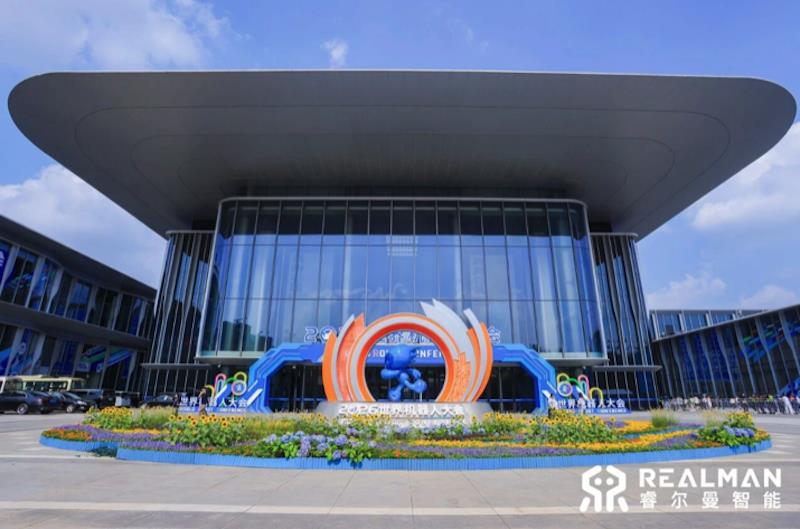
The company is showcasing what it calls its“Real-Work Robots” at the conference, which opened on August 19 at the Beiren Yichuang International Convention and Exhibition Center.
WRC 2026 brings together more than 300 exhibitors and more than 2,000 exhibits under the theme“Human-Robot Collaboration for Shared Industrial Growth”.
RealMan says its demonstrations are intended to show how robots can move beyond laboratory testing and exhibition demonstrations into practical, continuous operation in real-world environments.
Using its GLN remote operation network, the company demonstrated RealBOT robots restocking and retrieving medicines in a 24-hour smart pharmacy, carrying out inspections in a power distribution room and working alongside pastry chefs from Chinese food company Daoxiangcun.
RealMan also demonstrated remote operation of robots at its Embodied Intelligence Super Factory in Changzhou, where the systems were used for equipment commissioning and production-line inspection.
The company says GLN is designed to connect remotely located robots with human operators while collecting data from real-world operations that can subsequently be used to improve robotic systems.
RealMan receives CR L3 certificationDuring the conference, RealMan also received CR L3 certification for its ultra-lightweight humanoid robotic arms.
Zhu Xiaopeng, director of the Robot Testing and Certification Center at the Shanghai Robot Industry Technology Research Institute, presented the certification at RealMan's exhibition booth.
The Shanghai Robot Industry Technology Research Institute supports several Chinese robotics testing, research and standardization organizations, including the National Robot Testing and Evaluation Center. Its CR certification program is recognized by China's Ministry of Industry and Information Technology.
RealMan says its robotic arms have a mean time between failures, or MTBF, of 50,000 hours and are among a relatively small number of products in China to achieve CR L3 certification.
The company says the certification supports its plans to use the arms in robots designed for continuous operation and large-scale deployment.
GLN connects robots with remote human operatorsRealMan used its collaboration with Daoxiangcun to demonstrate how GLN can connect human operators with robots in other locations.
An operator at RealMan's Beijing headquarters remotely controlled a robot at the WRC exhibition booth, where it worked alongside a Daoxiangcun pastry chef to make traditional walnut pastries and lion-shaped dim sum.
RealMan says the system operates with millisecond-level latency and is intended to allow people to remotely operate robots over long distances.
The company sees remote operation both as a way of applying human skills in locations where workers are not physically present and as a means of collecting data from real-world robotic operations.
Data generated during these operations can be fed back into robot training systems, creating a loop in which robots learn from human operation and gradually improve their ability to handle different tasks and environments.
RealMan and PaXini demonstrate tactile sensingRealMan is also working with tactile sensing specialist PaXini at WRC 2026 to demonstrate an RM75 series robotic arm equipped with several forms of force and tactile sensing.
The system combines multidimensional force sensing, multidimensional tactile sensing, a six-axis force sensor and joint torque sensors.
RealMan says the architecture provides sensing from the robot's joints and end effector through to its contact surfaces, creating a force and tactile feedback loop for seven-degree-of-freedom manipulation.
Potential applications include precision assembly, compliant grasping, human-robot collaboration and complex trajectory demonstration.
The companies say improved force and tactile sensing could help manufacturers increase production yield while reducing collisions, equipment stoppages, damaged workpieces and safety risks associated with human-robot collaboration.
Nearly 1,000 RealBOT deployments plannedRealMan says its broader deployment strategy is based on three main elements: reliable robot hardware, data collected from real-world operations and its GLN remote operation infrastructure.
The company plans to deploy nearly 1,000 RealBOT robots in real-world environments during 2026 through the GLN network.
Those deployments are expected to generate operational data that RealMan can use to further develop its robotic systems.
RealMan is also using the production capacity of its Embodied Intelligence Super Factory to support the initiative as it works with technology and industry partners on larger-scale deployments.
The company says its objective is to establish an ecosystem covering robot hardware, data collection and remote operation, enabling robots to move from demonstrations into production and other practical working environments.

Legal Disclaimer:
MENAFN provides the
information “as is” without warranty of any kind. We do not accept any
responsibility or liability for the accuracy, content, images, videos,
licenses, completeness, legality, or reliability of the information
contained in this article. If you have any complaints or copyright issues
related to this article, kindly contact the provider above.
Comments
No comment