

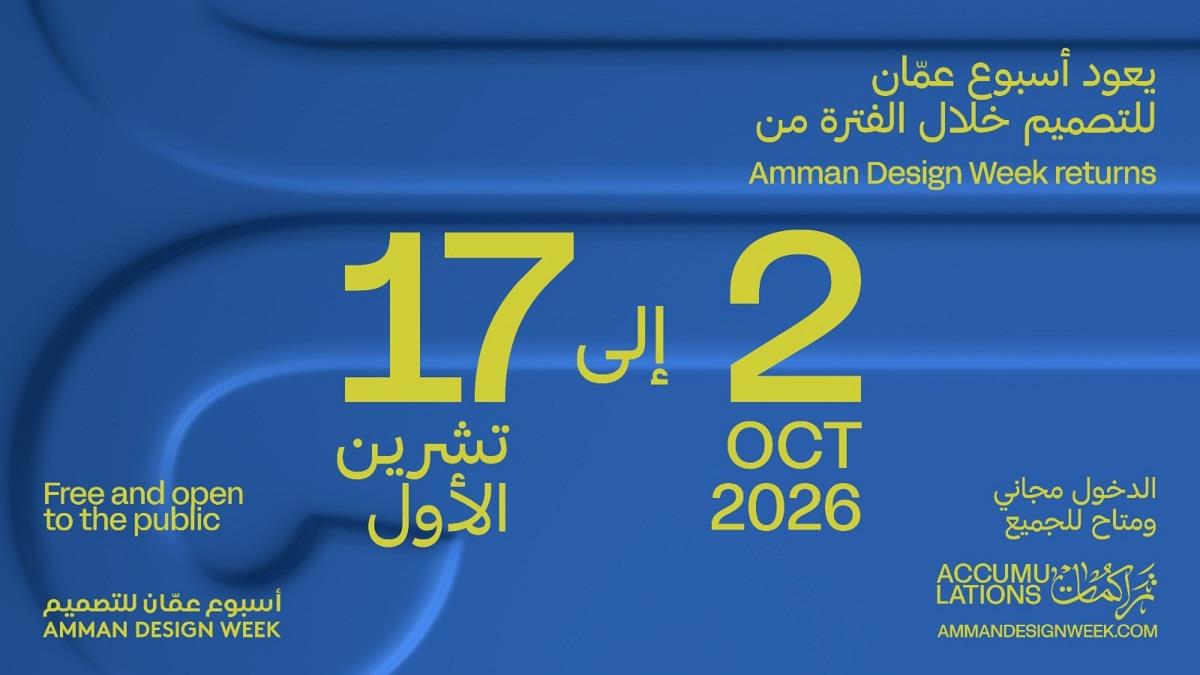
Amman Design Week Returns After Seven-Year Hiatus


- Fourth edition opens Oct. 2 with more than 220 designers, makers and creative collectives - Events to span Ras Al Ain, Jabal Al-Weibdeh, Jabal Amman, Iraq Al-Amir and Aqaba - Amman Design Week to offer free public admission Amman, Sept. 16 (Petra) -- Amman Design Week will return next month after a seven-year hiatus, bringing more than 220 designers, makers and creative collectives together for its fourth edition, with 204 events planned across Amman and other locations in the Kingdom.
Held under the patronage of Her Majesty Queen Rania Al Abdullah, the event will run from Oct. 2 to 17 under the theme "Accumulations," with a program spanning exhibitions, workshops, guided tours, lectures and public discussions. All events will be open to the public free of charge.
Activities will extend from Ras Al Ain to Jabal Al-Weibdeh and Jabal Amman, as well as Iraq Al-Amir and Aqaba. More than 60 participating spaces across Amman, most of them concentrated in Jabal Amman, will host exhibitions, workshops, talks and other events over the two-week program.
Launched at the initiative of Queen Rania in 2016, Amman Design Week aims to make design accessible to a wider public and broaden participation in the sector. Its approach places makers and craftspeople alongside designers, including practitioners working with ceramics, textiles and stone.
The 2026 edition will also introduce four permanent projects that will remain in public spaces after the event concludes, including three in Ras Al Ain and one in Jabal Al-Weibdeh.
The biennial event returns under new leadership, with Sarah Hijazin and Bishr Tabbaa serving as directors of Amman Design Week.
Hijazin said the seven-year absence of the public event did not mean design activity had stopped, with designers continuing to experiment, makers transferring their expertise and students pursuing learning and research through workshops, classrooms, studios and communities across the Kingdom.
"Amman Design Week never completely disappeared," Hijazin said. "Over seven years, and without a public platform, the design community continued its work; designers tested new ideas, makers passed on their expertise, and students continued to learn." Tabbaa said the fourth edition would bring that accumulated work before the public and highlight the presence of design in everyday life across the Kingdom.
Amman Design Week has maintained a partnership with the Greater Amman Municipality (GAM) since its launch, with the municipality supporting the event as part of efforts to incorporate design, culture and creativity into the development of the city.
GAM Executive Director for Smart City Lubna Al-Hunaiti said the municipality supports designers and creatives across different age groups, particularly young people and adolescents, while promoting urban design and broader community participation under its 2022-2026 strategic plan.
She said the partnership also reflects GAM's efforts to create a more inclusive, sustainable and higher-quality urban environment while strengthening Amman's urban standing and preserving the city's identity.
The 2026 edition will also showcase work produced through the Ithra Design Residency in collaboration with Amman Design Week, which brought together designers from Jordan and Saudi Arabia.
The Student Exhibition will return for a third edition with support from the Sakhtian Foundation, presenting 34 projects by 40 students selected from 203 applications submitted by participants from 88 educational institutions.
This year's "Accumulations" theme, curated by Faisal Tabbarah and Khaled Al-Bashir, explores how design develops over time through accumulated materials, inherited knowledge, repeated practices and the environments in which creative work takes shape.
Al-Bashir, the program curator, said the concept examines how individual ideas connect to wider networks of materials, histories, people, systems and places.
Tabbarah, the exhibitions curator, said the edition seeks to present a rooted, multilayered view of what design means in the region, shaped by local hands, materials and memory, as well as people's relationship with place.
//Petra// RZ

Legal Disclaimer:
MENAFN provides the
information “as is” without warranty of any kind. We do not accept any
responsibility or liability for the accuracy, content, images, videos,
licenses, completeness, legality, or reliability of the information
contained in this article. If you have any complaints or copyright issues
related to this article, kindly contact the provider above.
Comments
No comment