

Caught Between The US And China, Can Switzerland Stay Neutral In The AI Race?


I analyse the risks, opportunities and concrete impacts of artificial intelligence on society and everyday life. Since joining SWI swissinfo in 2020, I translate the complexity of science and technology into stories that speak to a global audience. Born in Milan to an Italian-Egyptian family, I have been passionate about knowledge and writing since childhood. I worked between Milan and Paris as a multilingual editor for technology magazines before transitioning to international journalism with SWI swissinfo.
-
More from this aut
Italian Departm
-
Français
fr
Prise en étau entre les États-Unis et la Chine, la Suisse peut-elle rester neutre dans la course à l'IA?
Read more: Prise en étau entre les États-Unis et la Chine, la Suisse peut-elle rester neutre dans la course à
Italiano
it
Stretta tra Stati Uniti e Cina, la Svizzera può restare neutrale nella corsa all'IA?
Original
Read more: Stretta tra Stati Uniti e Cina, la Svizzera può restare neutrale nella corsa al
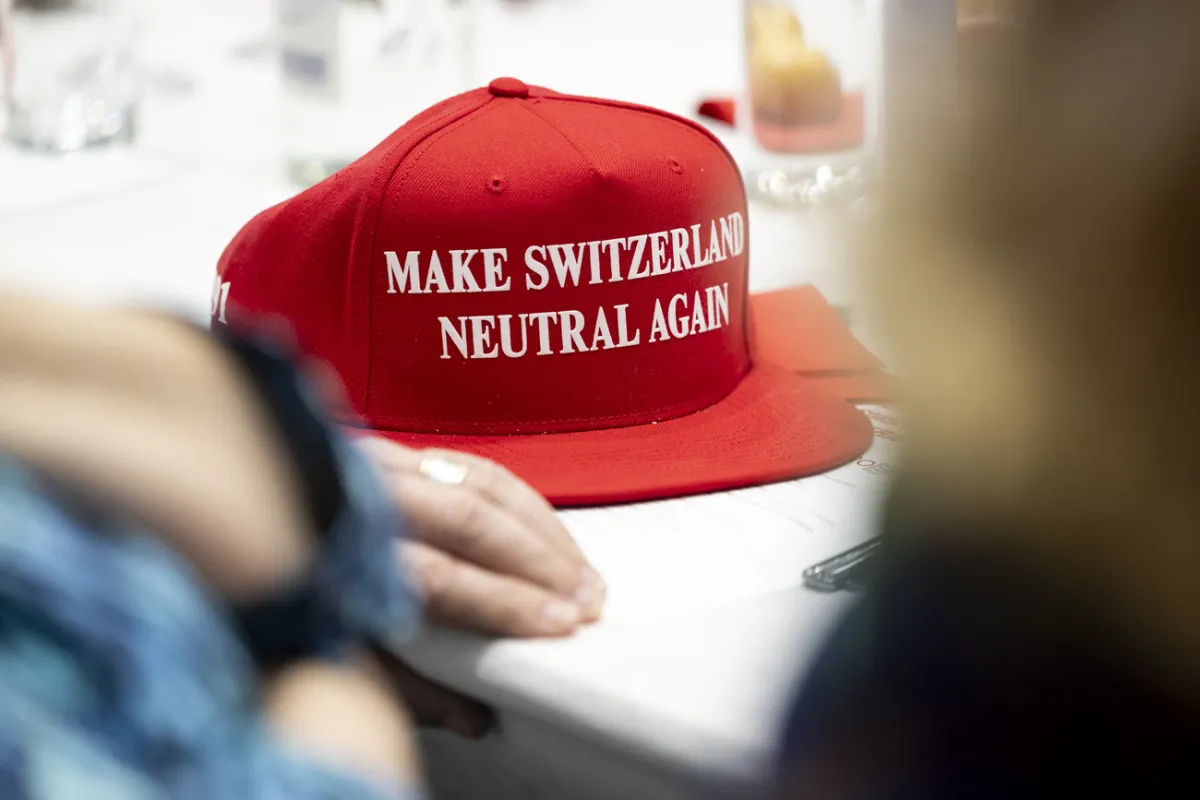
For more than two centuries, Swiss neutrality has defined Switzerland's position in armed conflicts. On September 27, Swiss voters will decide whether to enshrine a more restrictive interpretation of neutrality in the Constitution limiting the country's ability to impose sanctions on belligerent states outside those decided by the United Nations Security Council.
Whatever the outcome of the vote, the question of how to remain neutral in a world in which artificial intelligence (AI) and other strategically important technologies are controlled by two rival powers – the United States and China – is as pressing as ever. This issue is particularly sensitive for Switzerland, which depends heavily on technologies developed by both countries.
“If you are in the middle, you get caught in the crossfire,” says Jean-Marc Rickli, head of global and emerging risks at the Geneva Centre for Security Policy.
Driven by economic competition and geopolitical tensions, the US and China are accelerating the development of increasingly powerful AI systems, even“at the expense of security,” Rickli says. The rise of advanced, autonomous agentic AI models is an example.
“With agents, you have new entities that are potentially able to develop and carry out their own plan, including staging their own attack without human intervention, in order to reach their assigned goal. And this is something completely new,” Rickli says. In this environment, he believes the danger of mistakes or escalation is becoming more tangible.
Maxime Stauffer, co-founder and CEO of the Simon Institute for Longterm Governance, a Geneva-based think tank, believes that advances in frontier AI are changing the cyberspace threat landscape.
“Day to day, various states and non-state actors launch cyberattacks on each other. That's known and almost routine. But there used to be an equilibrium between offense and defence capabilities, which AI is now disrupting,” he says.
The growing US-China rivalry over AI has even prompted comparisons with a new“Cold War”, although the analogy remains contestedExternal link.
Despite the calls, neither Washington nor BeijingExternal link appears willing to slow down the AI race.“We're leading China in AI (...) and frankly, I want to keep it that way because whoever wins AI, wins,” US President Donald Trump said recentlyExternal link. China, for its part, has dismissed calls to slow down the development of AI, calling them“fearmongering” and part of a“Cold War playbook”.
Both countries use access to their technology, sanctions and industrial dependencies for geopolitical leverage. In this context, remaining equidistant between Washington and Beijing is becoming“increasingly difficult,” Rickli says,“because you have to choose a side, in order to avoid potential sanctions”.
According to the Swiss State Secretariat for Security Policy (SEPOS), US and Chinese companies' growing influence over countries' economic and military capabilities and the conduct of warfare is“jeopardising strategic stability”.
>>Here is everything you need to know about the upcoming neutrality on September 27:
More More Neutrality How the neutrality initiative could affect Swiss policyThis content was published on Nov 18, 2025 The neutrality initiative seeks to incorporate a strict interpretation of Swiss neutrality in the federal constitution. What would this mean for Switzerland's foreign and security policy?
Read more: How the neutrality initiative could affect Swiss p
Legal Disclaimer:
MENAFN provides the
information “as is” without warranty of any kind. We do not accept any
responsibility or liability for the accuracy, content, images, videos,
licenses, completeness, legality, or reliability of the information
contained in this article. If you have any complaints or copyright issues
related to this article, kindly contact the provider above.
Comments
No comment