

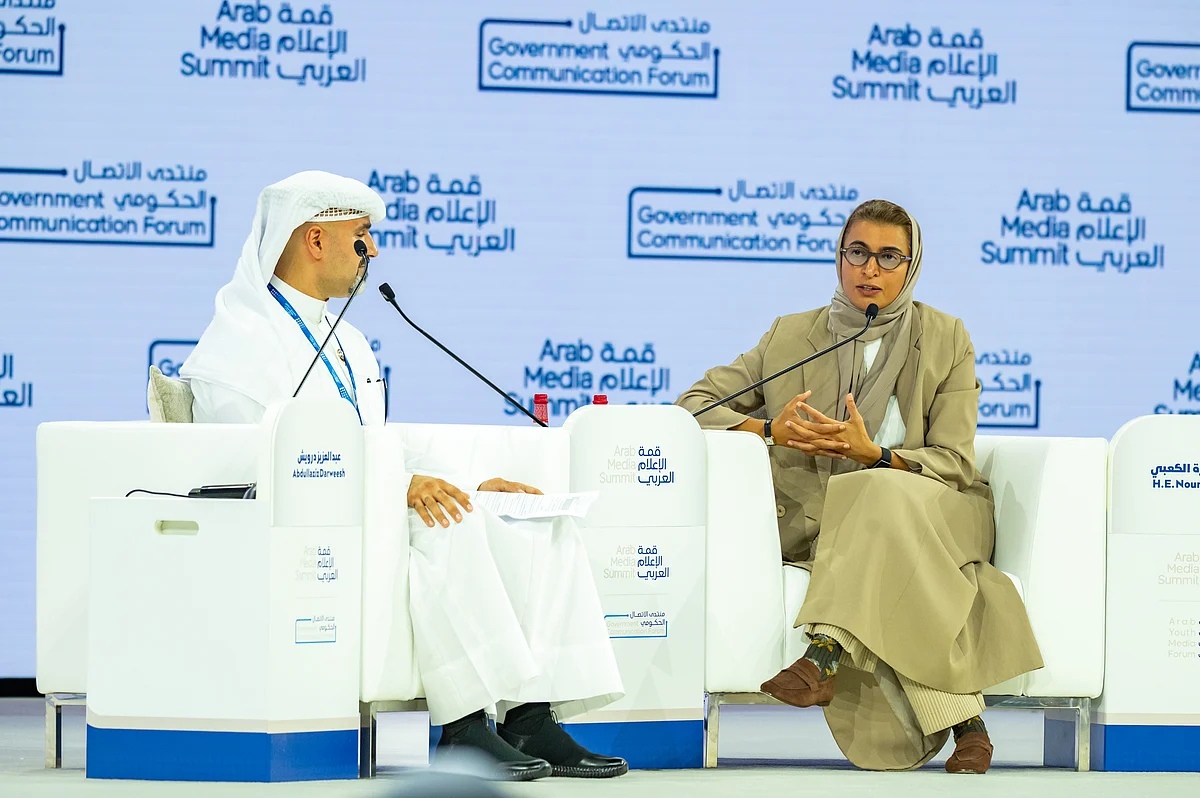
UAE Faced 2 Threats During Iran War: Air Strikes And Fake News, Says Noura Al Kaabi


- By: Azza Al Ali
[Editor's Note: Follow Khaleej Times live blog for the latest regional developments amid the US-Iran war.]
The UAE faced an unprecedented challenge during Iranian attacks, with the country having to respond not only to aerial strikes but also to a flood of fake news, disinformation and AI-generated content online since the war began, Minister of State Noura Al Kaabi said.
Recommended For YouSpeaking at a session titled 'Media and Diplomacy in a Changing World' at the Arab Media Summit, Al Kaabi said the attacks created two simultaneous threats, making the speed and credibility of information increasingly important.
“For the first time in our history, we lived through this,” Al Kaabi said, referring to the attacks on the UAE. She said the country had to deal with what was happening physically while also confronting what appeared on screens, including fabricated news, misinformation, disinformation and malinformation.
Stay up to date with the latest news. Follow KT on WhatsApp Channels.
The challenge, she said, has become more complex with the rapid development of artificial intelligence and other technologies that can accelerate the spread of false information.
Citing an MIT study, Al Kaabi said false news can spread significantly faster than factual information, making the challenge even greater when AI tools can be used to produce and circulate content rapidly.
“We are now at a stage where we need presence, assessment and speed, all three at the same time,” she said. For governments and institutions, responding to misinformation is therefore not simply a communications issue but also a security concern, she said.
Al Kaabi stressed that credibility built over time is one of the strongest tools for countering false information, acknowledging that governments cannot convince everyone or expect everyone to agree with them.
“What is important is that I have a record of credibility,” she said.
She urged people to question the source of information before accepting or sharing it, particularly when encountering unfamiliar accounts, websites or logos publishing breaking claims.
“When someone tells you news, the first thing you ask is: where did this news come from?” she said.
The same principle applies to governments and media organisations, she said, which must be able to respond quickly while also assessing information quickly.
Youth shaping the narrativeAl Kaabi then turned to the role of young people in shaping the Arab world's narrative, saying their familiarity with technology and AI gives them an advantage in a rapidly changing media environment.
Rather than simply telling young people what role they should play in shaping narratives, she said policymakers and older generations should listen to them and learn from them.
“Young people are the ones who teach you now,” she said.
However, she cautioned young people against allowing their immediate political or social passions to define everything they say online, noting that digital content can remain accessible for years.
She encouraged young people to consider how they might view their own posts a decade later.
The UAE's approach to coexistence, she said, provides a foundation for how young people can engage with different communities, beliefs and cultures.
Al Kaabi also highlighted the importance of institutions in creating opportunities for young people to build international connections, pointing to the UAE's participation in global events, such as Expo 2020.
She recalled seeing Emirati young people in Osaka who spoke Arabic, English and Japanese, alongside Japanese young people who had lived in the UAE.
Such exchanges, she said, help build bridges between countries because they allow young people to understand the audiences they are communicating with.
Understanding an audience is increasingly important in a fragmented media environment, Al Kaabi said, where people consume information across different platforms.
A message that works on X may not work on Instagram or TikTok, she said, making it essential for governments, institutions and communicators to understand where their audiences are and how they consume content.
The wider role of diplomacy, she said, is therefore no longer limited to traditional government channels, but increasingly involves culture, media, technology and the people who carry a country's story abroad.
ALSO READ- 640,000 cyberattacks in a day: Top UAE official warns fifth-generation wars target minds GCC chief calls for unified Gulf media strategy to counter misinformation

Legal Disclaimer:
MENAFN provides the
information “as is” without warranty of any kind. We do not accept any
responsibility or liability for the accuracy, content, images, videos,
licenses, completeness, legality, or reliability of the information
contained in this article. If you have any complaints or copyright issues
related to this article, kindly contact the provider above.
Comments
No comment