

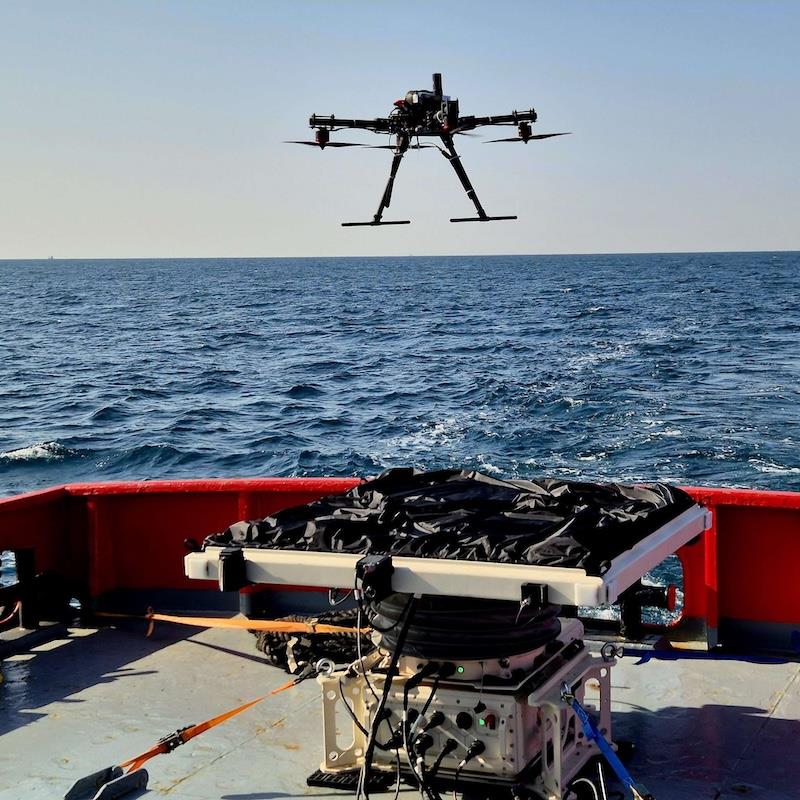
Waiv Robotics Completes 'World's First' Autonomous Drone Landing On Moving Vessel At Night


The system completed dozens of recoveries, using WaiV's patented catch-lock-release mechanism combined with its AI-powered predictive algorithms to guide drones onto moving decks and secure them on touchdown.
Testing exposed the system to sea spray, changing weather, and continuous deck movement, proving recovery can remain precise despite constantly changing conditions at sea.
The oil and gas drone market is projected to exceed $56 billion by 2030, driven by growing adoption of unmanned aerial vehicles (UAVs) for inspection, remote monitoring, leak detection, security, and other operations.
However, deploying drones offshore presents a different set of challenges. Aircraft must land on decks that shift with every wave, change in speed, and turn of the vessel, while wind and limited visibility further complicate the final approach.
As a result, many offshore operations either rely on specialized maritime pilots for recovery or avoid using drones altogether because recovery at sea remains too risky and complex.
Held over two days off the coast of Galveston, Texas, WaiV's demonstration brought together drone OEMs (original equipment manufacturers), drone service providers, integrators, and solution suppliers to observe the system in open-sea environments.
Flights and system operation took place during the day and at night, using radar and lidar sensors to track the drone and guide it back to the landing pad on the moving decks.
The result is a UAV recovery system that is built to keep offshore drone operations running at any hour of the day, without natural light or reduced visibility dictating when missions can be deployed and recovered.
By avoiding any hardware or software modifications to the aircraft, the system becomes platform-agnostic, allowing operators to bring autonomous recovery to existing drone fleets without replacing the aircraft already in service.
For manufacturers, that expands their offering into maritime operations without requiring them to redesign or modify their products.
“Offshore operations don't stop when the sun goes down, and drone operations should not have to either,” says Johnny Carni, founder and CEO of WaiV Robotics.
“The demonstration in Galveston served as a way for our team to show how autonomous launch and recovery can work across the conditions operators are actually facing at sea.
“Our goal is to remove the limits of when and where drones can operate offshore, so they can be ready whenever the mission demands it.”

Legal Disclaimer:
MENAFN provides the
information “as is” without warranty of any kind. We do not accept any
responsibility or liability for the accuracy, content, images, videos,
licenses, completeness, legality, or reliability of the information
contained in this article. If you have any complaints or copyright issues
related to this article, kindly contact the provider above.
Comments
No comment