

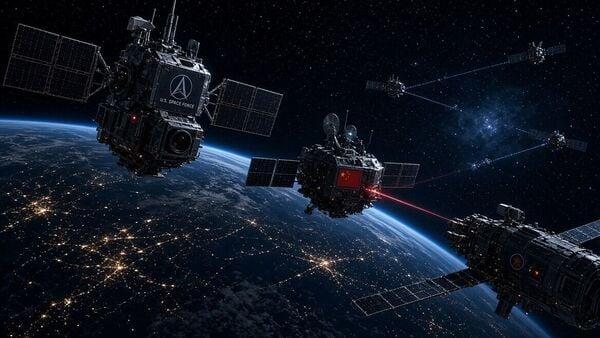
China, Russia Warn Against 'Weaponisation' Of Space After US Confirms Orbital Weapons


China's Foreign Ministry warned against turning outer space into a battlefield and urged Washington to stop expanding its military capabilities in space.
“We urge the US side to stop expanding its military capabilities and preparing for war in outer space,” ministry spokesman Guo Jiakun said at a briefing.
Quick answers to key questions
.5 QUESTIONS1What did China and Russia say about the weaponisation of space?⌵China and Russia warned against the weaponisation and militarisation of outer space, urging the US to stop expanding its military capabilities in that domain.
2Why has the US Space Force deployed weapons in space?⌵The US Space Force aims to protect its interests against perceived threats from China and Russia, as both nations are developing space and counterspace military capabilities.
3How do the US weapons in orbit function?⌵The US Space Force stated that these 'space control weapons' could disrupt, degrade, or destroy an adversary's space systems using both kinetic and non-kinetic methods.
4What was the significance of the US admitting to weapons in space?⌵The US acknowledgment of having weapons in orbit marks a significant shift in transparency regarding its military capabilities in space, potentially intensifying the arms race with Russia and China.
5Should China be concerned about US weapons in space?⌵Yes, China should be concerned as the US's deployment of weapons in space is seen as a direct counter to China's military modernization and perceived aggression in space.
Beijing opposed the“weaponisation of outer space, turning it into a battlefield, as well as an arms race there”.
The warning came after the US Space Force confirmed that Washington has“on-orbit space control weapons” capable of defending US forces against hostile actions by adversaries.
Russia calls for demilitarisationRussia also called for outer space to remain free of weapons.
“We are counting on broad international consolidation to continue working toward the complete demilitarisation of space,” Kremlin spokesman Dmitry Peskov said.
The US Space Force did not specify the number or type of weapons deployed in orbit. It said its space-control capabilities include kinetic and non-kinetic means to affect an adversary's space systems.
Why the US has weapons in spaceThe US Space Force has identified both China and Russia as major potential threats to American interests in space.
It says China is developing space and counterspace capabilities as part of its military modernisation, while Russia considers space a warfighting domain.
Military competition in space dates back to the Cold War and the launch of the Soviet Union's Sputnik in 1957. The US and Soviet Union subsequently developed capabilities to protect their own satellites and potentially disable those of adversaries.
Satellites are now critical to military communications, surveillance, intelligence gathering and navigation.
US disclosure raises arms-race concernsThe US disclosure, which analysts cited by AFP described as confirming a longstanding open secret, could further strain Washington-Beijing ties and fuel concerns over an escalating arms race in space.
Song Zhongping, a Hong Kong-based military commentator and former Chinese army instructor, said the disclosure was“no surprise at all”, as US possession of such weapons had long been widely known.
He said the key difference was that Washington had moved from ambiguity to openly acknowledging its capabilities.
Song warned that China would not simply stand by if the US moved toward further deployment of weapons in space.
Also Read | US judge blocks Trump administrations new visa rules for foreign students, journalists China could respond to US movesSong said whether Beijing would deploy its own weapons in orbit would depend on Washington's future actions.
China already has its own space station in orbit, he noted.
The disclosure comes amid wider tensions between the US and China over military and technological capabilities.
Space weapons face regulatory gapsThe development of space weapons has also exposed gaps in international law.
The 1967 Outer Space Treaty bans the placement of nuclear weapons and other weapons of mass destruction in orbit, but does not prohibit all conventional weapons or technologies capable of attacking satellites.
According to AFP, space law expert Laetitia Cesari said existing international rules leave many modern military capabilities in space largely unregulated.
The issue could come up at a United Nations disarmament meeting in November, she said, as Moscow and Beijing have pushed for a treaty restricting the placement of weapons in space, while Western countries have favoured rules on responsible behaviour.
Also Read | Who is Umar Kremlev? Putin aide who partially funded Trump Jr's wedding
Legal Disclaimer:
MENAFN provides the
information “as is” without warranty of any kind. We do not accept any
responsibility or liability for the accuracy, content, images, videos,
licenses, completeness, legality, or reliability of the information
contained in this article. If you have any complaints or copyright issues
related to this article, kindly contact the provider above.
Comments
No comment