

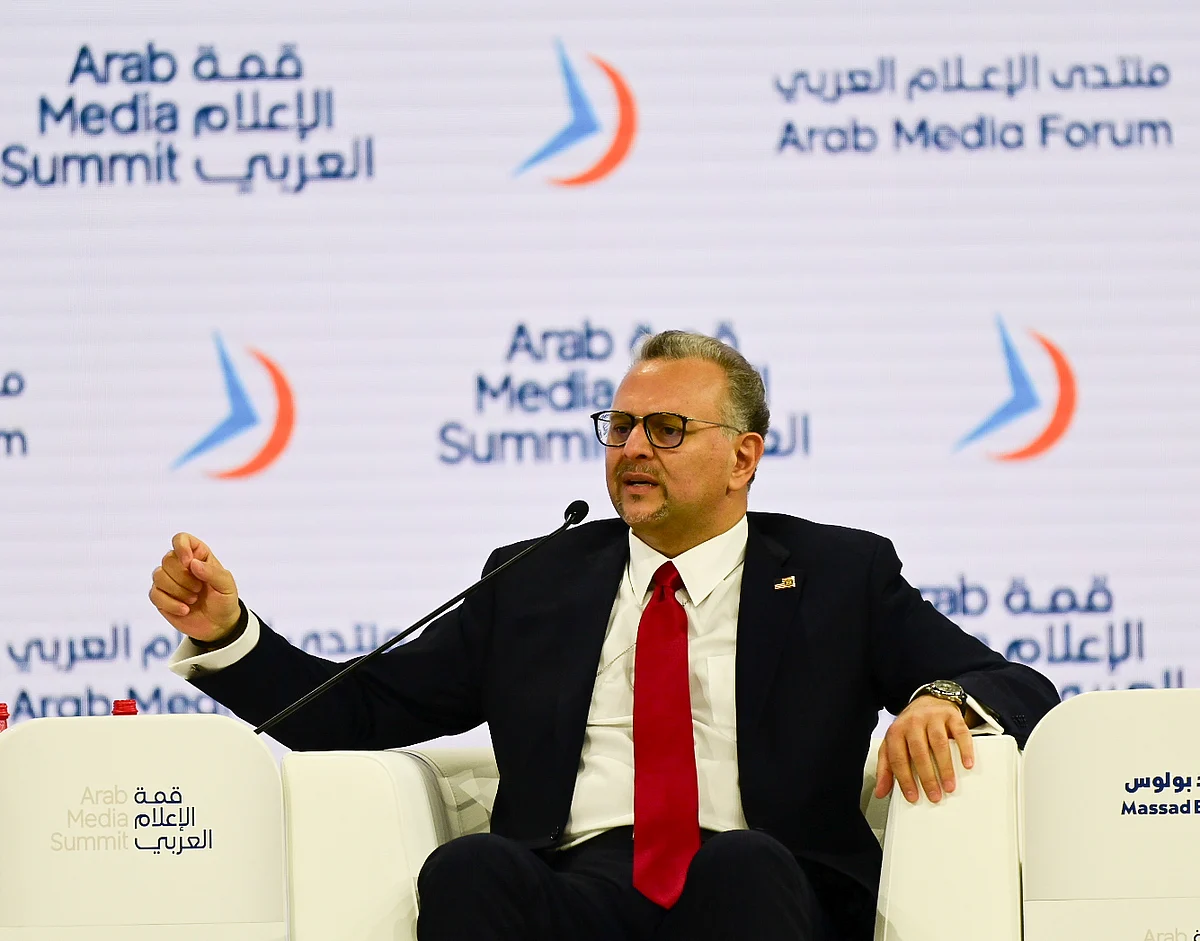
Positive Developments Soon At Bab Al Mandab, Says Trump Adviser


Positive developments concerning the Bab Al Mandab Strait could emerge soon, a senior adviser to US President Donald Trump said at the Arab Media Summit, as he described intensive coordination between Washington and its Gulf partners.
Recommended For YouMassad Boulos, Senior Advisor to the President of the United States on Arab & Middle Eastern Affairs, said the administration was treating the situation with urgency and seriousness, but without panic. Referring specifically to developments around Bab Al Mandab, Boulos said the issue was only about two days old. He did not identify a specific agreement or outcome, but said early signs of change had already appeared.“We have begun to see matters turn in a positive direction over the past few hours,” he said.“We will see developments for the better in the next few hours.”
Stay up to date with the latest news. Follow KT on WhatsApp Channels.
Boulos referred to comments made by US Vice-President JD Vance the previous day about Washington's approach to the issue. Vance had said the security of the region and the direction of events at Bab Al Mandab were extremely important to the United States, describing the matter as a red line.“There is coordination with our allies and partners in this regard,” he said.“we will see positive developments emerge on the ground soon.”
Daily contact with Gulf leadersBoulos said Trump was in continuous contact with Saudi Crown Prince Mohammed bin Salman, UAE President Sheikh Mohamed bin Zayed Al Nahyan and other regional leaders. Boulos said he had met about 12 heads of state from the Arab League's 22 member countries over roughly the past year and a half. In many of the remaining countries, he said, he had met crown princes or foreign ministers.
“I am in constant contact with a large number of foreign ministers and other officials, especially in the UAE, Saudi Arabia, Qatar and Egypt,” he said. He said Arab leaders had a“high degree of confidence” in Trump's handling of regional crises.
Boulos said the Iranian crisis could not be viewed in isolation from the other crises facing the region. Many Arab countries were confronting wars or conflicts directly or indirectly, Boulos added, while others were paying the price for instability elsewhere. He linked Washington's handling of these overlapping challenges to the close consultations it maintained with Arab capitals.
Sudan 'largest humanitarian disaster on earth'Turning to Sudan, Boulos described the conflict as“the largest humanitarian disaster on earth” and said about 35 million people required humanitarian assistance.“This is a major priority for the United States,” he said.
Boulos said Washington had provided more than $3 billion in humanitarian aid since the war began, which he described as the largest contribution by any single donor.
“We remain committed to, and insist on, the roadmap that we developed with our partners in the region because we believe in it,” he said. However, he acknowledged that the plan had not been implemented about a year after it was drawn up.
He said Sudanese civilians and civil society must remain central to the political process.
“There must be an agreement as soon as possible on a civilian government and civilian rule in Sudan,” he said, adding that the country's future should be removed from militia control and military domination.
Lebanon needs support for army and stateOn Lebanon, Boulos said progress depended on strengthening the Lebanese army and national institutions.“We need to support the Lebanese army, the Lebanese state, the government and state institutions so that they can carry out their role,” he said.
Boulos said a conference in Paris was expected to focus on assistance for the Lebanese army, with France and other international partners involved.
“We must not forget the Arab role. It is very important,” he said, pointing to continuing coordination with Saudi Arabia, Qatar, the UAE, Egypt and Jordan.
Discussing the Lebanon-Israel track Boulos said implementation was“not proceeding at the speed we would like to see”. Progress would take time, he said, and would depend on the Lebanese army being able to assume its responsibilities.
He added that US military and security bodies were in regular contact with their Lebanese counterparts, while administrative decisions remained the responsibility of the Lebanese state.
Libya initiatives 'complementary'On Libya, Boulos said the American initiative and the UN-supported or French approach were“complementary” rather than competing. He said an agreement had been reached under a United Nations umbrella to hold parliamentary and presidential elections within two years.
Boulos said the two year interim period should not be allowed to pass without institutional reform.
He said Washington was working with regional and international partners particularly Turkey and Egypt, as well as the UAE, Qatar, France, Italy and Algeria to support the unification process.
“We must use the agreed two-year period to unify institutions, especially the military and security institutions,” he said.
“Libya is one of the richest Arab and African countries,” Boulos added, lamenting what he called“15 years of suffering” endured by its people.
ALSO READ- Trump says oil is flowing through Hormuz, US open to engaging with Iran US blocks Iran nuclear chief from IAEA meeting in Vienna Video: US Air Force officer survives '50 hours' after being shot down over Iran, CBS News reports Oman says Hormuz talks with Iran, Gulf states postponed to facilitate 'constructive dialogue'

Legal Disclaimer:
MENAFN provides the
information “as is” without warranty of any kind. We do not accept any
responsibility or liability for the accuracy, content, images, videos,
licenses, completeness, legality, or reliability of the information
contained in this article. If you have any complaints or copyright issues
related to this article, kindly contact the provider above.
Comments
No comment