

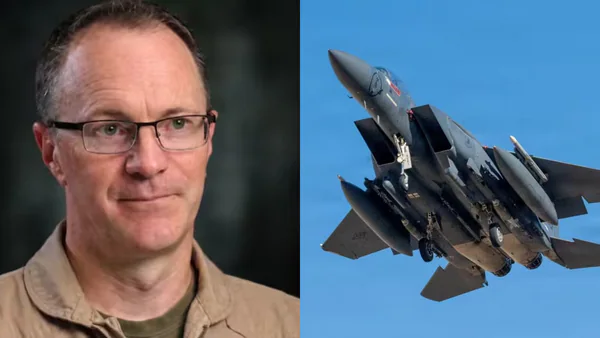
US Pilot Reveals How He Survived 50 Hours With A Broken Back In Iranian Mountains After Being Shot Down By Enemy Forces


The dramatic account of his survival and eventual rescue has now been detailed by CBS News' "60 Minutes", which spoke to the officer in his first public account of the incident.
US fighter jet shot down near IsfahanThe officer, known publicly only by his mission call sign "Bravo" because of security concerns, was the weapons-systems officer aboard a two-seat F-15E fighter jet.
The aircraft, operating under the mission call sign "Dude 44", was reportedly brought down by an "Iranian shoulder -fired missile" on April 2 during a mission near Isfahan.
CBS News reported that the jet had been carrying out a strike targeting industrial facilities associated with Iran's drone and missile programme.
Both crew members ejected after the aircraft was hit. However, Bravo and the pilot, referred to as "Alpha", became separated while descending.
Damaged parachute left Bravo falling at 70-100 mphBravo's ordeal became even more dangerous when his parachute failed to deploy properly. He fell towards the ground at an estimated 70 to 100 miles per hour before landing in a mountainous desert region.
Also Read | How India managed its energy needs amid the Iran warThe fall left him with multiple injuries, including a broken back, arm and shoulder.
"At one point when I looked up and saw no parachute, that was the most terrifying thing I've ever seen," Bravo told '60 Minutes' in his first public account of the incident.
Despite the severity of his injuries, Bravo moved away from the crash site. He later made his way towards a ridgeline estimated to be 7,000 feet high, where he concealed himself among the mountainous terrain.
"I paused, right then, and I prayed, 'Lord, your will be done. But if I'm getting through this, I need help," he said.
Rescue team initially failed to find BravoBravo landed roughly five miles away from Alpha. While Alpha was located and rescued by US forces several hours after the jet went down, the rescue team could not find Bravo and eventually had to withdraw.
The search then turned into a race against time, with Iranian forces also moving through the area in an attempt to locate the downed American airmen.
Also Read | BRICS Summit: Can India bridge divisions in the Middle East due to Iran war?US War Secretary Pete Hegseth was briefed about the incident after the aircraft was lost and ordered preparations to search for the crew.
"Whether they're alive or not, we're going to go get them," Hegseth said, according to CBS News.
Gen. Dan Caine, chairman of the US Joint Chiefs of Staff, said Iranian ground forces came within a few hundred metres of Bravo.
"There was clear intent out of the Iranian ground force to come find those two guys," Caine said.
CIA deception operation helped locate the airmanBravo eventually managed to establish communication with US forces and conveyed that he was injured but still moving.
According to CBS News, the CIA then combined intelligence capabilities with a deception operation to determine Bravo's location.
Before the next rescue attempt, the US military reportedly launched strikes against Iranian Revolutionary Guard forces close to the area where Bravo was hiding.
More than 90 US service members were deployed on the ground for the operation. Hundreds more took part in the air operation, while several thousand personnel provided additional support.
The rescue force used search-and-rescue aircraft along with smaller helicopters to reach Bravo in the rugged mountainous region.
'One of the greatest moments of my life'After almost 50 hours alone, Bravo finally saw the rescue team approaching.
He described seeing the rescuers as "one of the greatest moments of my life".
When the team reached him, Bravo said his response was simple:
"Let's go."
The operation, however, was not yet over. CBS News reported that two US aircraft landed on a makeshift desert airstrip but became trapped in the sand.
The stranded aircraft and helicopters were subsequently destroyed by the US military to prevent sensitive equipment from falling into Iranian hands.
Bravo was eventually flown out of Iran as the sun rose on Easter Sunday, nearly 50 hours after his F-15E had been shot down.

Legal Disclaimer:
MENAFN provides the
information “as is” without warranty of any kind. We do not accept any
responsibility or liability for the accuracy, content, images, videos,
licenses, completeness, legality, or reliability of the information
contained in this article. If you have any complaints or copyright issues
related to this article, kindly contact the provider above.
Comments
No comment