

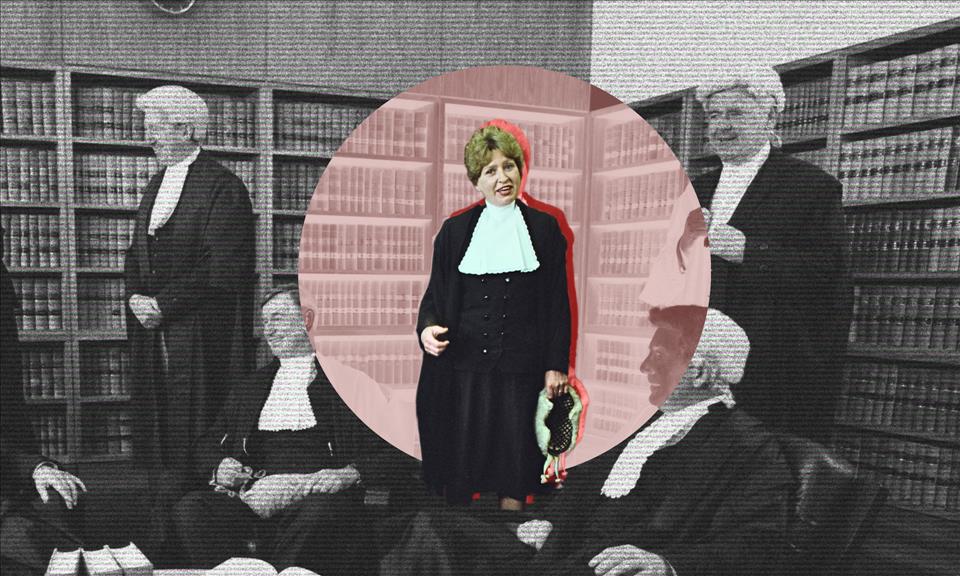
Trailblazing Lawyer Mary Gaudron, A Woman Of Many Firsts, Leaves A Huge And Lasting Legacy


Known for her courage, integrity and compassion, Gaudron brought her fierce intellect to bear on some of the nation's most significant legal cases. In the process, she helped change the legal profession and became an inspiration to many young women lawyers.
Early lifeBorn in Moree in country New South Wales in 1943, there is a famous anecdote about young Mary that came to exemplify her career and her impact on the country.
In 1951, then opposition leader“Doc” Evatt was in Moree to campaign for the“no” vote on a referendum to outlaw communism. Eight-year-old Mary famously approached him and asked“please sir, what is a constitution?” She was not impressed when he gave her a copy, finding it to be a rather flimsy document.
But the image of that clever young working-class girl seeking out a copy of the Constitution from a figure such as Evatt speaks to the significance of the trajectory of her life achievements.
When Australia's Constitution was drafted, it could scarcely have been imagined that someone like Gaudron would exercise legal authority within it.
Legal careerGaudron entered Sydney University law school in 1961, graduating in 1965 with first-class honours and the university's Medal for Law. She was the second woman to be awarded this honour (after another eminent lawyer, Elizabeth Evatt), and the first to do so as a part-time student.
She married and had her first child while still at law school, where she faced barriers as someone who did not fit the mould. After marrying she was forced to leave her part-time job at the Crown Solicitor's Office because of the rule that married women were not permitted in the public service.
Gaudron had been told of an attempt by the vice-chancellor to award her medal to the male student who had come second to her, with the rationale being that because she was a wife and mother, the man would be more likely to make good use of the medal. Gaudron is reported to have said,“The only difference between us is that I sit down to pee.”
She made more than good use of the medal and was a woman of many firsts. She was the first woman appointed Queen's Counsel in NSW, and the first woman to serve as solicitor-general in any jurisdiction across Australia. Then in 1974, she became the youngest person (and first woman) to be appointed a federal judge with her 1974 appointment to the Conciliation and Arbitration Commission as deputy president.
When Gaudron came to the Bar in 1968, her extraordinary academic record did not translate into an easy path to chambers. She was repeatedly refused a room simply because she was a woman, eventually sharing chambers with fellow pioneering barrister Janet Coombs.
As a barrister she successfully argued the Equal Pay Case for the Whitlam government before the Conciliation and Arbitration Commission. Yet she famously quipped“we won equal pay for equal work in 1967. We won again in 1969, and again in 1972, and in 1974. Yet we still do not have equal pay.”
Gaudron might be described as a larger-than-life figure. She had a brilliant legal mind with a sharp wit, a fondness for champagne, and a formidable temper - earning her the nickname“Mary the Merciless”. She also had an irreverent streak that made her anything but conventional.
Her appointment to the High Court occurred at a time when two vacancies arose more or less at the same time. This made it possible for then prime minister, Bob Hawke, to appoint a woman without making it appear as if he was pandering to“special interests”.
A trailblazer leaves a lasting legacyJustice Gaudron keenly perceived the weight of expectations generated by herappointment to the High Court. As the first woman to sit at the apex of Australia's judicial hierarchy, she well understood the historical significance of her appointment. This is partly reflected in her insistence at the time that she wanted to be seen as just“one of seven”. It is also reflected in comments she made ten years later that she did not want to be“the first and last” or give occasion for people to say“we tried a woman once and it did not work”.
In a speech she delivered in 1997 while a sitting judge, Gaudron spoke to some of tensions and challenges that existed for trailblazing women trying to fit in a system that was not made for them:
Gaudron's expertise in equality and discrimination theory meant her appointment to the High Court contributed to the development of a more sophisticated understanding of discrimination law. In the case Street v Queensland Bar Association, for example, she explained that discrimination is not simply about treating people differently: it can also occur when people in different circumstances are treated the same.
For many, her joint judgment with Justice Deane in the Mabo case is perhaps one of her most significant and memorable. Their Honours described past treatment of Indigenous Australians as“the darkest aspect of the history of this nation” and argued the“nation as a whole must remain diminished unless and until there is an acknowledgement of, and retreat from, those past injustice.”
Gaudron retired in 2003, well before the constitutionally prescribed retirement age of 70. In her farewell speech to Australian Women Lawyers, Gaudron remarked that leaving the Court was the best way of ensuring another woman was appointed. It was a comment that demonstrated some awareness of the prevailing gender politics of judicial appointment. At that time, it was thought perhaps there was only room for one woman on the High Court.
After her retirement she joined the International Labour Organization, serving as the president of its administrative tribunal from 2011 to 2014.
Although Gaudron maintained a commitment to law, and its possibilities to change and improve people's lives, in retirement she was not keen to insert herself into public discourse or debate. She eschewed interviews with journalists, and did not cooperate with a biography of her.
She did however, attend the 2011 swearing-in of Nicola Roxon as Ausralia's first woman attorney-general, and pose for a historic photograph with the other women“firsts” – the first woman prime minister, Julia Gillard, and first woman governor-general, Quentin Bryce.
When I began my law degree, Gaudron was the“one and only” – the slightest crack in the long-held notion that judging (especially at the very apex) was the proper business of men.
As someone who went on to write a PhD about gender and judging, she has always felt like something of a lodestar, perhaps made all the more magnificent for being brash and brilliant in equal measure.
Gaudron's experiences of class, place, racism, gender discrimination, work and motherhood shaped the way she understood law and the world around her. Her legacy is distinctive not simply because she broke the barrier of the High Court, but because of the particular perspective she brought with her.


Legal Disclaimer:
MENAFN provides the
information “as is” without warranty of any kind. We do not accept any
responsibility or liability for the accuracy, content, images, videos,
licenses, completeness, legality, or reliability of the information
contained in this article. If you have any complaints or copyright issues
related to this article, kindly contact the provider above.
Comments
No comment