

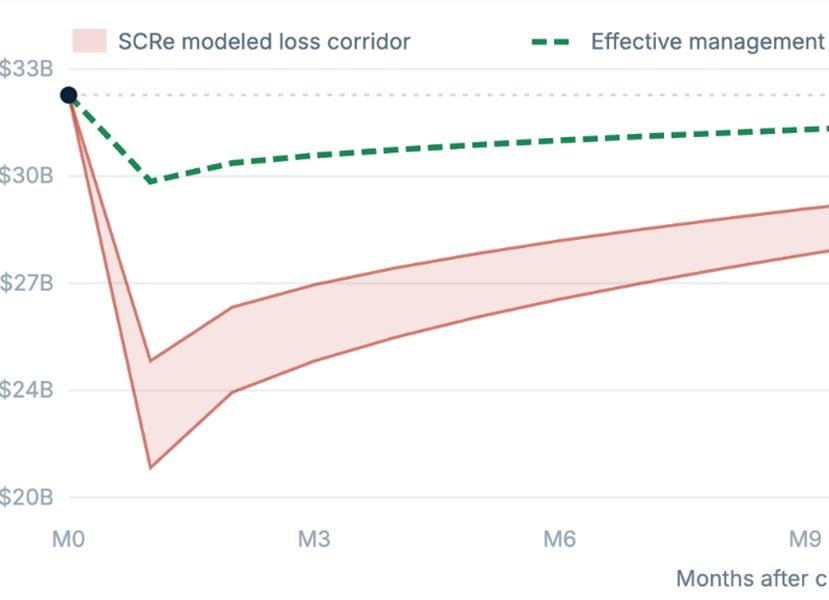
A Strong Reputation Can Protect $1 Billion In Market Value When Crisis Hits


Companies in the lowest quartile of corporate reputation saw their market value decline by a median 20.1% relative to their industry peers when a crisis hot, while companies with stronger reputations lost just 8.5% of the value, according to new Corporate Reputation Report published by Augur Intelligence Corp, which marked the firm' emergence from stealth mode.\
On a $10 billion company, the 11.7-point difference is worth roughly $1.2 billion, the report notes.
Augur, led by founder and chief executive Aidan Ryan, former head of North American issues and crisis at We Communications and a member of our 2026 Innovator 25, aims to track the economic value of reputation over time and turn intangibles into numbers leaders can act on.
The underlying reputation measurement is based on information from the firm's founding data partner, Steel City Re, which wrote the first reputation risk policies almost three decades ago and built the metric to underwrite those policies.“That's the part that matters,” says Ryan, noting that the company“had to predict real loss, because they were paying claims against it.”
The inputs include financial analysts' forward expectations for a company, purchased from FactSet, which Steel City Re transforms into its Reputation Value Metric. Augur is able to“unbundle” it back into the individual stakeholder groups behind it: investors, customers, employees, creditors, suppliers and partners, allowing it to identify the impact of a crisis on each of those groups,
“We deliberately keep media and social data out of the core number.” Says Ryan.“Coverage is the discussion of reputation; it isn't what reputation costs.”
Its inaugural Corporate Reputation Report tracked crises across 13 categories, including product recalls, data breaches, labor strikes, CEO departures, layoffs, activist campaigns, DEI and sustainability reversals, ensuring each company against a matched set of industry peers every week from the event through the following year.
Among the key findings:
-
Reputation acts as ballast: across all 139 events, a company's pre-event reputation value is associated with a shallower drawdown.
The association is strongest in the cohorts where a crisis arrives from outside-product recalls, data breaches, and labor strikes.
But reputation value is a floor, not a rebound. Higher-reputation companies fall less but there is no evidence that they recover faster. The effect lives entirely in the depth of the trough.
Reputation moves with equity without duplicating it. Watching the share price is not a substitute for monitoring reputation.
Two event types break the pattern: Mergers and activist or proxy concessions-both transacted directly with investors rather than inflicted on the company-show no protective effect.
"One finding should change the standard approach to crisis management immediately," Ryan says. "Equity damage from a reputational event is drawn out over months, not weeks, meaning that losses often continue to accrue even after a company has stood down its situation room and resumed business as usual. These decisions are often based on incomplete data."
Ryan believes that the chief communications or marketing officer may own the value of reputation day to day, investor relations, the general counsel, and the board audit committee reach for it when reputation has to be weighed on the same scale as everything else on the risk register.
Augur tracks Steel City Re's Reputation Value Metric-which includes roughly 7,500 companies-over time and against peers, and helps organizations price reputation against risk. Its Crisis Simulator allows companies to [redict what an event could cost and how much a strong response recovers.
"Reputation moves enterprise value, and the tools most companies rely on to measure it are slow, costly, and questionable," says Ryan. "By the time the numbers arrive, the window to act has closed-and none of them put a dollar figure on what a reputational issue actually costs. Reputation you can measure is reputation you can defend. This study is the first time we can say what the difference is worth."

Legal Disclaimer:
MENAFN provides the
information “as is” without warranty of any kind. We do not accept any
responsibility or liability for the accuracy, content, images, videos,
licenses, completeness, legality, or reliability of the information
contained in this article. If you have any complaints or copyright issues
related to this article, kindly contact the provider above.
Comments
No comment