

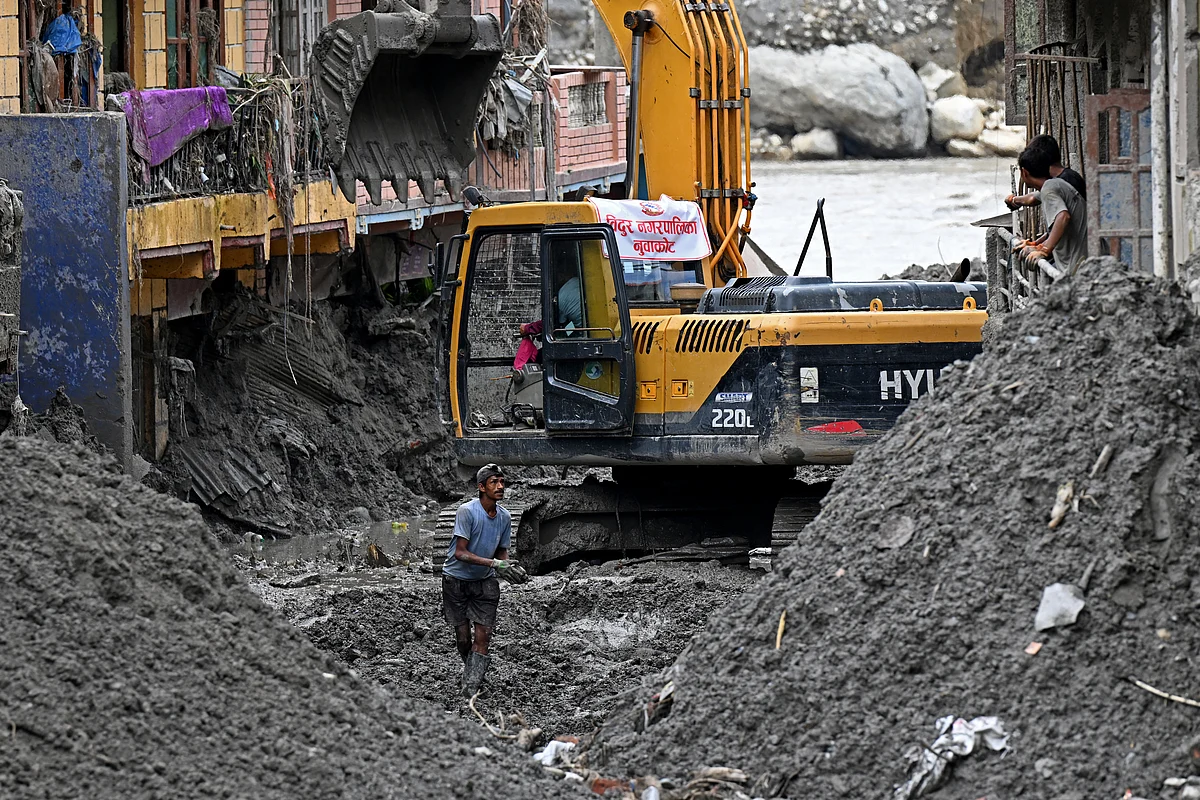
Disasters Cost World Up To $800 Billion A Year As Infrastructure Risks Grow


The UAE can play a role in sharing its experience and best practices in developing resilient infrastructure with countries around the world, as governments face growing economic losses from disasters and climate risks, according to the head of the Coalition for Disaster Resilient Infrastructure (CDRI).
Recommended For YouStay up to date with the latest news. Follow KT on WhatsApp Channels.
Amit Prothi, Director General of CDRI, said there was a clear role for exchanging knowledge and practical experiences between countries.
Prothi said, adding that CDRI seeks to bring together experiences and examples from different parts of the world and make that knowledge accessible to its members.
The Coalition for Disaster Resilient Infrastructure said the challenge is becoming increasingly urgent as countries continue to expand cities, transport systems, energy networks and other critical infrastructure.
Around 75 per cent of the infrastructure the world will need by 2050 has yet to be built, creating an opportunity to incorporate resilience into projects before they are constructed rather than dealing with the economic cost of vulnerabilities later.
Prothi said the coalition's approach is to bring together experiences and best practices from different parts of the world and make them accessible to countries seeking to strengthen infrastructure resilience.
And he pointed to examples and experiences from different countries, including South Africa and Indonesia, as part of the coalition's efforts to enable countries to learn from one another.
$10 billion infrastructure finance ambitionCDRI aims to influence $10 billion in infrastructure finance as part of its ambitions for 2026 and beyond, while scaling up technical assistance, knowledge programmer and capacity building across member countries.
The coalition said private-sector involvement in disaster-resilient infrastructure is no longer optional, describing it as an increasing necessity for asset owners and a growing expectation among investors.
CDRI's approach includes bringing together private companies, infrastructure funds, private equity firms and sovereign wealth funds.
It is also developing technical benchmarks; guidelines and rating systems aimed at reducing uncertainty for investors and helping capital flow towards resilient infrastructure.
The coalition is advocating for blended finance models and guarantee mechanisms to encourage further investment.
70-member global coalitionCDRI has grown into a 70-member coalition comprising countries and organizations and works with governments, multilateral institutions, the private sector and academia.
Its work ranges from vulnerability and risk assessments to disaster-risk financing, technical guidance and capacity-building programmer.
Technical assistance has extended across dozens of countries and covers areas including power, transport, telecommunications, healthcare, urban resilience and infrastructure governance.
The coalition's urban programmer supports 16 cities, while other projects include power sector assessments, disaster-risk financing and work on earthquake preparedness, resilient bridges, landslide mitigation and urban flood-risk management.
450 officials from more than 60 countries trainedCDRI has trained 450 officials from more than 60 countries and organized more than 250 dialogues and panel discussions involving more than 500 experts on resilient infrastructure.
Its fellowship programmer has supported 214 fellows across 26 countries, while the coalition has also established a consortium of universities to support research and new curricula on disaster-resilient infrastructure.
Mapping risks in more than 170 countriesCDRI has also developed the Global Infrastructure Risk Model and Resilience Index (GIRI), which provides infrastructure risk data for more than 170 countries.
The platform helps governments understand potential average annual losses from infrastructure damage caused by disasters and climate change.
Its data is being used by institutions including the World Bank and several UN agencies, while high-resolution national and sub-national risk assessments have been piloted in Chile and Fiji.
BRICS, G20 pushThe coalition is also working through international platforms including BRICS, the G20 and UN climate conferences to make disaster resilient infrastructure a greater part of global policy and investment discussions.
Its broader goal is to ensure that the vast amount of infrastructure still to be built worldwide is designed from the outset to withstand disasters and climate risks, reducing future economic losses while protecting communities and investment.
ALSO READ- Explained: Why small nations like Nepal are hit hard by climate disasters UAE firms ramp up resilience spending as cyber threats expose gaps Policy, markets and AI required to unlock solutions to global challenges

Legal Disclaimer:
MENAFN provides the
information “as is” without warranty of any kind. We do not accept any
responsibility or liability for the accuracy, content, images, videos,
licenses, completeness, legality, or reliability of the information
contained in this article. If you have any complaints or copyright issues
related to this article, kindly contact the provider above.
Comments
No comment