

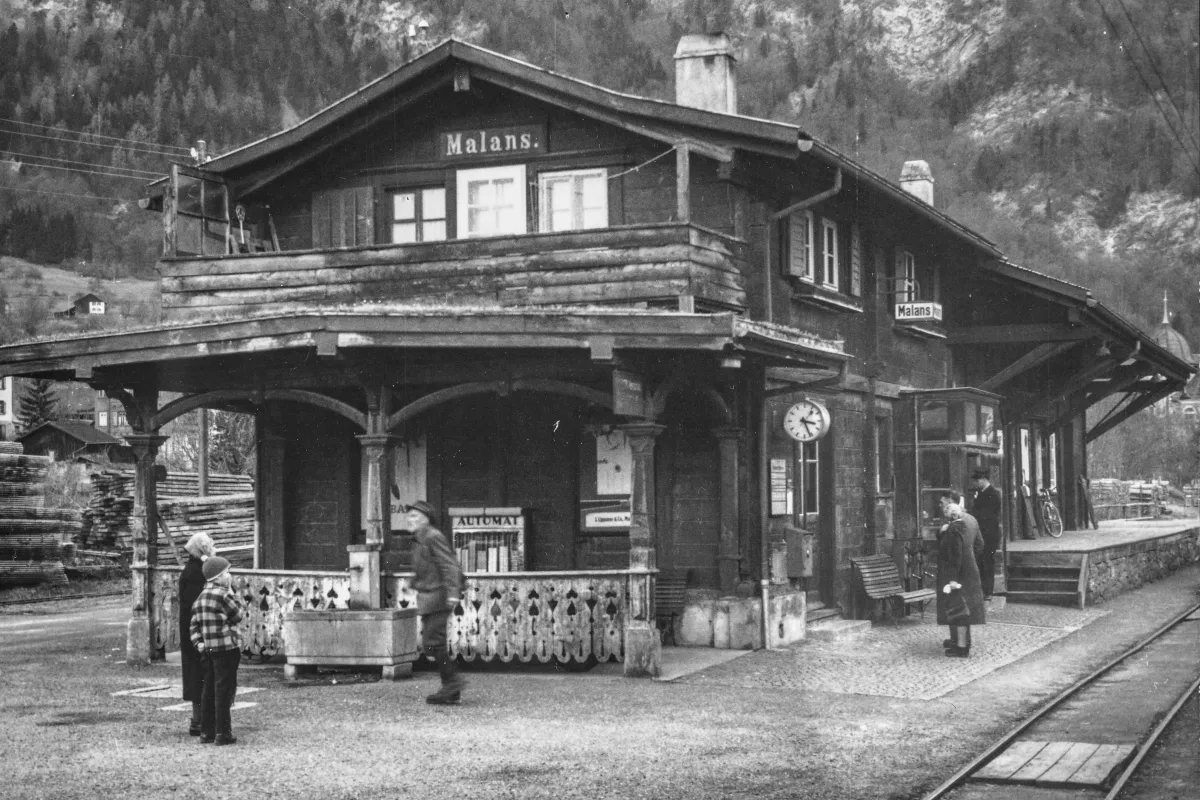
Chalet-Style Stations Shape Switzerland's Image


-
Deutsch
de
Wie Chalet-Bahnhöfe das Bild der Schweiz geprägt haben
Read more: Wie Chalet-Bahnhöfe das Bild der Schweiz geprägt
Français
fr
Comment les gares-chalets ont façonné l'image de la Suisse
Original
Read more: Comment les gares-chalets ont façonné l'image de la S
Русский
ru
Как вокзалы-шале формировали открыточный образ Швейцарии
Read more: Как вокзалы-шале формировали открыточный образ Швей
Let's start with a basic question. Is the chalet to Switzerland what chocolate and watches are?“Yes,” replies Christophe Goumand. The Valais-based archaeologist and historian knows what he's talking about, given that his father's family were born and raised in a chalet. And not just any chalet. Not an Alpine chalet or a luxury holiday home, but a railway stop. In other words, a“gare-chalet”, a railway stop where passengers could board and alight.
“My grandfather was a railway maintenance worker responsible for maintaining the tracks at Finhaut station (canton Valais). The station was not a stone building but a wooden chalet, where his family lived. That was in the 1930s. There was another chalet station in the municipality of Finhaut: Châtelard-Village, run by a private company. When the operator wanted to demolish it, my grandfather – who was retiring at the time but still felt attached to the railway world – told him: 'Don't demolish it; I'll take it.' With the help of a contractor, he dismantled the wooden structure of the Châtelard station and reassembled it not far away, in Giétroz. Once moved there, this chalet became our holiday home. As a child, I used to go there often.”
Attracting English touristsThis personal journey explains Goumand's fascination with chalet-style railway stations, to which he has dedicated an exhibition that runs until September 13 at the Galerie Victoria in Finhaut. Original plans, scale models, and old and recent photographs are on display for visitors to admire. As well as the history of the Swiss chalet, documented in the exhibition, visitors can explore the architecture of the wooden stations dotted along the Martigny–Châtelard line in the Trient Valley (Valais). Operated by a private railway company, Transports Martigny et Régions (TMR), it is now a“protected” line.
“This means it cannot be demolished,” explains the archaeologist.
Chalet-style stations also dot the landscapes of Gruyère, the Bernese Oberland, Graubünden and the Lake Geneva Riviera.“Some of them belong to the Swiss Federal Railways, such as the Vaud stations at Gland, Coppet and Roche. The latter was recently restored by the Federal Railways,” says Goumand.
Whether privately or publicly owned, most of them are still in service. They have existed since the late 19th and early 20th centuries and form part of Switzerland's railway heritage. Their construction was once driven by a desire to attract English tourists, who were, at the time, very keen on Alpine holidays in the heart of a romantic Switzerland.
Rousseau and the romanticism of the chalet“To my knowledge, there is no equivalent to these chalet-style stations anywhere else in Europe. In France, for example, there are some, but they are wooden houses; they do not have the same heritage value as ours,” says Goumand.
He goes on to highlight the role played by Jean-Jacques Rousseau in the idealisation of the beauty of the Swiss Alps. It was indeed the Genevan writer and philosopher who, in his novel La Nouvelle Héloïse (published in 1761), gave the chalet a prominent place as a setting for idyllic contemplation. Swiss engineers in the late 19th century were quick to recognise the chalet concept as an opportunity to export the image of an idyllic Switzerland and to reap significant profits from it.
Showcasing the expertise of Swiss carpentersWith the advent of the railways in the 19th century, railway stations flourished alongside the construction of chalets, which would become stopping points for trains. At the time, Swiss builders succeeded in exporting prefabricated chalets to France, taking advantage of the 1889 Paris World's Fair to showcase their expertise.“Their approach proved successful. It's worth noting that the Swiss Confederation, then in its infancy, promoted the talent of its carpenters at major exhibitions,” notes Goumand.
As a result, wealthy European families commissioned chalets to be installed on their vast estates. Prefabricated buildings, which also emerged in the 19th century, were highly sought after. Among the buyers was Charles Dickens, who owned a chalet on the outskirts of London.“It still stands today, amidst modern buildings; it was where the British author used to write,” says Goumand.
More More 'The chalet is the first prefab house in history'This content was published on May 31, 2025 The chalet first conquered the world – and then Switzerland. So why is it considered a quintessentially Swiss building?
Read more: 'The chalet is the first prefab house in his
Legal Disclaimer:
MENAFN provides the
information “as is” without warranty of any kind. We do not accept any
responsibility or liability for the accuracy, content, images, videos,
licenses, completeness, legality, or reliability of the information
contained in this article. If you have any complaints or copyright issues
related to this article, kindly contact the provider above.
Comments
No comment