

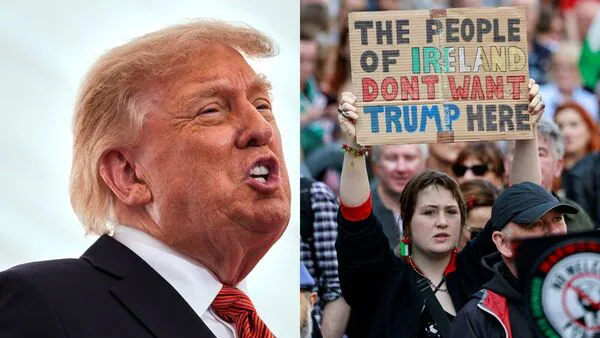
Donald Trump Stirs Controversy, Predicts UK-Run Ireland 'Eventually': 'I'd Love To See It Unified, Would Be Fantastic'


He also said that eventually the Republic of Ireland will be merging with the United Kingdom's Northern Ireland.
“I don't want to cause any problems but I'd love to see it unified," Trump told a reporter as quoted by AP. He was asked for his opinion on the issue. "It's going to happen eventually. It may as well happen now."
“I think it would be a fantastic thing," the Republican president said, adding "the UK will have something to say about it, obviously.”
However, during his next stop, Trump changed his earlier candid stance. He acknowledged there is“no good answer” to the reunification question while addressing business leaders from both countries at a gathering which took place at the US ambassador's residence.
Also Read | US-Iran war LIVE: When will Iran war end? Trump reveals 'probably right after....' Why it is controversialTrump's statement is likely to draw mixed reactions from the Irish people.
Previously, a section of people or demonstrators were spotted against Trump's visit in the country. People carried banners, suggestive balloons and Irish flags during a protest against the visit of the US President in Dublin.
Also Read | Did Trump defend Iran war and link it to 9/11 at Pentagon memorial? History of IrelandThe subject of Irish unification remains a deeply sensitive issue among the Irish people. This is because Northern Ireland is divided between two communities with competing views on its constitutional future. Nationalists, who are predominantly Catholic, generally support joining the Republic of Ireland. However, unionists, who are largely Protestant, want Northern Ireland to remain part of the United Kingdom.
The issue runs deep in Irish history. It stems from Ireland's partition and decades of sectarian and political violence known as the Troubles. The 1998 Good Friday Agreement largely ended the conflict and established a framework for deciding Northern Ireland's future through democratic consent. Under the agreement, a referendum on Irish unification can be held if it appears likely that a majority would vote in favour of leaving the UK and joining the Republic of Ireland.
However, any move towards a referendum remains politically contentious. As predicted by experts, it is expected to reopen divisions between nationalist and unionist communities.
Meanwhile, the UK government has maintained that a referendum should only be considered when there is clear evidence that a majority in Northern Ireland wants unification.

Legal Disclaimer:
MENAFN provides the
information “as is” without warranty of any kind. We do not accept any
responsibility or liability for the accuracy, content, images, videos,
licenses, completeness, legality, or reliability of the information
contained in this article. If you have any complaints or copyright issues
related to this article, kindly contact the provider above.
Comments
No comment