

Bronze Daggers And Shell Jewellery: The Swiss Teacher Who Unearthed The Past


-
Deutsch
de
Bronzedolche und Schneckenschmuck: Lehrer Wuillemin grub Geschichte frei
Original
Read more: Bronzedolche und Schneckenschmuck: Lehrer Wuillemin grub Geschichte
Français
fr
Poignards en bronze et bijoux en coquille d'escargot: l'instituteur qui exhumait le passé
Read more: Poignards en bronze et bijoux en coquille d'escargot: l'instituteur qui exhumait le p
Italiano
it
Pugnali di bronzo e gioielli: l'insegnante Wuillemin riporta alla luce la storia
Read more: Pugnali di bronzo e gioielli: l'insegnante Wuillemin riporta alla luce la s
Men armed with pickaxes and shovels trudged through the woods. They opened ancient graves and unearthed swords, jewellery and skulls. Whatever they found changed hands for money, disappeared into private collections or ended up in museums.“It was, in some respects, a Wild West,” Bern's cantonal archaeologist Adriano Boschetti tells Swissinfo. At the same time, it marked the beginning of modern archaeology.
“Today's archaeology builds on the work of the 18th, 19th and early 20th centuries,” Boschetti says.“Without these foundations, modern research would be inconceivable. At the same time, we're frustrated today because so little was documented back then. As a result, information was lost.”
The Thun region in the Bernese Oberland in particular attracted such“renegade archaeologists”. They were teachers, foresters and municipal clerks who, in their spare time, made some astonishing discoveries.
Perhaps the most enthusiastic amateur archaeologist was François“Franz” Wuillemin, a teacher. Born in Berlin in 1879, he grew up in Gurmels, canton Fribourg. In 1898 he obtained his teaching qualification. After getting married, he moved to Thun. In 1906 he took charge of the senior class in the Thun hamlet of Allmendingen, while his wife, Marie, taught the younger pupils.
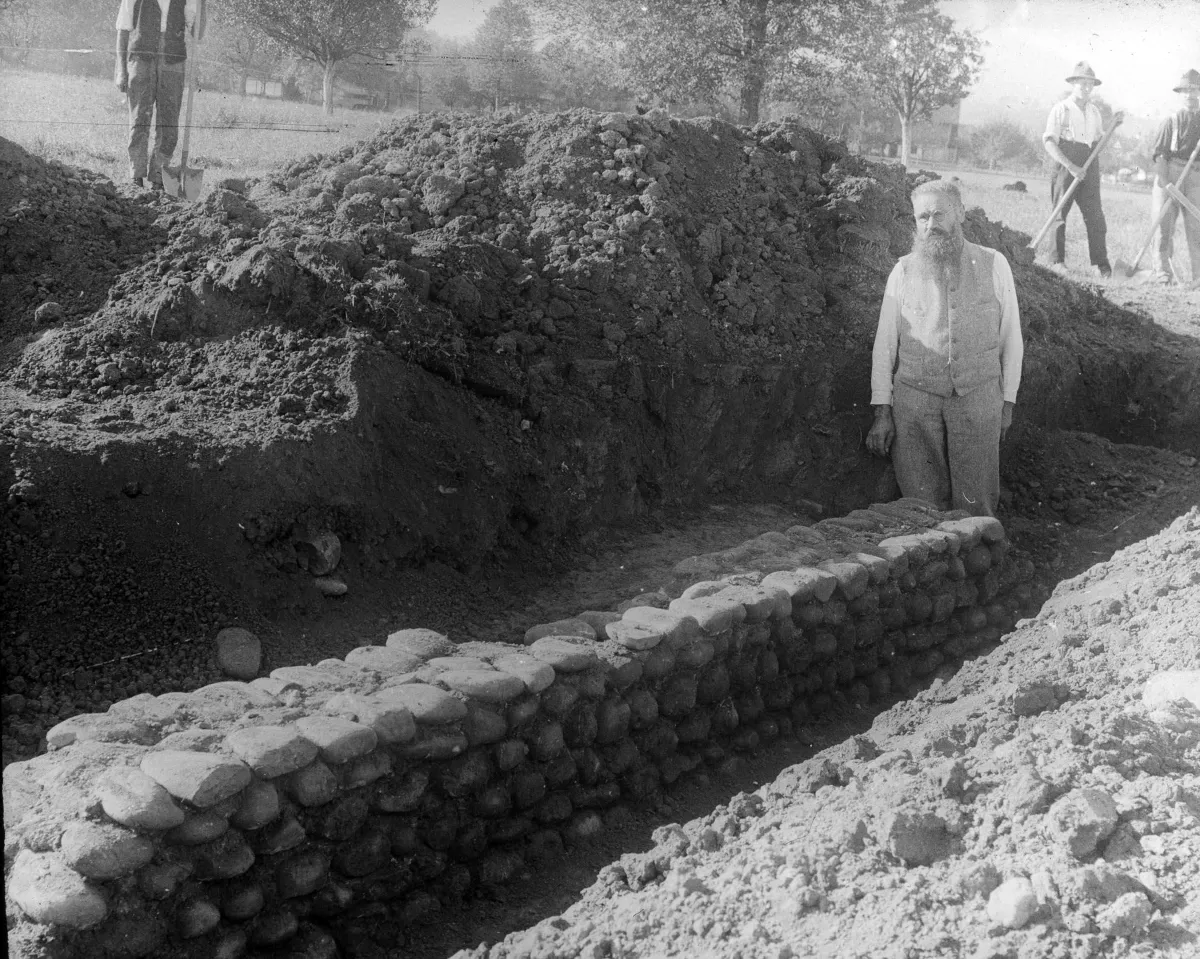
But Wuillemin was never just a teacher. Contemporaries described the man with a moustache and angular features as restless. He collected, observed and documented. His photographic archive in the Thun City Archives bears witness to this: it comprises hundreds of photographs of landscapes, caves, old houses and archaeological discoveries.
He also had a camera to hand, for instance when a gravel extraction site in the Wylerhölzli near Thun-Allmendingen brought a bronze dagger to light in 1920. Wuillemin secured the site of the find and continued digging. He was able to uncover two skeletons, one of an adult and one of a child.
Over the following months, he excavated further graves and made some interesting finds: jewellery made from sea snail shells – evidence that long-distance trade had already been taking place thousands of years ago.
The sanctuary beneath the groundThe Thun region continues to fascinate archaeologists to this day owing to its unique location between the Central Plateau and the Alps. Even in prehistoric times, major transport and trade routes crossed here. Wuillemin's excavation site was situated between Thun and the villages at the entrance to the Simmental, a gateway to the Alps.
Time and again, he had his photograph taken on a prominent hilltop on the Strättli Hill, which he described as an“earth pyramid”, with the Stockhorn range in the background. The photographs show a man out in the countryside, wearing a hat and boots, gazing into the distance. The images are reminiscent of Caspar David Friedrich's Romantic-era painting Wanderer above the Sea of Fog.
In fact, early archaeology was characterised by a thoroughly Romantic outlook: attention turned back to the origins, to a hidden world beneath the surface.
And often, a mere chance encounter was enough to uncover this world. In 1926 a farmer was ploughing a field in Thun-Allmendingen. Suddenly, he came to a halt: the ploughshare had struck something hard in the ground. When a large stone was uncovered, it became clear that it had been shaped by human hands.
This brought a site back into the spotlight that had almost been forgotten. Roman remains had already been documented here in the 19th century. After that, all trace of them was lost. Wuillemin began excavations, uncovered a large stone bearing an inscription and discovered fragments of a marble statuette.
More More Culture Facing up to Switzerland's Roman pastThis content was published on Jun 5, 2019 Meet Adelasius Ebalchus. He lived in what is now northern Switzerland some 1,300 years ago, centuries after the collapse of the Roman Empire.
Read more: Facing up to Switzerland's Roman
Legal Disclaimer:
MENAFN provides the
information “as is” without warranty of any kind. We do not accept any
responsibility or liability for the accuracy, content, images, videos,
licenses, completeness, legality, or reliability of the information
contained in this article. If you have any complaints or copyright issues
related to this article, kindly contact the provider above.
Comments
No comment