

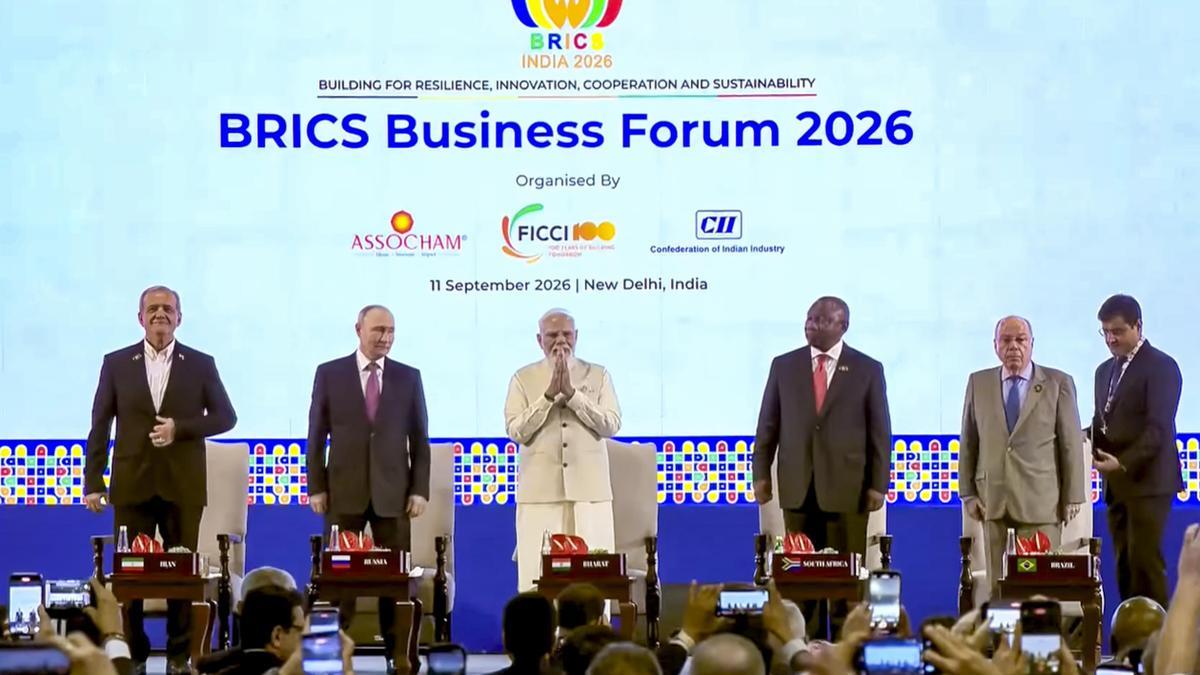
BRICS Summit Kicks Off In New Delhi With Leaders Of 11-Nation Bloc


The summit, taking place from September 12 to 13, includes leaders from Brazil, Russia, India, China, South Africa, Iran, Egypt, Ethiopia, Indonesia, the United Arab Emirates and Saudi Arabia, alongside UN Secretary-General António Guterres and representatives from several partner countries. It is the first BRICS summit hosted by India since the bloc expanded its membership.
In his opening remarks, Modi said BRICS has become an increasingly important platform for cooperation among emerging economies and called for stronger collaboration on resilient supply chains, digital innovation, artificial intelligence and sustainable development.
The summit's official theme,“Building for Resilience, Innovation, Cooperation and Sustainability”, reflects the bloc's efforts to strengthen economic cooperation while increasing the influence of developing countries in international institutions.
Xi Jinping Returns to India After Seven YearsChinese President Xi Jinping's visit to India is among the summit's most closely watched developments. It marks his first trip to India in seven years and comes after years of strained relations following military clashes along the disputed Himalayan border.
Diplomatic officials from both countries have described the visit as an opportunity to stabilize bilateral ties and expand cooperation in trade, climate policy and regional connectivity, although significant disagreements over border issues remain unresolved.
Russian President Vladimir Putin is also attending the summit, using the gathering to reinforce Moscow's ties with countries across Asia, Africa and Latin America despite continued Western sanctions over the war in Ukraine.
Trade, AI and Alternative Financial SystemsA major focus of the summit is expanding economic cooperation among BRICS members, including increasing trade in national currencies, improving cross-border payment systems and accelerating work on the BRICS New Development Bank.
Officials are also discussing cooperation in artificial intelligence, digital infrastructure, clean energy, agriculture and critical minerals as members seek to reduce dependence on Western-dominated financial and technological systems.
While some members continue to promote reducing reliance on the U.S. dollar in international trade, analysts say creating a unified BRICS currency remains unlikely in the near term because of major economic and political differences within the bloc.
Afghanistan Remains on the Regional AgendaAfghanistan is expected to feature prominently in regional security discussions, particularly issues related to terrorism, narcotics trafficking and humanitarian assistance.
Several BRICS members have previously called for an inclusive political system in Afghanistan while expressing concerns about regional security threats. India has also emphasized Afghanistan's role in regional connectivity and stability across Eurasia.
Despite its growing global influence, BRICS continues to face significant internal divisions.
India has resisted efforts to portray BRICS as an explicitly anti-Western alliance, instead promoting it as a platform for strategic autonomy and pragmatic cooperation. China and Russia have increasingly framed the bloc as a counterweight to Western political and economic influence.
Iran's membership has added another layer of complexity, particularly as tensions between Tehran, Israel and the United States continue to dominate Middle East diplomacy. Differences between Iran and some Gulf members of BRICS have also complicated efforts to reach consensus on regional security issues.
Originally founded by Brazil, Russia, India and China in 2009 before South Africa joined in 2010, BRICS has expanded into an 11-member grouping representing nearly half of the world's population and roughly 40 percent of global economic output.
Analysts say the summit underscores the bloc's ambition to give emerging economies a stronger voice in international decision-making while expanding cooperation outside traditional Western-led institutions.

Legal Disclaimer:
MENAFN provides the
information “as is” without warranty of any kind. We do not accept any
responsibility or liability for the accuracy, content, images, videos,
licenses, completeness, legality, or reliability of the information
contained in this article. If you have any complaints or copyright issues
related to this article, kindly contact the provider above.
Comments
No comment