

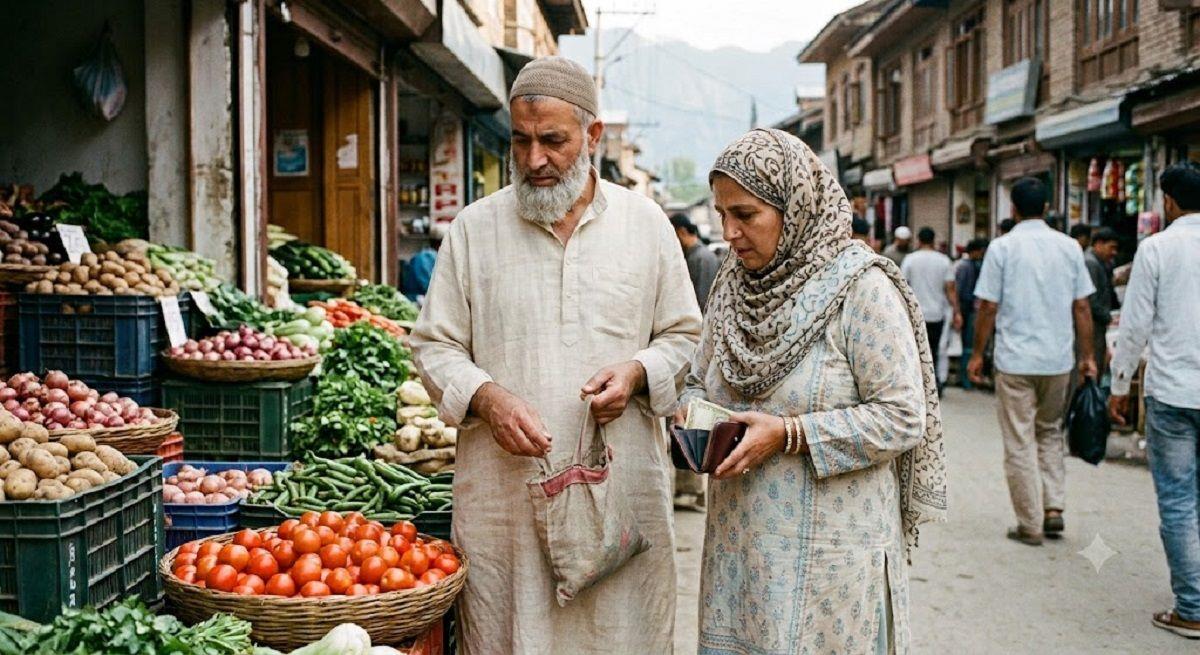
J&K Families Feel The Pinch As Essential Prices Stay High


The latest available J&K price data shows retail prices of several essential commodities at elevated levels. The average retail price of milk stands at ₹62.67 per litre, while sugar is priced at ₹63.33 per kilogram. Moong dal is recorded at ₹121.33 per kilogram and masoor dal at ₹104.33 per kilogram.
For consumers, the impact extends beyond the headline inflation rate, as household expenditure is shaped by the prices families actually pay for food, cooking essentials and other daily-use commodities in local markets.
The Directorate of Economics and Statistics has an official mechanism for monitoring prices across the Union Territory. Retail prices of essential commodities are collected from selected markets and shops in all 20 districts and analysed to identify price fluctuations and regulate supplies. Daily prices of 22 essential commodities are also submitted to the Union Ministry of Consumer Affairs for monitoring.
The Food, Civil Supplies and Consumer Affairs Department is responsible for monitoring the prices and availability of essential commodities and protecting consumer interests. Its enforcement machinery includes the Legal Metrology Department, which checks compliance relating to packaged commodities, weights, measures and pricing.
The authorities have also taken enforcement action in recent months.
Read Also The Factory Gate Is Kashmir's Next Economic Test Video: Why Your Money Buys Less Today? ADVERTISEMENTThe Legal Metrology Department said it realised about ₹44.55 lakh in revenue and ₹9.10 lakh through composition during August 2026, while more than 50 improvement notices were served to establishments for minor or rectifiable deficiencies. In September, two online sellers were also penalised ₹25,000 each in a consumer-protection action.
In Jammu, a market inspection conducted in Trikuta Nagar and adjoining areas on August 30 detected deficiencies in MRP display and expired products at some establishments, following which notices were issued.
Despite these measures, consumers continue to face concerns over the prices being charged at the retail counter and whether enforcement is translating into tangible relief for households.
The J&K Economic Survey 2025-26 also points to sustained price pressure during 2025. According to the Survey, combined inflation in J&K remained above the all-India rate during the year. Inflation stood at 4.8 per cent in January 2025 against 4.3 per cent nationally, while in September it was 4.4 per cent in J&K compared with 1.4 per cent across India. In December, J&K recorded inflation of 2.3 per cent against 1.3 per cent nationally.
However, official inflation figures may not fully reflect the experience of individual households because inflation is an average measure based on a broad basket of goods and services. Families spending a larger proportion of their income on food and essential commodities can experience a sharper increase in monthly expenditure when prices of those items rise.
The continuing pressure on food budgets has also been reflected in the latest Crisil household-food indicator. The cost of a home-cooked vegetarian thali rose one per cent year-on-year in August, while the non-vegetarian thali became five per cent costlier. Crisil attributed the increase mainly to onion, vegetable oil, rice and LPG prices.
For consumers in J&K, the concern therefore extends beyond whether inflation is rising or falling on paper. The focus remains on the actual prices paid for essential commodities, possible gaps between prescribed and retail prices, and the effectiveness of inspections and enforcement in preventing overcharging.
With price-monitoring mechanisms already operating across all 20 districts, consumers are likely to look to the administration for closer enforcement, greater transparency in district-wise prices and effective action wherever violations are detected. (KNT)

Legal Disclaimer:
MENAFN provides the
information “as is” without warranty of any kind. We do not accept any
responsibility or liability for the accuracy, content, images, videos,
licenses, completeness, legality, or reliability of the information
contained in this article. If you have any complaints or copyright issues
related to this article, kindly contact the provider above.
Comments
No comment