

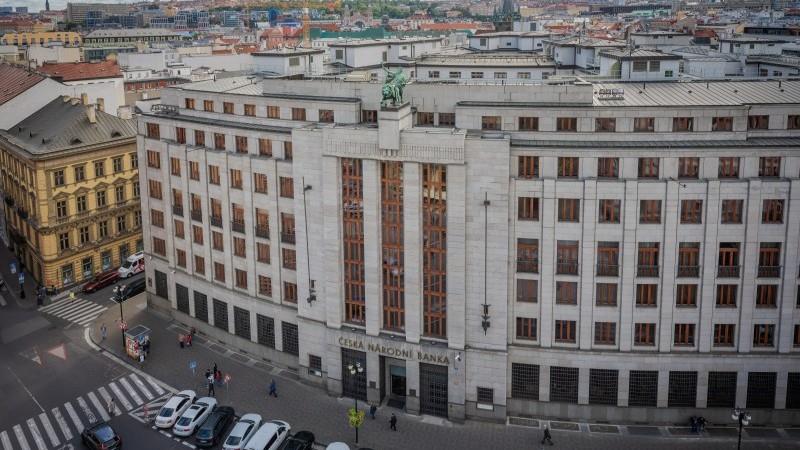
CNB Preview: Wait-And-See Is The Preferred Attitude


When considering the core of Czech policymakers' comments, we understand that the CNB Board currently assesses the broad monetary conditions as having a mildly restrictive effect, en gros. This doesn't necessarily hold for each and every segment of the economy, such as the overheating housing market. Nevertheless, when it comes to the one rate that is supposed to rule them all, things seem to be in the right place with the 3.75% base rate. And yes, that rate remains above the long-run equilibrium rate in the CNB's workhorse forecasting model, whether you are a big fan of this concept or not. Voilà: we conclude that rates are set to remain unchanged next Thursday.
Real rates set to decline only temporarily Source: CNB, ING, Macrobond">
Such conditions are consistent with an economy that has slowed down over the first half of the year and is currently operating below its potential, in our view, which will likely be the case up until mid-next year. Here, we take the stance that the rebound in industry will support economic growth at around 2%, while household consumption will likely come under some pressure, as rising consumer prices will bite into real purchasing power in the coming quarters. With the escalation and persistence of the Hormuz turmoil, we have revised up our inflation forecast in recent weeks, while risks to economic activity have once again bared their claws. And it seems that we may actually get more of both over the next few weeks.
November may bring a fresh viewIn any case, November is set to become more interesting, as we get a fresh CNB forecast, while potentially receiving punchy numbers for both November's headline and core inflation. Should our inflation forecast be right, this would mark the start of an eight-month period during which both headline and core inflation record prints surpassing the 3% upper bound of the CNB tolerance band. Several factors are set to drive annual inflation in 1Q27, with all of them pointing in one direction: i) the effect of a low early-2026 comparison base, ii) rebounding food prices, iii) renewed growth in regulated prices, iv) still-elevated fuel prices, and v) persistent core inflation.
Inflation set to rise from September onwards Source: CNB, ING, Macrobond">Should all the above-mentioned stars align, headline inflation would peak at some 3.9% in February, while the core rate would peak at 3.5% in January. Sure, January is a month that is notoriously hard to estimate, as we must handle the change in regulated prices and the menu-adjustment effects, which are both challenging to predict. With regulated prices, we will receive more news about the plans of large distributors from September onwards. Nevertheless, we take the position that the window for securing energy at favourable prices has not reopened since March. With that in mind, we see the potential for a strong increase in regulated prices in January and beyond, be it driven by electricity and natural gas end-prices, heating or water charges.
Persistently elevated oil prices will shape regulated segment Source: CNB, ING, Macrobond">
With that in mind, we gauge the CNB's summer inflation outlook, especially for the next year, as somewhat optimistic and expect an upward revision in the autumn edition. At the same time, the current CNB forecast for economic growth also seems rather optimistic, given the somewhat disappointing real GDP figures so far. Meanwhile, the escalation of the Hormuz conflict, with Brent crude prices creeping above $100/bbl, is only adding fuel to the global negative supply shock. As a result, we expect the CNB staff to come up with a slightly higher inflation forecast and a somewhat less robust GDP forecast. With that combination, only God knows what kind of endogenous rates path we get as a result. In any case, plans for a more expansionary fiscal stance may tilt the balance towards a somewhat higher rates trajectory.
The labour market and fiscal stance will be closely watchedDeputy Governor Eva Zamrazilova mentioned that she does not see any reason for the onset of a genuine tightening cycle right now, especially as a tangible downward revision to 1Q26 wage growth brought labour costs to a more digestible range. No doubt other board members felt similar relief. Still, the labour market conditions will be tightly followed, as the planned 11% increase in the minimum wage and the government's plans to increase public wages between 5% and 9% require some caution.
Nevertheless, we believe that the manufacturing sector will be somewhat restrained when it comes to wage increases, as profitability has been pressured by increasing input costs on the one hand and tight competition on the other. We see overall nominal wage growth in the economy of around 6% in the coming year. That's in conditions when the unemployment rate continues in a gradual upward trend.
Unemployment rate creeps up gradually Source: CZSO, Labour Office, Macrobond">The fiscal stance represents another hot topic, given the government's first budget draft suggesting a 3.5% deficit-to-GDP ratio, which is somewhat above the previously assumed 3%. Only cosmetic downside adjustments are expected to take place in the coming negotiations, as both junior coalition partners are pushing for spending cuts, and are well aware of the CNB's distaste for excessive public spending. That said, the inflationary impact will likely be limited, mostly channelled through the planned wage increases.
Still, in combination with the accelerating oil prices and higher policy rate from the European Central Bank, plans for generous government spending could make the November policy meeting quite interesting. Unchanged rates even beyond the September pause remain our base case scenario, while we assign a 35% probability to a one-and-done rate hike in November.
Economic performance is neither too bad nor too good Source: CNB, ING, Macrobond"> Our market viewThe Czech market is again being driven by global factors and high energy prices. However, around CNB meetings, investors still pay attention to domestic developments and central bank commentary. Despite the rise in CZK rates, the interest-rate differential has narrowed and remains the best guide to EUR/CZK. Dovish signals from policymakers, alongside market pricing of roughly 100bp of tightening, have weakened the koruna in September, with scope for further losses. We expect EUR/CZK to enter next week's meeting near 24.30. If the press conference confirms our view that a rate hike is not currently under consideration, the pair could move higher as hike expectations are pared back and oil and gas prices continue to rise.
Rates remain the key focus, but energy prices are still the main driver, while the CNB's impact is likely to be temporary. After some easing in market pricing over the summer, recent sessions have brought renewed selling, in line with moves in core markets. With the CNB having already raised rates in June and the board signalling no urgency to tighten again, we expect some reduction in hike expectations at the front end. However, in the current environment, pricing is unlikely to fall below three hikes. The long end should remain under pressure from higher core yields and a larger-than-expected fiscal deficit planned for next year. Overall, we expect the curve, currently among the flattest globally, to steepen.

Legal Disclaimer:
MENAFN provides the
information “as is” without warranty of any kind. We do not accept any
responsibility or liability for the accuracy, content, images, videos,
licenses, completeness, legality, or reliability of the information
contained in this article. If you have any complaints or copyright issues
related to this article, kindly contact the provider above.
Comments
No comment