

Why Robotics Teams Are Rethinking Their Manufacturing Roadmaps


The path from a working prototype to a shippable robot rarely goes in a straight line
Robotics development is unusual in how many manufacturing methods a single project can pass through before a design is finished.
A prototype chassis might start as a printed part to test fit and function, get redesigned three or four times as the electronics layout shifts, and eventually need to transition into a molded or higher-volume process once the robot moves from lab testing toward an actual product.
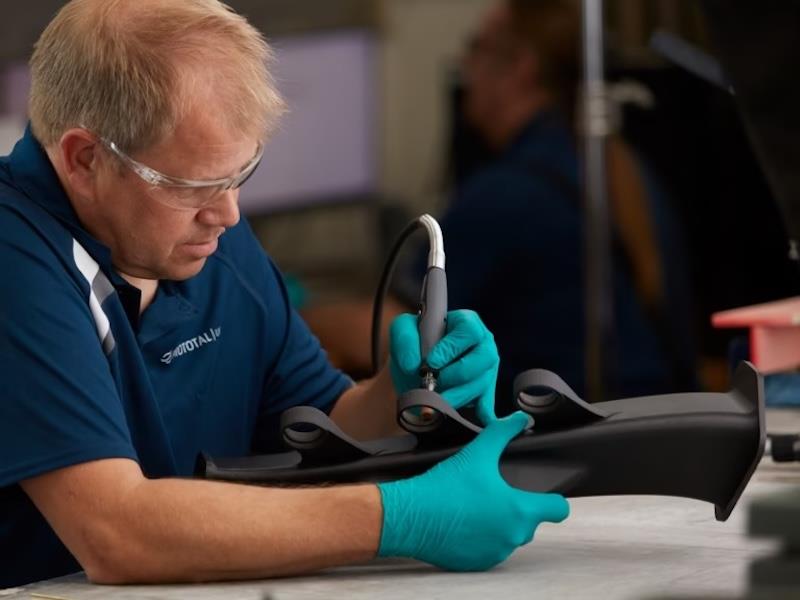
That kind of shifting requirement is exactly what Prototal's additive manufacturing solutions are built to support, covering everything from early rapid prototyping through hybrid manufacturing and full serial production rather than specializing narrowly in just one stage of that process.
The rapid prototyping phase matters more in robotics than in most other industries, because so much of a robot's design depends on physical iteration. A gripper mechanism or a joint housing often can't be fully validated on a screen.
It needs to be printed, tested under load, adjusted, and printed again, sometimes multiple times in a single week during active development.
Short lead times aren't a convenience at this stage, they're what determines how many design iterations a team can actually run before a deadline forces a decision.
Hybrid manufacturing becomes relevant once a robotics project starts combining components with very different requirements within the same assembly.
A robot might need a few structural parts that make sense as injection-molded components for cost and durability, alongside more complex housings or brackets that are better suited to 3D printing because of their geometry or low volume.
Being able to move fluidly between these two processes under a single production relationship, rather than coordinating separate suppliers for each technology, removes a layer of complexity that can otherwise slow a project down significantly.
Material performance is where robotics places some genuinely unusual demands. Components need to be light enough not to strain motors and actuators, yet stiff enough to hold precise tolerances during repeated motion, and often durable enough to survive constant vibration without fatiguing.
Reinforced engineering polymers developed for exactly this kind of mechanical stress have made it possible to print functional robotic components that hold up under real operating conditions, not just parts that look correct in a demo.
None of this means every robotics component should be printed. Some parts genuinely make more sense machined or molded from day one. What changes is how much flexibility a team has to make that decision project by project, rather than being locked into whichever process their current supplier happens to specialize in.
Scaling from a handful of units to a real production run changes what actually mattersThe jump from building ten prototype robots to producing a thousand production units exposes problems that never show up at small scale.
A part that fits perfectly by hand on unit one can reveal tolerance drift by unit fifty, and a process that seemed fast enough for a demo can become a genuine bottleneck once volume climbs.
Facility capacity is the first thing that starts to matter at this stage in a way it didn't before. A supplier running a handful of printers out of a single site can service prototyping work without issue, but struggles once a robotics company needs consistent output across dozens or hundreds of units on a predictable schedule.
Operating across multiple facilities in different countries provides a form of redundancy that a single-site operation simply can't match, since production can shift between locations if one site faces a disruption without derailing a customer's delivery schedule.
Quality documentation becomes essential the moment a robotics product moves toward commercial deployment, particularly if it's destined for industrial, medical, or defense applications where component traceability isn't optional.
A supplier holding relevant sector-specific certifications alongside general quality management standards has demonstrated the kind of process discipline that regulated buyers require, and that documentation trail often matters as much as the part itself once a product needs to pass procurement review.
Cost structure shifts meaningfully as volume grows too, which is where the option to transition toward injection molding for higher-volume components becomes genuinely valuable.
Parts that made sense to print at low volumes during early production runs may become more economical to mold once demand justifies the tooling investment, and having that transition available within the same manufacturing relationship avoids the disruption of requalifying an entirely new supplier partway through a product's lifecycle.
For a robotics company scaling from prototype to product, that continuity can be the difference between a smooth ramp-up and a stalled one.
<
Legal Disclaimer:
MENAFN provides the
information “as is” without warranty of any kind. We do not accept any
responsibility or liability for the accuracy, content, images, videos,
licenses, completeness, legality, or reliability of the information
contained in this article. If you have any complaints or copyright issues
related to this article, kindly contact the provider above.
Comments
No comment