

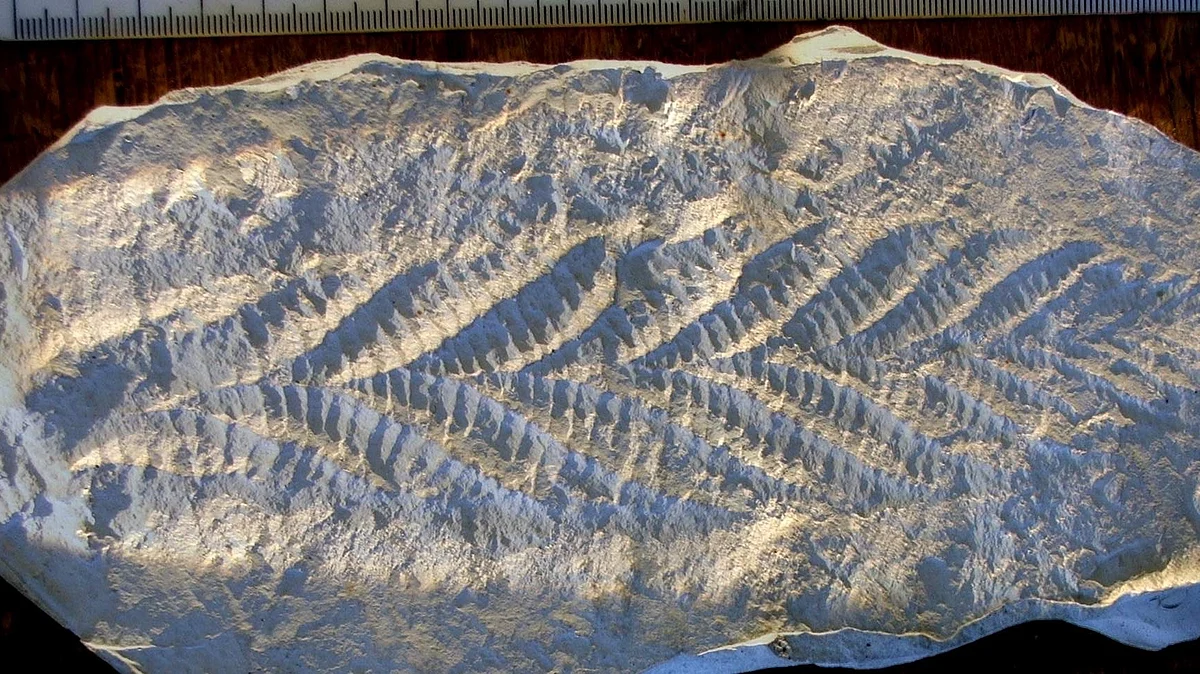
No Mouth Or Organ: 560-Million-Year-Old Animal Fossil Found In Norwegian Sheep Field


The creature looked more like a plant than an animal. It had no mouth, no organs and no visible way of moving, yet scientists believe Charnia was among the earliest animals to live on Earth.
Recommended For YouThe discovery by researchers from the University of Cambridge was made in Finnmark, northern Norway, and is the first confirmed Charnia fossil found in Scandinavia. Researchers say the area is also the first major new fossil site of its kind discovered in Europe in decades. They published a report in the journal Palaeontology.
Stay up to date with the latest news. Follow KT on WhatsApp Channels. How did it end up in a sheep field?
The discovery happened unexpectedly. Scientists were studying an area where earlier evidence suggested ancient organisms had once lived on the seafloor.
Nearby, rocks had fallen from a cliff into a sheep field. Some of the rocks broke open, revealing the Charnia fossil inside. Researchers also found evidence of other ancient organisms in the area, suggesting the site could contain more fossils waiting to be discovered.
Why is this fossil so special?Charnia lived during the Ediacaran Period, more than half a billion years ago, when complex forms of life were beginning to appear on Earth.
Most creatures from this period had soft bodies rather than bones or shells, making it difficult for their remains to survive for millions of years.
When fossils from this time are discovered, they are usually flattened in rock.
But this Charnia fossil was different. It was preserved in three dimensions, allowing scientists to see parts of its body in much greater detail.
Researchers even discovered small ridges along its branches that had not been noticed in previously discovered, flatter Charnia fossils.
How did it survive for 560 million years?Scientists believe an underwater avalanche played an important role.
Charnia was swept away and quickly buried on the seafloor. Sediment filled its soft body and helped keep its three-dimensional shape instead of allowing it to become completely flattened.
That unusual process helped preserve the creature for around 560 million years.
What exactly was Charnia?Despite its plant-like appearance, Charnia was not a plant. It lived attached to the seafloor and had no mouth, organs or obvious way of moving. Researchers describe its body as soft and filled with fluid.
Scientists are still studying exactly where Charnia belongs in the history of animal life, but it is thought to be among the earliest animals known to have existed.
Could more fossils be hiding there?The discovery may only be the beginning. Scientists found other fossils alongside Charnia, suggesting the site could preserve a much larger community of ancient life.
The finding also shows that important fossils may still be hiding in places scientists have not studied closely before.
For researchers, a rock that happened to break open in a Norwegian sheep field has now provided a rare look at life on Earth hundreds of millions of years before the first dinosaurs appeared.
ALSO READ- Look: How extinct animals like dodo, woolly mammoth are 'resurrecting' in Dubai 3.2 million-year-old fossil that rewrote human history now on display in Abu Dhabi Sharjah: 80,000-year-old tools found in Jebel Faya, showing early humans stayed in Arabia

Legal Disclaimer:
MENAFN provides the
information “as is” without warranty of any kind. We do not accept any
responsibility or liability for the accuracy, content, images, videos,
licenses, completeness, legality, or reliability of the information
contained in this article. If you have any complaints or copyright issues
related to this article, kindly contact the provider above.
Comments
No comment