

How Did Ancient Builders Move 25-Tonne Stones 18Km? New Study Solves Part Of 4,000-Year-Old Mystery


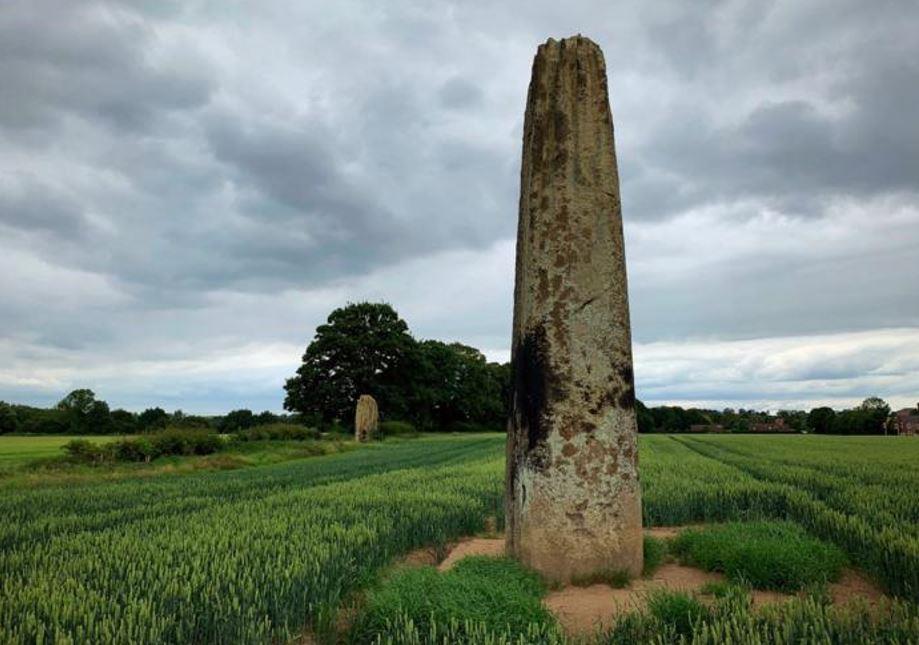
Doha, Qatar: Around 4,000 years ago, prehistoric communities in Britain transported enormous stones weighing more than 25 tonnes each across at least 18km, apparently passing over closer sources of suitable rock, to construct a monument that still stands today.
Scientists have now identified where the giant stones known as the 'Devil's Arrows' came from, settling a longstanding debate over the origins of Britain's tallest surviving prehistoric stone row.
The research, led by Curtin University in Australia in collaboration with the University of York in Britain, traced the stones to Brimham Rocks in North Yorkshire, around 18km west of their present location near Boroughbridge.
The three surviving stones stand as high as seven metres, taller than the stones at Stonehenge. Researchers believe they were transported and erected during the Late Neolithic or Early Bronze Age, possibly around 2000 BC.
But exactly where such enormous stones originated, and whether people or natural processes were responsible for moving them, had remained uncertain.
The new findings indicate that prehistoric builders deliberately selected the stones from a distant landscape rather than simply taking material from the closest available source.
"Our research shows these stones weren't simply taken from the nearest available source, they were deliberately chosen from a challenging landscape 18 kilometres away," lead author Dr Anthony Clarke of Curtin University's School of Earth and Planetary Sciences said in a statement announcing the findings.
Plumpton Rocks, closer to the monument, had previously been considered the probable source. Suitable gritstone also occurs only around 5km west of Boroughbridge, according to the University of York.
Instead, the analysis pointed to the considerably more distant Brimham Rocks.
"Each stone weighs more than 25 tonnes, so moving them would have required incredible planning, coordination and engineering skill," Clarke said.
He said the choice suggested that the landscape from which the stones originated may itself have held significance for the communities that built the monument.
Solving the mystery required an unusually simple-looking tool: adhesive tape.
Because the Devil's Arrows are protected monuments, researchers developed a low-impact technique to collect microscopic mineral grains from their surfaces without damaging the stones.
They then analysed the geological age "fingerprints" of zircon and apatite minerals contained in the samples and compared them with potential source locations.
The fingerprints matched Brimham Rocks, allowing the researchers to identify the geological birthplace of the megaliths.
The evidence also strongly supports deliberate human transportation rather than the stones having been carried to the area naturally by glaciers.
Study co-author Dr Jim Leary of the University of York said the findings demonstrate that prehistoric communities were making deliberate choices about where the material for their monuments came from.
The discovery also resolved another local mystery.
Historical accounts indicated that the Devil's Arrows originally included at least one additional stone.
Researchers used the same mineral fingerprinting to confirm that part of a missing monolith was later reused in the Battle Cross at Aldborough, supporting a theory first proposed in the 19th century.
Despite identifying where the giant stones came from, one of the biggest questions remains unanswered: how did people living around 4,000 years ago actually move objects weighing more than 25 tonnes across 18km and then raise them upright?
The researchers now plan targeted excavations at the monument and its newly identified source and hope to use the non-invasive technique on other standing stones whose origins remain unknown.
"These next steps could help us better understand when the stones were moved and how these extraordinary monuments were constructed," Clarke said.

Legal Disclaimer:
MENAFN provides the
information “as is” without warranty of any kind. We do not accept any
responsibility or liability for the accuracy, content, images, videos,
licenses, completeness, legality, or reliability of the information
contained in this article. If you have any complaints or copyright issues
related to this article, kindly contact the provider above.
Comments
No comment