

Pyxis Oncology Announces Positive Updated Data From Phase 1 Monotherapy Study Of Micvotabart Pelidotin (MICVO) In Second-Line And Beyond Recurrent/Metastatic Head And Neck Squamous Cell Carcinoma (2L+ R/M HNSCC)


| Efficacy Measure | 5.4 mg/kg Dose Cap (N=33) |
| Confirmed objective response rate (cORR), % (n/N) | 36% (12/33) |
| Disease control rate (DCR), % (n/N) | 94% (31/33) |
| Responders achieving response by the first scan at six weeks, % | 75% |
| Responders achieving >50% tumor reduction from baseline*, % | 83% |
| Median progression-free survival (mPFS), months, (95% CI) | 6.2 (4.8-8.8) |
| 12-month overall survival (OS) probability, %, (95% CI) | 79% (58.1,90.3) |
| Median overall survival (OS), months | NR (NR-NR) |
Data as of 18-Aug-2026
*Per RECIST v1.1
Abbreviations: n/N: number of patients.
Table 3: Efficacy Data Across Key Patient Subgroups
| Patient Subgroup | N | 5.4 mg/kg Dose Cap Confirmed ORR, % | 5.4 mg/kg Dose Cap Median PFS, months |
| HPV Status | |||
| HPV+ oropharyngeal | 17 | 35% | 6.2 |
| HPV-unrelated | 16 | 38% | 5.9 |
| Prior EGFRi | |||
| Yes | 18 | 28% | 5.0 |
| No | 15 | 47% | 8.8 |
| Prior Novel EGFRi* | |||
| Yes | 5 | 40% | 5.8 |
| Prior Taxane | |||
| Yes | 23 | 35% | 6.2 |
| No | 10 | 40% | 4.9 |
Data as of 18-Aug-2026
*Prior novel EGFRi subgroup is a subset of patients with prior EGFRi treatment.
Abbreviations: HPV: human papillomavirus; ORR: objective response rate; EGFRi: EGFR inhibitor; n/N: number of patients.
Safety Data
No new safety signals were observed with MICVO. The tolerability data was consistent with that of other ADCs with auristatin payloads and was generally manageable. Adverse events of interest, including peripheral neuropathy, generally occurred after patients had received evidence of benefit, and after prolonged duration of treatment.
Table 4: Safety Data Summary – 5.4 mg/kg Dose Cap Population (N=35)
| TRAEs | 5.4 mg/kg with Dose Cap (N=35) | ||
| Treatment duration – median days (range) | 120 (21-470) | ||
| All TRAEs, n (%) | 32 (91.4%) | ||
| TRAEs of CTCAE Grade ≥ 3, n (%) | 19 (54.3%) | ||
| Non-Hematologic TRAEs of CTCAE Grade ≥ 3, n (%) | 15 (42.9%) | ||
| Serious TRAEs, n (%) | 5 (14.3%) | ||
| TRAEs leading to treatment discontinuation*, n (%) | 5 (14.3%) | ||
| TRAEs leading to treatment discontinuation days, median (min-max) | 162 (104-212) | ||
| TRAEs leading to dose reduction, n (%) | 14 (40.0%) | ||
| Treatment related deaths (Grade 5) | 0 | ||
| ADC Payload TRAEs of Interest | 5.4 mg/kg with Dose Cap (N=35) | ||
| Gr1/2 | Gr3 | ||
| Cutaneous, n (%) | 17 (48.6%) | 2 (5.7%) | |
| Peripheral Neuropathy, n (%) | 14 (40.0%) | 6 (17.1%) | |
| Peripheral Neuropathy days to onset, median (min-max) | 82 (3-151) | 166 (85-197) | |
| Ocular, n (%) | 10 (28.6%) | 2 (5.7%) | |
| Pneumonitis, n (%) | 4 (11.4%) | 0 |
Data as of 18-Aug-2026
*TRAEs leading to discontinuation, N=1 Ocular, N=1 Muscle Weakness, N=3 Peripheral Neuropathy
Abbreviations: ADC: antibody-drug conjugate; TRAE: treatment-related adverse event; CTCAE: Common Terminology Criteria for Adverse Events; Gr: grade; N: number of patients.
MICVO Next Steps
Monotherapy
Pyxis Oncology is advancing the clinical development of MICVO through Project Optimus, a U.S. Food and Drug Administration (FDA) initiative focused on dose optimization and dose selection in oncology drug development. An End of Phase 2 meeting with the FDA to align on dose selection is anticipated in the first quarter of 2027. Updated overall survival data from the MICVO monotherapy study are expected in the first half of 2027.
The Company has aligned with the feedback from the FDA and the European Medicines Agency (EMA) on the design of the planned pivotal Phase 3 monotherapy study of MICVO in patients with second- or third-line R/M HNSCC who have progressed following treatment with both a platinum-based therapy and an anti-PD-1 therapy. The randomized, open-label, 2-arm study will enroll approximately 500 patients who will be randomized 1:1 to receive MICVO or investigators' choice of cetuximab, docetaxel, or methotrexate. The co-primary endpoints of the study will be overall response rate and overall survival. Pyxis Oncology plans to initiate the study in mid-2027 following alignment with the FDA on dose selection.
Combination with KEYTRUDA® (pembrolizumab)
Pyxis Oncology expects to report updated data from the ongoing Phase 1/2 combination dose escalation study of MICVO and Merck's (known as MSD outside of the US and Canada) anti-PD-1 therapy KEYTRUDA® (pembrolizumab) for 1L R/M HNSCC patients in the fourth quarter of 2026. Preliminary positive results for the treatment of 1L/2L+ R/M HNSCC were shared in December 2025. Additional data evaluating initial durability and selection of the recommended Phase 3 dose (RP3D) for the 1L combination are expected in the second half of 2027.
Webcast Information
Pyxis Oncology will host a live webcast today at 7:30 a.m. Eastern Time. To participate in the live event, please register using this link. The event and accompanying slides can be accessed by visiting the investor relations section of the Company's website at . An archived webcast will be available on the Company's website following the event.
About the MICVO Phase 1 Monotherapy Trial
The ongoing Phase 1 monotherapy study of MICVO is a multi-part study. Part 1 was a dose escalation study across multiple doses and tumor types, with initial results shared in November 2024. Part 2 is a dose expansion study in 2L+ R/M HNSCC. Preliminary Phase 1 study results in 2L+ R/M HNSCC were shared in December 2025.
The dose expansion portion of the study includes two arms: post-platinum and anti-PD-(L)1 patients (Arm 1) and post-EGFR inhibitor and anti-PD-(L)1 patients (Arm 2). Target enrollment for each arm was approximately 20 patients, and the Company completed target enrollment in the Phase 1 Part 2 monotherapy dose expansion study in the first quarter of 2026.
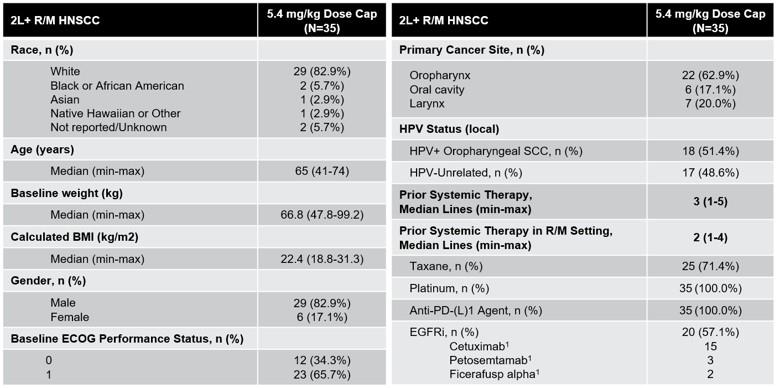
In December 2025, a dose cap was implemented for high body weight patients. Based on internal pharmacokinetic (PK) simulation modeling indicating that MICVO exposures with dose capping and adjusted ideal bodyweight (AIBW) dosing are expected to be comparable, dose capping was prioritized due to its operational simplicity and speed of implementation. The updated results reported today focus on patients treated at 5.4 mg/kg Q3W with a dose cap.
About Micvotabart Pelidotin (MICVO)
Micvotabart pelidotin (MICVO, formerly PYX-201) is an antibody-drug conjugate (ADC) that uniquely targets extradomain-B of fibronectin (EDB+FN), a non-cellular structural component of the tumor extracellular matrix. MICVO is designed to generate a multi-pronged attack on difficult-to-treat cancers by directly killing cancer cells, reducing extra-cellular matrix density, inhibiting tumor angiogenesis and mobilizing an anti-tumor immune response.
MICVO received Fast Track Designation from the U.S. Food and Drug Administration for the treatment of adult patients with R/M HNSCC whose disease has progressed following treatment with platinum-based chemotherapy and an anti-PD-(L)-1 therapy.
About Pyxis Oncology, Inc.
Pyxis Oncology, Inc. is a clinical-stage biopharmaceutical company developing therapeutics for difficult-to-treat cancers. The Company's lead candidate, micvotabart pelidotin (MICVO), is a first-in-concept antibody-drug conjugate (ADC) that targets extradomain-B of fibronectin (EDB+FN), a non-cellular structural component of the tumor extracellular matrix (ECM). EDB+FN is selectively overexpressed in the tumor microenvironment of a wide range of solid tumors and largely absent from normal adult tissues. MICVO is designed to treat solid tumors through a three-pronged mechanism of action: direct cancer cell killing, bystander effect and immunogenic cell death. MICVO is currently being evaluated as monotherapy in a Phase 1 clinical study in patients with recurrent and metastatic head and neck squamous cell carcinoma (R/M HNSCC) and in combination with Merck's anti-PD-1 therapy, KEYTRUDA® (pembrolizumab) in a Phase 1/2 clinical study in patients with R/M HNSCC and other solid tumors. Pyxis Oncology is focused on advancing MICVO, with the goal of improving outcomes for patients living with R/M HNSCC and contributing to meaningful progress in cancer treatment.
To learn more, visit or follow us on LinkedIn.
KEYTRUDA® is a registered trademark of Merck Sharp & Dohme LLC, a subsidiary of Merck & Co., Inc., Rahway, NJ, USA.
Forward-Looking Statements
This press release contains forward-looking statements for the purposes of the safe harbor provisions under the Private Securities Litigation Reform Act of 1995 and other federal securities laws. All statements other than statements of historical facts contained in this press release, including without limitation statements regarding the Company's plans to develop, manufacture and commercialize its product candidate, including micvotabart pelidotin ('MICVO'); preliminary data, timing and progress of the Company's ongoing clinical trials; the expected results of the Company's clinical trials; the ability of preliminary, initial and topline clinical data to de-risk MICVO and be confirmed with clinical trial progression, including the safety, tolerability, and potential efficacy of MICVO; the potential differentiation, advantage or effectiveness of MICVO compared to other approved products or products in development; the dosage and treatment potential of MICVO; the size and future of the market; the plans and objectives of management, and the future results of operations and financial position of the Company, are forward-looking statements. These statements are neither promises nor guarantees, but are statements that involve known and unknown risks, uncertainties and other important factors that are in some cases beyond the Company's control that may cause actual results, performance or achievements to be materially different from any future results, performance or achievements expressed or implied by the forward-looking statements, including, but not limited to, the following: the risks inherent in drug research and development, the Company's projected cash runway and potential needs for additional funding; the lengthy, expensive, and uncertain process of clinical drug development, including potential delays in or failure to obtain regulatory approvals; the Company's reliance on third parties and collaborators to conduct clinical trials, manufacture its product candidate, and develop and commercialize its product candidate; and the Company's ability to compete successfully against other drug candidate. Accordingly, investors should not rely upon forward-looking statements as predictions of future events. Except as required by applicable law, the Company undertakes no obligation to update publicly or revise any forward-looking statements contained herein, whether as a result of any new information, future events, changed circumstances or otherwise. Additionally, investors should read risk factors in the section titled“Risk Factors” set forth in Part II, Item 1A. of the Company's Quarterly Report on Form 10-Q filed on August 13, 2026, and the Company's other filings, each of which is on file with the Securities and Exchange Commission.
Pyxis Oncology Contact
...
A photo accompanying this announcement is available at


Legal Disclaimer:
MENAFN provides the
information “as is” without warranty of any kind. We do not accept any
responsibility or liability for the accuracy, content, images, videos,
licenses, completeness, legality, or reliability of the information
contained in this article. If you have any complaints or copyright issues
related to this article, kindly contact the provider above.
Comments
No comment