

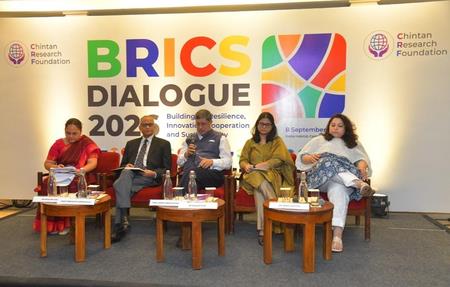
India's BRICS Presidency Translates Growing Global Weight Into Effective Multilateral Action: Experts


The BRICS Dialogue organised by the Chintan Research Foundation (CRF) brought together diplomats, policymakers, scholars and experts to examine the evolving role of BRICS in the international order.
During the discussions, the experts emphasised that India's fourth BRICS Presidency came at a particularly significant juncture, amid geopolitical contestation, economic fragmentation, technological disruption and growing demands for reform of global governance institutions.
India's presidency, they mentioned, sought to strengthen BRICS as a platform for practical, inclusive and sustainable cooperation under the theme of 'Building for Resilience, Innovation, Cooperation and Sustainability'.
"BRICS is at the core of the Global South. Its relevance has grown amid a rapidly changing global order. Combining strengths is critical, and trilateral cooperation can be one of the most feasible ways to advance meaningful collaboration despite differences," said Ambassador Dammu Ravi, Former Secretary (Economic Relations) at the Ministry of External Affairs (MEA), who represented India at several key BRICS meetings during his tenure.
Emphasising the importance of multilateral organisations such as BRICS, he further noted: "It is not about de-dollarisation, but about creating alternative avenues for trade and financial transactions. Given the diversity within BRICS, mechanisms such as the New Development Bank, with its capacity to facilitate transactions in local currencies, can play an important role.”
He added that India can take the lead in setting up a BRICS Secretariat.
CRF President Shishir Priyadarshi also highlighted the importance of economic cooperation, noting that trade is one of the strongest pillars of geo-economic cooperation.
"The other three are financial cooperation, technology, and geopolitical integration. The challenge is building effective groupings despite geopolitical differences," mentioned the noted expert who is also a former Director of the World Trade Organisation (WTO).
BRICS has evolved considerably since its emergence as an economic grouping. Its agenda today extends across global governance and institutional reform, trade and investment, development finance, technology and artificial intelligence, energy and climate, digital transformation and South-South cooperation.
Following its recent expansion, BRICS now represents approximately 49.5 per cent of the world's population and around 40 per cent of global GDP, significantly enhancing its potential influence on global economic and political debates.
Former BRICS Sherpa, Ambassador Sanjay Bhattacharyya, reflected that BRICS was originally created with a focus on economic development, but it has evolved to engage with the multilateral system and integrate more closely with the global
order.
He stated that addressing the digital divide is an important part of this process and that BRICS needs to "pursue issue-based multilateralism" and play a "much greater role" in global rule-making.
Bringing India's BRICS chairship into focus, Professor Srikanth Kondapalli said that, in an emerging multipolar world order, it is important to recognise that major partners have different perspectives on multipolarity.
"BRICS is important because it enables a bottom-up approach to cooperation, allowing countries to build resilience, diversify risks and strengthen alternative economic and strategic partnerships, rather than pursuing complete decoupling from existing systems," he said.
Heena Makhija highlighted that BRICS is not a charter-based organisation and has witnessed both vertical and horizontal expansion, resulting in power asymmetry.
"Given this evolving and diverse membership, building consensus on establishing a BRICS Secretariat in New Delhi could be challenging," observed Makhija.
Professor Harsh V Pant from the Observer Research Foundation (ORF) noted that BRICS was originally conceived as a geoeconomic platform, but divergences among member countries on the geopolitical front have made geopolitics an increasingly important dimension of the grouping. He also raised the question of whether BRICS can effectively serve as a platform for advancing India's multilateral agenda.
Highlighting the idea of 'Vasudhaiva Kutumbakam' propagated by India, Sabyasachi Saha from the Research and Information System for Developing Countries (RIS) said that BRICS must focus on delivering tangible collective value beyond bilateral relationships among its members.
Re-emphasising Ambassador Dammu's remarks, Pritam Banerjee called for innovative financial instruments within the NDB's mandate to strengthen financial cooperation among BRICS members.
The discussion also examined several areas where cooperation could deliver tangible results, including a BRICS Grain Exchange, interoperable paperless trade systems, reduction of non-tariff barriers and greater local-currency trade where commercially viable. Such initiatives could strengthen economic resilience while demonstrating the practical value of BRICS cooperation.
A key takeaway from the dialogue was that BRICS' future credibility will increasingly depend on its ability to move from declarations to implementation. Its growing membership provides greater representation and collective weight, but also makes consensus-building and institutional continuity more important.
Analysts reckoned that there is a need for India's 2026 presidency to leave behind mechanisms and initiatives capable of sustaining momentum beyond the year. They mentioned that, with the presidency moving to China next year, continuity will be critical to ensuring that priorities advanced during India's chairship contribute to the longer-term evolution of BRICS.
BRICS, the participants agreed, is at an important turning point and its ability to turn diversity into complementarity, political intent into practical outcomes and greater representation into more effective multilateralism will determine the extent to which it can shape the evolving global order.

Legal Disclaimer:
MENAFN provides the
information “as is” without warranty of any kind. We do not accept any
responsibility or liability for the accuracy, content, images, videos,
licenses, completeness, legality, or reliability of the information
contained in this article. If you have any complaints or copyright issues
related to this article, kindly contact the provider above.
Comments
No comment