

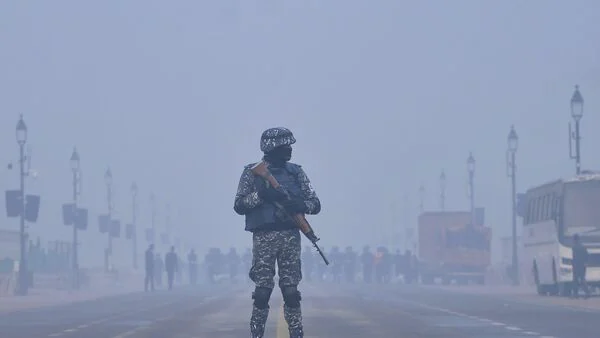
Clean-Air Ranking 2026: Delhi Ranks Ahead Of Bengaluru, Srinagar In Clean-Air Survey Despite Toxic Smog


The ranking, released by the Union Environment Ministry on Monday, is not based solely on air quality levels. It also evaluates the steps cities have taken to control and reduce pollution.
Lucknow leads million-plus citiesLucknow topped the category for cities with populations above 10 lakh, scoring 198 points. Indore, which has been recognised as India's cleanest city for eight consecutive years in the annual Swachh Survekshan rankings, finished narrowly behind.
Also Read | Delhi-NCR unveils seven-month pollution plan as winter smog loomsJabalpur secured third place with 195 points, while Bhopal and Agra jointly occupied fourth place, each scoring 192 points.
The Swachh Vayu Sarvekshan is conducted by the Union Environment Ministry under the National Clean Air Programme (NCAP). Its assessment covers several pollution -control measures, including road-dust management, solid-waste disposal, reduction of vehicle and industrial emissions, construction and demolition waste management and public awareness initiatives.
Why Delhi ranks higher despite poor airDelhi's air quality frequently deteriorates to hazardous levels during winter, with AQI often exceeding 400 and entering the“severe” category. On some occasions, the index has also crossed 450.
As a result, the survey's ranking should not be interpreted as a direct list of India's cities with the cleanest air. A city with poor ambient air quality can score better if it demonstrates stronger pollution-control measures and implementation.
Delhi had ranked 32nd in the 2025 Swachh Vayu Sarvekshan, recording 157.3 points. Indore topped that year's list, followed by Jabalpur, while Agra and Surat shared the third position.
This year, Delhi scored 172 points and shared the 21st position with Visakhapatnam among cities with populations above 10 lakh. Srinagar scored 162.6 points to rank 26th, while Bengaluru received 152.6 points and finished 32nd, according to the official results.
Patna also performed better than Bengaluru and Srinagar, ranking 16th with 178 points.
Delhi ahead of Mumbai, Chennai and KolkataThe national capital also finished above several other major metropolitan centres. Mumbai ranked 28th with 160.8 points; Chennai ranked 35th with 147.7 points; and Kolkata ranked 38th with 142.2 points. Hyderabad, however, performed better than Delhi, securing 19th position.
Among cities with populations between three lakh and 10 lakh, Odisha's Rourkela topped the rankings. Firozabad in Uttar Pradesh and Guntur in Andhra Pradesh jointly took second place, while Amravati in Maharashtra was third.
For cities with populations below three lakh, Kalinga Nagar in Odisha emerged as the leader, followed by Angul and Talcher, also in Odisha.
Delhi's pollution record remains a concernDelhi's ranking may appear surprising given its continuing status as one of India's most polluted urban centres.
The government described 2025 as Delhi's best year for particulate pollution since 2018, excluding 2020 when Covid-19 restrictions sharply reduced activity. Yet the capital's annual average PM10 concentration was 198 micrograms per cubic metre, while PM2.5 averaged 97 micrograms per cubic metre.
Both readings remained substantially above India's annual permissible standards of 60 micrograms per cubic metre for PM10 and 40 micrograms per cubic metre for PM2.5, according to the ministry.
Delhi's air pollution problem also intensified during the 2025-26 winter season.
In January 2026, authorities imposed Stage IV restrictions under the Graded Response Action Plan after air quality deteriorated into the most severe pollution category.
Also Read | Maharashtra govt increases cost of pollution check certificate; check new rates Survey covers 130 NCAP citiesThe fifth edition of the Swachh Vayu Sarvekshan 2026 evaluated 130 cities covered under the National Clean Air Programme across three population categories.
The assessment involved self-evaluation by participating cities, scrutiny and approval by state-level monitoring committees, assessment by the Central Pollution Control Board and field verification conducted by independent teams.
According to the government, 108 of the 130 cities recorded lower PM10 concentrations during 2025-26 compared with their 2017-18 baseline levels. However, only 14 cities met India's prescribed annual PM10 standard.

Legal Disclaimer:
MENAFN provides the
information “as is” without warranty of any kind. We do not accept any
responsibility or liability for the accuracy, content, images, videos,
licenses, completeness, legality, or reliability of the information
contained in this article. If you have any complaints or copyright issues
related to this article, kindly contact the provider above.
Comments
No comment