

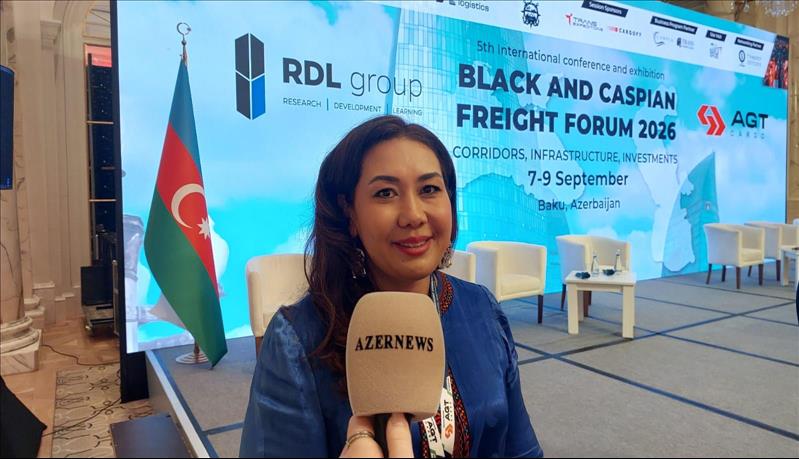
Middle Corridor Countries Need Better Coordination To Unlock Its Potential, Says Expert


Coordination between the countries along the Middle Corridor has become essential for the route's development, Aizhan Beiseyeva, Head of CPCS Central Asia, told AzerNEWS in an interview.
Beiseyeva said that the Trans-Caspian International Transport Route, also known as the Middle Corridor, has reached a stage where better coordination between the countries involved is necessary.
“In my view, we have already reached the point where both practitioners and experts agree that without coordination, the Middle Corridor cannot develop successfully,” she said.
According to Beiseyeva, this coordination should cover not only the planning and development of physical infrastructure but, more importantly, the so-called soft component. She referred to the seven recommendations outlined in a 2023 report by the European Bank for Reconstruction and Development (EBRD), stressing that they should be implemented as part of efforts to improve the corridor.
Beiseyeva noted that she represents an association bringing together members from seven countries working in transport and logistics along the corridor, including five Central Asian countries and the South Caucasus countries of Georgia and Azerbaijan. She said small and medium-sized businesses operating along the route are among the first to feel the impact of poor coordination and imbalances between the countries.
"This lack of coordination and imbalance leads to long queues at the borders," Beiseyeva stressed.
According to her, some challenges, such as unpredictable weather conditions on the Caspian Sea, cannot be avoided. However, she stressed that other problems can be addressed through better coordination and the use of new technologies.
"Artificial intelligence has already been introduced, and this is now a number one priority," she highlighted.
An expert also pointed out that individual countries are investing heavily in physical infrastructure, which she said is undoubtedly important and necessary.
“We need to come together and forecast,” Beiseyeva said, adding that it is not enough simply to hold meetings, discuss future developments and organize foresight sessions connecting Central Asia and the Caucasus.
She also noted that this monitoring should not be carried out only by the Trans-Caspian International Transport Route or government bodies. "The private sector itself must also track and measure the results," Aizhan Beiseyeva added.

Legal Disclaimer:
MENAFN provides the
information “as is” without warranty of any kind. We do not accept any
responsibility or liability for the accuracy, content, images, videos,
licenses, completeness, legality, or reliability of the information
contained in this article. If you have any complaints or copyright issues
related to this article, kindly contact the provider above.
Comments
No comment