

Ukrainian AI Company After NATO Competition: Effectiveness Of Strikes On Russian Airfields Could Increase Tenfold


“In short, our development is artificial intelligence for making the destruction of enemy airfields ten times more effective. It involves precision targeting of airfields, and the solution can be used both on UAVs and missiles,” the company head said.
He explained that Russia should not be underestimated, as it has one of the world's best air defense systems, combined with one of the world's best electronic warfare systems, which makes it considerably more difficult for Ukrainian forces to strike its airfields.
“Essentially, we are dealing with the protection of military airfields at a level that may not exist anywhere else in the world. Despite this, Ukraine is managing to effectively 'reach' Russian aircraft and helicopters at their airfields, both in Crimea and deep inside their territory,” Wild Cat said. At the same time, he believes that introducing the new development“will fundamentally change this situation.”
Read also: Ukrainian Forces Test New Robotic Turrets with Machine Guns on the Front Line
“This will help Ukraine significantly improve the effectiveness of strikes on enemy airfields,” the head of the Ukrainian company emphasized.
He noted that he had expected to win NATO's Innovation Competition because he benchmarks his company against its main competitors in Ukraine and around the world, including the U.S. company Palantir Technologies, which develops artificial intelligence, including for Hornet“middle-strike” drones,“with which the Ukrainian side is currently wreaking havoc on the enemy's logistics.”
According to him, Palantir remains stronger in the logistics sector, but the Ukrainian development has an advantage in airspace protection and operations against enemy airfields.
The company head said that winning the NATO competition represents recognition of the Ukrainian company's solutions at the Alliance level.
“We are the only Ukrainian company to have won this competition. This means that our solution has been recognized as the best in this field across the Alliance. We are being invited to take part in further testing and trials, with the prospect of implementing our solutions at the NATO level. This is a huge boost for the company's development and integration into the Alliance's defense system,” he emphasized.
The head added that the company had been developing its technology since 2022 and had since collected, in his assessment, globally unique databases for training its artificial intelligence.
“No one else in the Western world has anything like this. And training data accounts for more than half of success,” the head of the Ukrainian AI company said.
Read also: Ukraine and Britain Sign Historic Artificial Intelligence Agreement
Wild Cat said that during the event, the company had also reached cooperation agreements with several other partners, including an agreement on joint production with a foreign company, as well as cooperation with a Ukrainian manufacturer. He added that since the company develops exclusively software modules, practical implementation of the solution requires cooperation with manufacturers of drones or missile systems.
The company head also said that a presentation of the solution at a training range was scheduled to take place within several weeks as part of an exercise. The next steps will include flight and combat trials, followed by the production of a small batch to identify shortcomings under real operating conditions, and only later full-scale production. According to the company head's preliminary estimates, it should take between six and eighteen months for the development to enter combat use.
Regarding the financial prize in NATO's Innovation Competition -the three winning companies will receive a total of €250,000-Wild Cat said it amounts to approximately 5–7% of the project's current costs. However, he said the main value of the victory was not financial but reputational, providing an argument for potential investors and partners.
Assessing the development's potential impact on the course of hostilities, the company head described it as“an ongoing confrontation between means and countermeasures.”
“We are now considering what the war will look like in two or three years. To some extent, we are already anticipating how the Russians will protect their airfields in the future-for example, they are already actively building bunkers for aircraft. We are developing the solution so that even these bunkers will not help them,” he emphasized.
The head of the AI company added that it had been working on strikes against enemy airfields since 2022, and that the current development takes into account its previous experience and the countermeasures Russia has attempted to use to reduce the effectiveness of Ukrainian attacks.
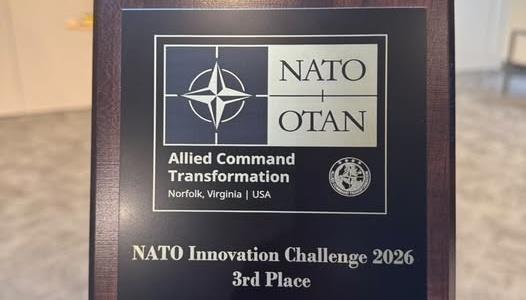
As previously reported by Ukrinform, NATO's 19th Innovation Competition, organized by NATO's Allied Command Transformation (ACT) and the NATO-Ukraine Joint Analysis, Training and Education Centre (JATEC), focused on persistent airfield denia. The Persistent Airfield Denial competition sought innovative technologies capable not only of damaging a military airfield but also of making it difficult for the enemy to restore its operations for an extended period.
The Ukrainian company took third place with an artificial intelligence-based solution for autonomous control of unmanned aerial vehicles. The technology enables operation without a constant connection to an operator, as well as the use of autonomous navigation and target recognition.
First place in the competition went to Czech company LPP Holding, which presented an autonomous long-range unmanned system capable of operating in conditions of active electronic warfare and without GPS navigation.
Second place went to Polish company Supercluster with its StratoAIM concept. The development involves using high-altitude balloons to launch autonomous gliding systems.

Legal Disclaimer:
MENAFN provides the
information “as is” without warranty of any kind. We do not accept any
responsibility or liability for the accuracy, content, images, videos,
licenses, completeness, legality, or reliability of the information
contained in this article. If you have any complaints or copyright issues
related to this article, kindly contact the provider above.
Comments
No comment