

Convict Or Fete? The World Is Splitting On Myanmar's Generals


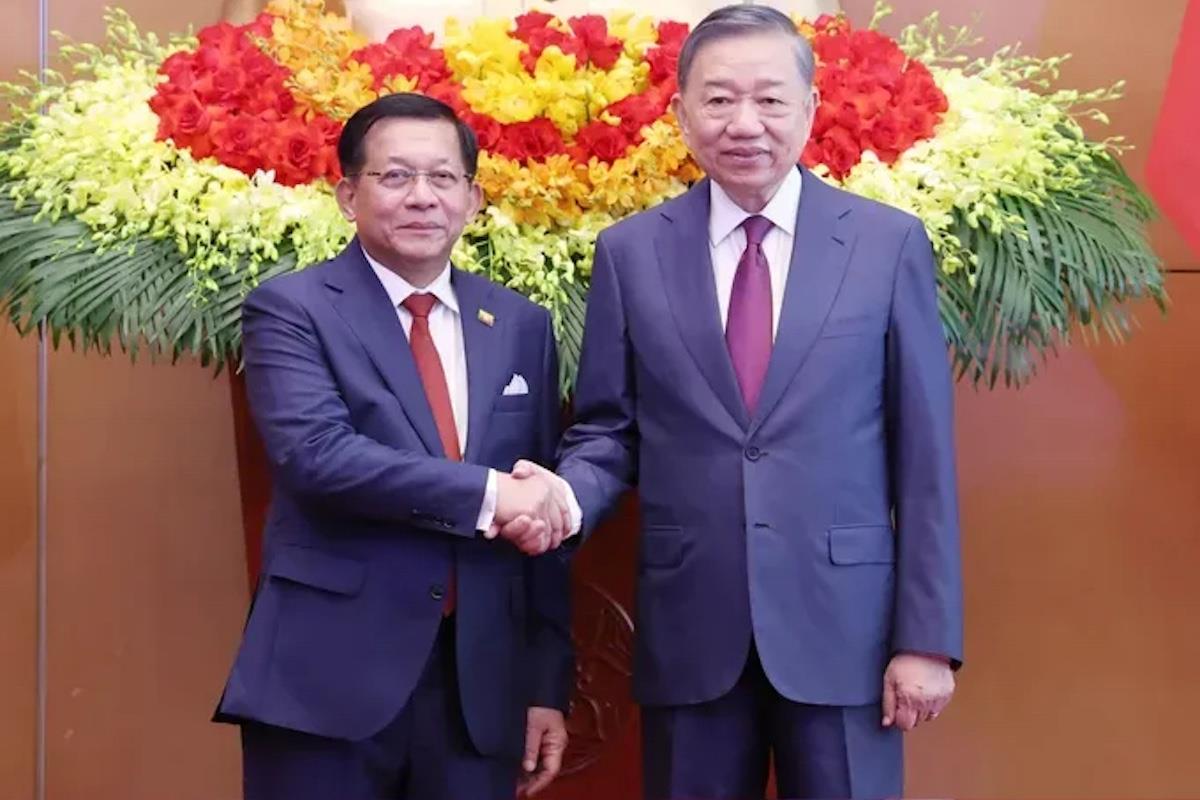
Meanwhile, in Hanoi, Myanmar's coup maker and self-appointed president, Senior General Min Aung Hlaing, was received with the pageantry of a head of state. Phnom Penh will repeat the treatment from September 11-12.
Two calendars: one of evidence, one of optics. Unless the first sets the terms for the second, the second wins.
The High Commissioner's report on the Rohingya and other minorities, covering June 2025 through May 2026, documents intensified military attacks, mass displacement, forced conscription, arbitrary detention, humanitarian obstruction and continued systematic discrimination against the Rohingya. It also names abuses attributed to the rebel Arakan Army and the damage done by unregulated rare-earth extraction.
Its recommendations to states are cutting and clear: a UN Security Council referral of the military to the International Criminal Court, a halt to transfers of arms, ammunition, jet fuel and dual-use items, and - in the report's own words - states should“refrain from lending political legitimacy to the military's purported exercise of civilian authority.” It warns that“figures on verified deaths represent an underestimation.”
The UN Independent Investigative Mechanism, addressing the same Council, reported that“serious international crimes are being committed with greater frequency and intensity” and that“civilians are the principal victims.”
It has now assembled evidence from more than 1,600 sources and 750 witnesses and shared material with the International Criminal Court (ICC), Argentine authorities and the International Court of Justice. This is not unsubstantiated commentary. It is an evidence-based judicial pipeline.
Latest stories Is Indonesia's largest Muslim group getting too close to power? Not all foreign influence in the Philippines is malign Prabowo's personal diplomacy is costing IndonesiaThe European Union closed the loop. Brussels identified forced conscription, continued military access to arms and intensified airstrikes as the drivers of the crisis, and said that“the EU does not recognize any elections that are neither free nor fair and that aim to legitimize the military.”
Three institutions, one message: escalating violations, an evidentiary record built for court and a refusal to call a stage-managed vote democracy.
In the same week, on September 5, Min Aung Hlaing's talks in Hanoi with Vietnamese leader To Lam produced an agreement to deepen defense and security cooperation as“a pillar” of bilateral ties, covering military training, young-officer exchanges and information sharing.
His visit also took in a VinFast factory and Viettel, whose Mytel joint venture operates inside Myanmar. The Straits Times reported that Phnom Penh will host him later this week - his eighth country visit and fourth to an ASEAN member since he took the presidency this year.
ASEAN summits still exclude Min Aung Hlaing pending progress on the Five-Point Consensus. But carefully selected bilateral hosts confer, one visit at a time, the trappings of a normal head of state while the bloc's collective policy notionally holds. As a recent Stimson Center essay put it,“ASEAN should distinguish functional engagement from political rehabilitation.” That distinction is being blurred in real time.
The policy testFour conclusions follow. First, the New York credentials fight matters more than it looks. When the UN General Assembly's Credentials Committee reconvenes, member states will decide whether the seat labeled“Myanmar” carries the voice of a coup regime whose airstrikes the EU has just condemned, or the mandate of Myanmar's coup-ousted elected representatives.
The Geneva record doesn't resolve credentials on its own - that remains a procedural matter - but it raises the political cost of upgrading the military's UN standing. Keeping Ambassador Kyaw Moe Tun in his seat is the minimum consistent with the UN's own findings.
Second, ASEAN states that want to preserve any credibility for the Five-Point Consensus should publish the conditions under which they engage bilaterally with Min Aung Hlaing. Silence turns“pragmatism” into rehabilitation.
Vietnam and Cambodia may need to talk to Naypyidaw about borders, migration and organized crime. They should say publicly what they're asking for - and what happens if it isn't delivered.
Third, targeted pressure should follow the enablers Geneva has now named: arms, ammunition, jet fuel, dual-use goods, opaque financial channels and extractive-resource revenue.
That points to a coherent next phase - energy-sector sanctions on the Myanma Oil and Gas Enterprise, evidence-based measures at the Financial Action Task Force, and scrutiny of the scam-center finance that has metastasized out of the border zones.
Any sanctions regime needs civilian safeguards for humanitarian remittances and lawful family transfers, so it punishes enablers, not ordinary people. Buyers of Myanmar-origin heavy rare-earth oxides and the processors who launder their provenance belong on the same list.
Sign up for one of our free newsletters-
The Daily Report
Start your day right with Asia Times' top stories
AT Weekly Report
A weekly roundup of Asia Times' most-read stories
Fourth, and most uncomfortable for the anti-coup resistance: international credibility is indivisible. The UN High Commissioner names the military first and most severely, but the Mechanism's evidence pipeline does not discriminate. A federal-democratic Myanmar cannot demand accountability for the junta while excusing violations by anyone flying an anti-junta flag.
Rakhine and the Rohingya are not a side file. They are the credibility test on which the rest of the case rests. The National Unity Government and ethnic revolutionary organizations should treat civilian protection, minority rights, humanitarian access and transparent investigation as strategic assets, not concessions.
The Spring Revolution's strongest asset abroad has always been the coherence of the facts.
New research from the Stimson Center, based on 287 interviews in Sagaing, Magway and Mandalay between November 2025 and February 2026, found that 90% of respondents believe the revolution should end only through armed victory over the military - while those same respondents pressed their own side for greater unity and cleaner governance.
The public inside the country is not ambivalent about the junta. It is asking its allies not to be ambivalent either. The task in the coming weeks is to make sure the Geneva calendar sets the terms for Hanoi and Phnom Penh - not the other way around.
That means conditioning contact, closing supply lines, protecting the UN seat, funding the evidence and refusing to treat a coup election as a democratic reset.
James Shwe is a semi-retired professional engineer based in California and an advocate for democracy in Myanmar.
Thank you for registering!
-
Share on X (Opens in new window)
Share on LinkedIn (Opens in new window)
LinkedI
Share on Facebook (Opens in new window)
Faceboo
Share on WhatsApp (Opens in new window)
WhatsAp
Share on Reddit (Opens in new window)
Reddi
Email a link to a friend (Opens in new window)
Emai
Print (Opens in new window)
Prin

Legal Disclaimer:
MENAFN provides the
information “as is” without warranty of any kind. We do not accept any
responsibility or liability for the accuracy, content, images, videos,
licenses, completeness, legality, or reliability of the information
contained in this article. If you have any complaints or copyright issues
related to this article, kindly contact the provider above.
Comments
No comment