

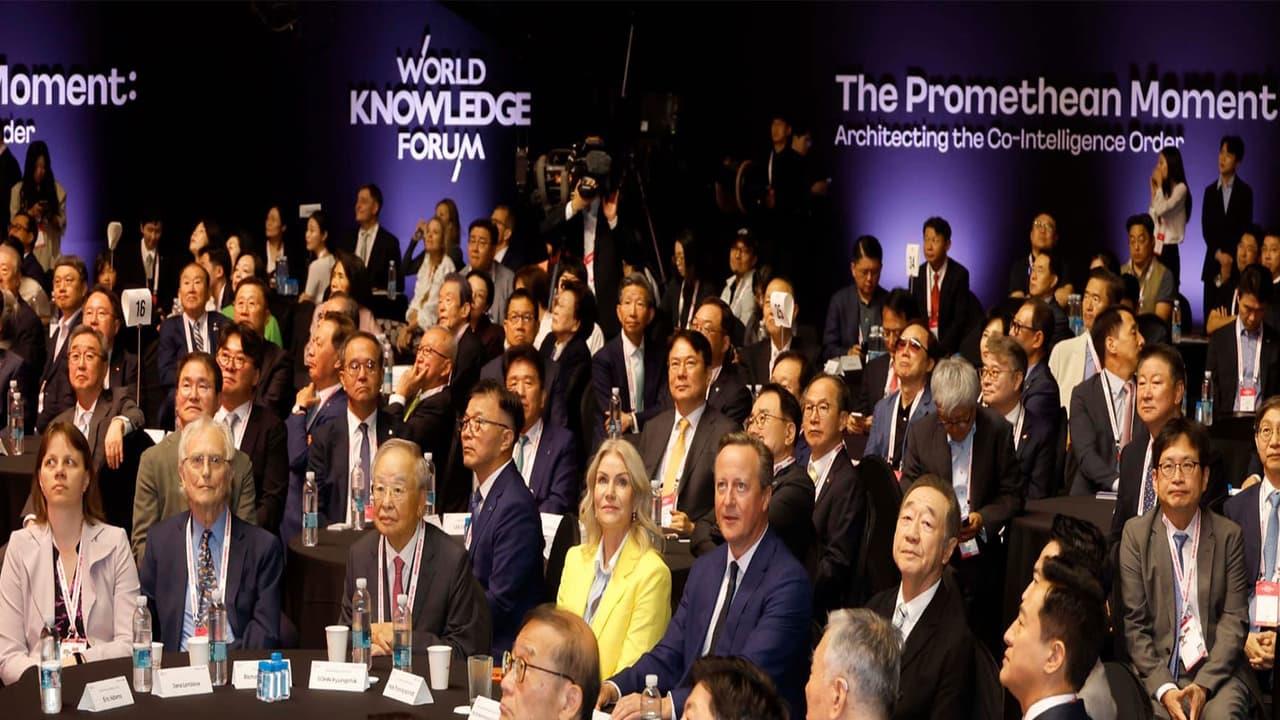
Global Leaders Gather In Seoul For 27Th World Knowledge Forum On AI


The 27th World Knowledge Forum opened in Seoul on Tuesday, bringing together global political leaders, scientists, technology pioneers and business leaders to examine the future of humanity in an era increasingly shaped by artificial intelligence.
The three-day forum, being held at The Shilla Seoul and Jangchung Arena, is centred around the theme,“The Promethean Moment: Architecting the Co-Intelligence Order.”
Former British Prime Minister David Cameron delivered the opening special address at the forum, while leading global thinkers and policymakers gathered to discuss artificial intelligence, geopolitics, economic transformation and the future of humanity.
AI: A Tool for a New Civilisation
Addressing the gathering, Speaker of South Korea's National Assembly, Cho Jeong-sik, said artificial intelligence had moved beyond the boundaries of technology and was fundamentally changing the way people work and live.
“AI is becoming a tool of a new civilisation, transcending the boundaries of technology and changing the way we work and live,” Cho said.
However, he cautioned that the rapid rise of AI was also creating ethical and social challenges, including job losses, growing inequality and human alienation.
“What determines the level of a civilisation is not how fast or how far technology advances, but whom it is for,” he said.
Cho stressed that AI should expand human potential rather than replace people.“Just as humanity advanced its civilisation by learning how to harness Prometheus' fire, AI must likewise be a tool to expand human potential, not a technology that replaces people,” he said.
He added that technological progress must be guided by human dignity and coexistence.“Ensuring that technological progress leads to human dignity and mutual coexistence, that is the era of Co-Intelligence that we must build together,” Cho said.
The Importance of AI Diffusion and 'Co-Intelligence'
Maekyung Media Group Chairman Chang Dae-whan, in his opening address, said the defining challenge of the AI revolution would not be technological invention alone, but how widely and deeply artificial intelligence spreads across society.
“History teaches us an important lesson. Global hegemony does not belong to those who first lit the fire, but to those who spread that fire the farthest,” Chang said.“The printing press, the steam engine, electricity, and IT. Likewise, it is not the moment of invention that will determine the future of the AI revolution.”
“In the end, the outcome hinges on diffusion, on how deeply AI takes root across our society,” he added.
Chang said this vision had prompted Maekyung Media Group to declare its ambition for an“AI Native Korea.”
“The true battleground is not the technology itself. It is diffusion. We must become a country where all citizens use AI as fluently as their mother tongue,” he said.
Explaining the concept of“Co-Intelligence”, Chang said the relationship between humans and AI must evolve beyond simply working alongside one another.“Humans use AI to broaden the horizons of their thinking, while AI operates within the norms set by humans. That is what I call 'Co-Intelligence',” he said.
David Cameron on Global Crises and Leadership
The forum has brought together a distinguished line-up of international speakers, including evolutionary biologist and Oxford University Emeritus Professor Richard Dawkins, former New York City Mayor Eric Adams, Stanford University Professor Erik Brynjolfsson, former Danish Prime Minister Helle Thorning-Schmidt, Google X founder Sebastian Thrun, and Regeneron Pharmaceuticals founder and CEO Leonard Schleifer.
In his keynote address, former British Prime Minister David Cameron shifted the focus to leadership amid what he described as a growing global crisis marked by geopolitical instability and increasingly polarised domestic politics.
“To me, it is a double-headed crisis: an increasingly dangerous world and an unstable and populist-driven domestic politics that affects so many of our countries,” Cameron said.“These two things are completely connected,” he added.
Cameron warned that political instability, economic dislocation, uncontrolled migration and the growing influence of social media were weakening consensus and pushing societies towards greater polarisation.
“People increasingly have their own news, their own truth, their own facts. And this pulls people away from building consensus and often pushes them towards the extremes,” he said.
Calling for a more realistic approach to global challenges, Cameron said countries must prioritise both economic and national security.“There is no national security without economic security,” he said.
He urged leaders to build stronger alliances based on shared values and interests and cautioned against expecting global institutions alone to resolve emerging geopolitical challenges.“If national security and economic security are the priorities, we must share and partner with countries that share our values as well as our interests,” Cameron said.“Those alliances are more likely to survive and thrive.”
South Korea as a Global Example
Reflecting on South Korea's remarkable transformation over the decades, Cameron described the country as a global example of how political and economic choices can shape national destiny.
“You did it because you chose the right values,” he said, referring to South Korea's rise as a prosperous and democratic nation.
“That magic troika, that treble: democracy, the rule of law, and free enterprise economics,” Cameron added.“You proved here in this country that none of us are prisoners of geography, prisoners of climate, prisoners of ethnicity, or even prisoners of history. The most important thing we do is to choose our path, our politics, our way.”
AI: The 'Fire of the 21st Century'
Artificial Intelligence has emerged as the defining theme of this year's World Knowledge Forum, reflecting its growing role as a transformative force in the global economy, industry, governance and national security.
Organisers said AI has moved far beyond its earlier perception as a tool for improving productivity and technological innovation and is now increasingly seen as the driving force behind a major industrial transformation.
Drawing inspiration from the Greek myth of Prometheus, the forum describes artificial intelligence as the“fire of the 21st century”, a force capable of transforming civilisation while also carrying significant risks if left unchecked.
Under the broader theme of human-AI“Co-Intelligence”, discussions over the next three days will focus on five key pillars shaping the current era of transformation: Power, Capital, Intelligence, Planet and Humanity.
As artificial intelligence increasingly influences economies, societies and geopolitics, the 27th World Knowledge Forum seeks to bring together global perspectives on how humanity can harness the transformative power of AI while ensuring that technological progress remains aligned with human values, dignity and coexistence.
(Except for the headline, this story has not been edited by Asianet Newsable English staff and is published from a syndicated feed.)
Legal Disclaimer:
MENAFN provides the
information “as is” without warranty of any kind. We do not accept any
responsibility or liability for the accuracy, content, images, videos,
licenses, completeness, legality, or reliability of the information
contained in this article. If you have any complaints or copyright issues
related to this article, kindly contact the provider above.
Comments
No comment