

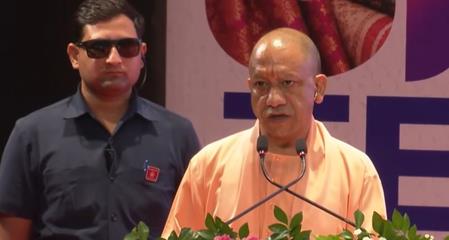
'One District, One Mafia' Had Become UP's Identity Before 2017, Says CM Yogi


Addressing the two-day 'UP Textile Conclave-2026', the Chief Minister welcomed entrepreneurs, investors, exporters, traditional weavers, handloom operators, industry representatives, and young people associated with the textile sector.
"First of all, I extend a heartfelt welcome and greetings to all the distinguished entrepreneurs, investors and exporters from the textile sector across the country, as well as traditional weavers, handloom operators, all the dignitaries and young friends who see their future in this sector," he said.
Highlighting Uttar Pradesh's long-standing textile traditions, the Chief Minister said the state's textile heritage had historical links with India's cultural and economic development.
He said that when gifts of clothing were presented by the King of Kashi at Yudhishthira's Rajasuya Yagya, ancient texts such as the Mahabharata made references to silk and pure cotton garments. Also referring to the period of Lord Ram's exile, he said religious scriptures mention Mata Janaki receiving divine garments at a sage's ashram.
"The textiles produced in India, particularly those made in Uttar Pradesh, were not only in demand in India but also in markets around the world," he said.
"If you look at Roman culture or Greek culture, there was a huge demand there as well for these textiles made in India and Uttar Pradesh. This means that the tradition of sending these products from here to other places existed even then," the Chief Minister said.
He also highlighted several major textile and manufacturing centres across the state, including Varanasi's silk sarees, Bhadohi's carpets, Lucknow's chikankari, and Kanpur's textile, leather, and industrial manufacturing ecosystem.
CM Adityanath also mentioned Agra's footwear and allied manufacturing sector, Sitapur's textile manufacturing capabilities, and Meerut's sports goods industry and the potential for technical textiles.
"These are not merely textile clusters of Uttar Pradesh. They represent different facets of Uttar Pradesh's textile heritage and industrial capabilities. These different facets visible across different regions draw our attention to the potential of the textile sector in Uttar Pradesh," he said.
Recalling the situation in Uttar Pradesh before 2017, Adityanath claimed the state's law and order situation was in disarray and alleged that mafia groups had established parallel systems of governance in several districts.
"Friends, what the situation in Uttar Pradesh was like before 2017 is not hidden from anyone. Law and order in the state was in disarray," he said.
"In every district, a parallel government run by the mafia operated. In other words, 'One District, One Mafia' had become the identity of Uttar Pradesh. Across the state, the industries of murder, extortion, illegal occupation, goon tax, and kidnapping were flourishing. Professional mafias and goons operated their own system parallel to the government," he claimed.
He further alleged that the prevailing environment had affected the safety of women, traders and potential investors.
"At that time, neither daughters were safe, nor traders were safe. Investors would come from outside with dreams of doing business and return with a slip of paper from the mafia demanding payment," Adityanath claimed.
The Chief Minister also alleged that festivals and celebrations could not be conducted peacefully because of frequent disturbances and riots.
"No festival or celebration could be held peacefully. In other words, disturbances would begin before the festivities. Across the state, there would be a major riot every third day, with the entire state engulfed in the flames of riots. Major riots took place in Bareilly, Kosi Kalan in Mathura, Muzaffarnagar and Saharanpur on a large scale," he said.
He said prolonged curfews and the closure of educational institutions and markets had a direct impact on economic activity.
"Curfews would remain in place for months. Schools and colleges would be closed. If there was a curfew, the markets would remain closed, and if the markets remained closed, business would inevitably come to a standstill. People could not even leave their homes. And when such a situation exists, the economy cannot move forward. A perception had taken hold," the Chief Minister said.
He said Uttar Pradesh had also acquired a negative perception because of poor infrastructure and inadequate lighting in several areas.
"I always mention this point: before 2017, Uttar Pradesh had come to be perceived as a place where, once the roads became bad and darkness began as soon as evening arrived, you could assume that you had entered the borders of Uttar Pradesh. This was the situation in Uttar Pradesh before 2017," he said.

Legal Disclaimer:
MENAFN provides the
information “as is” without warranty of any kind. We do not accept any
responsibility or liability for the accuracy, content, images, videos,
licenses, completeness, legality, or reliability of the information
contained in this article. If you have any complaints or copyright issues
related to this article, kindly contact the provider above.
Comments
No comment