

The Margaret Preston Retrospective At The National Gallery Of Victoria Is A Revelation


We see her work in the context of her students/lovers, Bessie Gibson and Gladys Reynell, and her obsession with First Nations art – her adaptations, her collections, and, now, commentaries on her adaptations by Trevor Nickolls and Gordon Bennett, among others.
A much more complex and nuanced image of Preston emerges than in previous exhibitions.
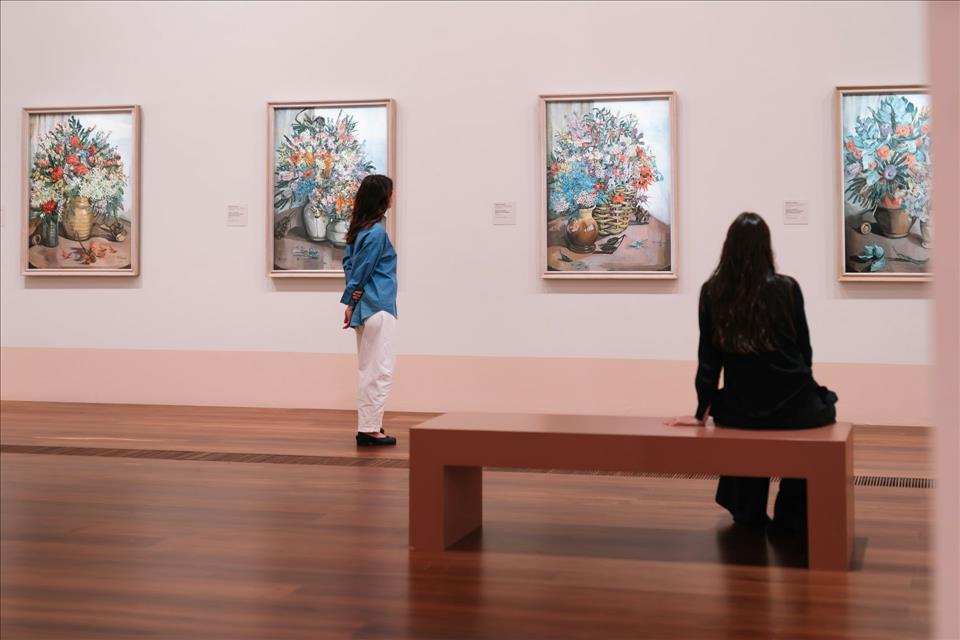
The show is a mixture of a chronological survey with her early still life paintings from the opening decade of the 20th century, then her decorative flower pieces moving to the magnificence of her hand-coloured woodcuts.
There is a desire to bring her art to life: we see her iconic Wheelflower print of 1929, next to the actual woodblock from which it was printed. Her First Nations pieces are shown together with their actual sources of inspiration.
The exhibition is full of these little detective pieces that save the exhibition from being just another Margaret Preston show to make it into the Margaret Preston show for our generation.
A spectacular makeoverBorn Margaret Rose McPherson in Adelaide in 1875, she initially trained in Sydney, then at the National Gallery School in Melbourne. She spent many years travelling in Europe, mainly in Germany, France and England.
She first travelled with Betty Davidson and then Gladys Reynell, with both of whom, the NGV catalogue asserts, she had a romantic bond.
She exhibited to limited acclaim, first under the name of Rose McPherson and by 1912 as Margaret McPherson.
Her personal and artistic makeover was as spectacular as it was sudden.
On the last day of 1919, the 44-year-old McPherson falsified her age by eight years and married Lieutenant William George Preston, subsequently a successful businessman. This made her, at least on the marriage certificate, a socially respectable two years younger than her husband, rather than the embarrassing six years older.
She changed her exhibiting name to Margaret Preston and, armed with her husband's wealth, launched her new career with a massive publicity blitz that was to last until her death in 1963.
Following her marriage, she settled with her husband in the bayside Sydney suburb of Mosman and moved rapidly up the social ladder to become a friend of the publisher Sydney Ure Smith.
Preston was the most articulate and outspoken female artist of her generation, writing frequent articles and giving lectures and interviews.
While always a committed traveller, after her marriage Preston embarked on numerous journeys throughout Asia and the Pacific, the Middle East and Europe.
At the height of the Depression, the Prestons moved from Mosman to a 14-acre block in rural Berowra, before returning to the Mosman neighbourhood in 1939, where they remained until her death.
A revelationFor me, a revelation of this exhibition is her late stencil pieces, including Christ turning the water into wine (1951) and White gum (1953) where Preston in her mature years is grappling with a host of conceptual problems and exhibits a brilliant technical inventiveness.
While many of the pieces have been seen before, here they gain a new poignancy through their new context.
With over 200 works on display, there is enough to present a comprehensive overview to gain a good understanding of her work and her contribution to Australian art and not an overkill requiring a packed lunch for viewing every print she ever made.
On 'primative' artAlthough a strong advocate for First Nations art, I feel that Preston's attitude still sat within the framework of cultural imperialism.
That is, it came from one who had not the slightest doubt in the superiority of her own culture that could absorb“primitive” elements from Indigenous cultures.
She illustrated how a sacred Kimberley dancing board could give you a suggestion for a curtain. In 1924 she boasted,
In 1925 Preston wrote,
Over the decades, Preston's attitude to First Nations art matured as she travelled thousands of kilometres to view rock art and art in various communities. But the art remained a quarry from which a“civilized” artist could plunder elements from which to create an“authentic” Australian national art.
Preston's ideas on a national art were naïve, but, as shown by this exhibition, she did create a powerful and memorable oeuvre.
Margaret Preston is at The Ian Potter Centre: NGV Australia until January 31 2027.


Legal Disclaimer:
MENAFN provides the
information “as is” without warranty of any kind. We do not accept any
responsibility or liability for the accuracy, content, images, videos,
licenses, completeness, legality, or reliability of the information
contained in this article. If you have any complaints or copyright issues
related to this article, kindly contact the provider above.
Comments
No comment