

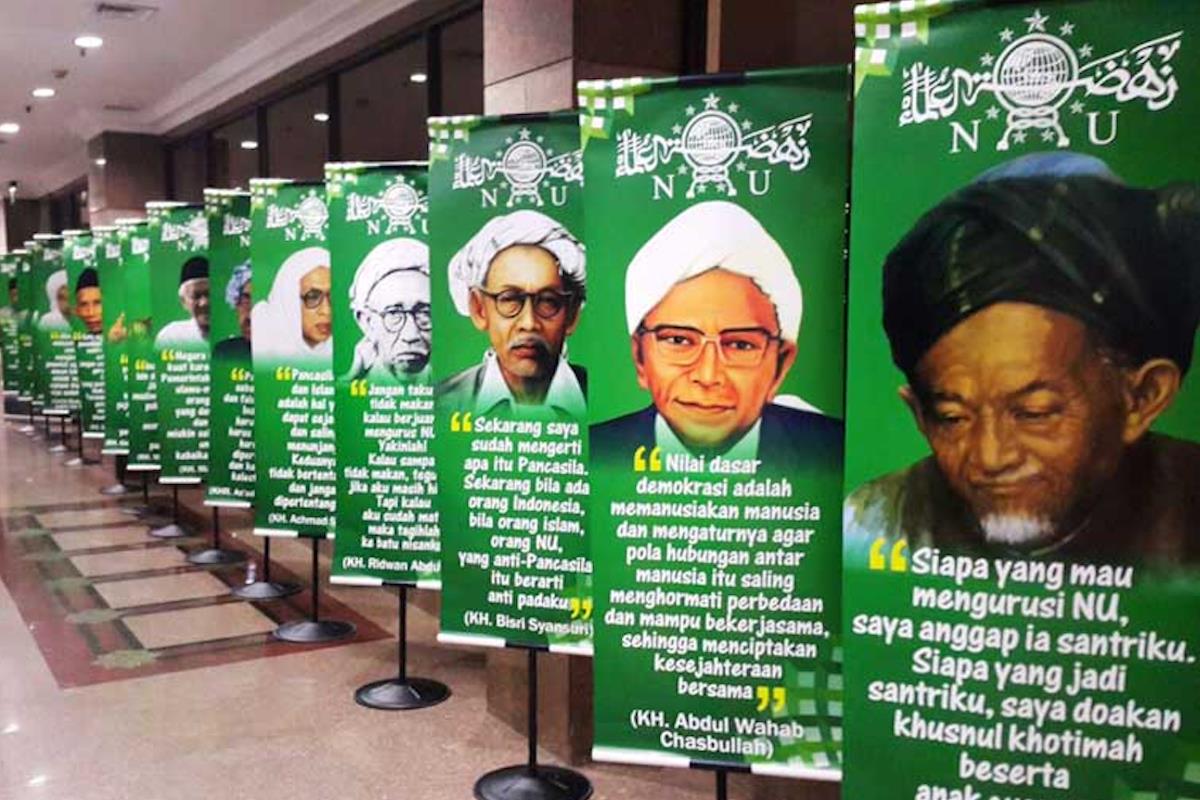
Is Indonesia's Largest Muslim Group Getting Too Close To Power?


KH Abdul Hakim Mahfudz, affectionately known as Gus Kikin, was appointed Executive Council (PBNU) chairman for the 2026–2031 period, with KH Miftachul Akhyar re-entrusted as Rais Aam (Supreme Leader).
Gus Kikin secured the highest vote count in the candidate screening phase with 472 votes, well clear of his closest rival at 262. The final appointment was confirmed via the Ahlul Halli wal Aqdi (AHWA) elder council mechanism.
On the surface, everything unfolded almost seamlessly. The kiais gathered, deliberated, and concluded the congress with a unified message. Yet in quieter corridors, political rumors began to circulate - chief among them the whisper of a“Palace Ticket”: allegations that the Gus Kikin–Miftachul Akhyar pairing represented the government's preferred configuration.
Both NU figures and government representatives have denied the claim, leaving it unsubstantiated. But political rumors rarely matter solely for their factual accuracy. They matter because they signal underlying anxieties: Is Indonesia's largest civil society organization edging too close to the levers of power?
NU is no ordinary mass Muslim organization. It spans a vast network of Islamic boarding schools (pesantren), Islamic scholars (kiai), educational institutions, youth and women's wings, and deep grassroots reach. Its influence derives not merely from sheer numbers, but from a century's worth of built-in social capital and moral authority.
Consequently, NU's relationship with the state is more than an internal affair; it is central to how Indonesian democracy maintains a healthy boundary between the state and civil society.
A functioning democracy requires more than elections, parliaments and political parties: it demands institutions relatively autonomous from the state to aggregate interests, build solidarity and keep power in check.
Independence does not imply reflexive opposition. Civil society organizations frequently collaborate with the state to address public issues. The danger arises when collaboration turns into dependence, and proximity dilutes the capacity for critical dissent.
Latest stories Not all foreign influence in the Philippines is malign Prabowo's personal diplomacy is costing Indonesia Not stopping 9/11 was catastrophic but bigger mistakes came laterThe Jombang Congress must be viewed through this lens. Of the 552 voting participants, 401 approved adopting the AHWA mechanism for selecting the chairman, while 150 voted to retain direct voting.
Because the shift itself was decided democratically, calling AHWA a hijacking of democracy misses the mark. Herein lies the paradox: an organization can use democratic procedures to select a mechanism that concentrates greater decision-making authority within its clerical elite.
AHWA is rooted in Islamic tradition and prioritizes consensus among senior scholars. But political realities dictate that it shifts the locus of legitimacy from direct congress voting to nine select council members. Naturally, the greater the authority vested in an elite group, the higher the demand for institutional accountability.
History offers a compelling lesson here, nowhere clearer than in the legacy of KH Abdurrahman Wahid, or Gus Dur. During the 29th NU Congress in Cipasung in 1994, when Gus Dur sought re-election as PBNU Chairman, tensions between NU and the Suharto regime reached a boiling point.
The state deployed its formidable political, bureaucratic and security machinery to back challenger Abu Hasan under an“Anything But Gus Dur” campaign. Gus Dur won nonetheless, albeit by a narrow margin.
Suharto held far more concentrated power than any leader in the post-reform era. Yet Gus Dur refused to subjugate NU to secure a comfortable relationship with the regime, choosing instead to maintain a critical distance.
Maintaining independence, crucially, did not mean personal hostility. In early 1999, while still PBNU Chairman, Gus Dur visited Suharto's Cendana residence to discuss the Ambon sectarian conflict, urging the former president to use his lingering influence to help de-escalate tensions.
Even after assuming the presidency, Gus Dur visited Suharto again on March 8, 2000, framing the meeting not as a political showdown but as a young man visiting an elder.
Gus Dur drew a clear line between criticizing power and harboring personal hatred toward those who hold it. He could oppose Suharto politically while keeping doors open for dialogue, preserving NU's independence without converting political differences into personal animosity. That represents the most mature form of independence: the ability to say“no” to power without losing the capacity for human respect.
This legacy is particularly vital for NU today. Gus Kikin carries a heavy mandate. He does not need to prove his autonomy by reflexively opposing every government policy; rather, he must demonstrate that institutional proximity to the state does not erode PBNU's willingness to offer constructive critique.
The true test will emerge through concrete issues: agrarian conflicts, natural resource management, economic policy, environmental protection, education, poverty and civil liberties. When the government is right, NU should offer support; when the state strays, NU must retain the courage to say no.
The gauge of NU's independence is not the frequency of its criticism, but whether it retains the capacity to criticize when necessary. This challenge is heightened further by Gus Kikin's background in the energy business, including his experience in upstream oil and gas operations.
Business experience is no proof of a conflict of interest. But leading a massive religious organization while holding a background in strategic economic sectors demands heightened standards of transparency.
When NU's immense social and symbolic capital intersects with political access and economic interests, the boundaries between moral authority, organizational priorities and personal stakes must be guarded meticulously. The greatest threat to civil society is not state oppression alone, but state co-optation that makes organizations feel too comfortable near the centers of power.
Sign up for one of our free newsletters-
The Daily Report
Start your day right with Asia Times' top stories
AT Weekly Report
A weekly roundup of Asia Times' most-read stories
The organization may remain vast, its follower base intact, its pesantren standing, its leaders respected - yet its critical distance quietly evaporates. In such cases, co-optation needs no formal announcement; it is revealed simply by an inability to say“no.”
The Jombang Congress offers no definitive proof that NU has lost its independence, nor does it render concerns about state proximity unfounded.
The coming five-year term will serve as the true test. If NU preserves its autonomy, maintains transparency, fosters internal debate and champions public interest when state policy missteps, rumors of co-optation will fade.
Conversely, if PBNU finds it increasingly difficult to step back from power when public and state interests collide, the issue will cease to be a rumor and become a symptom of eroding civil independence.
The essential question post-Congress is not whether Gus Kikin represents a“Palace Ticket” - there is no evidence for that claim. The question is whether the new leadership can prove that being close to power does not mean being subservient to it.
Gus Dur showed that an NU leader can challenge rulers firmly while remaining open to dialogue. NU does not need leadership that treats the government as a perpetual adversary; it needs leadership that retains the courage to speak truth to power when the state overreaches.
NU's greatest strength has never rested on its proximity to the Palace, but on its capacity to step back when distance is required. So long as that capacity remains alive, NU will endure as a vital civil society pillar - rather than just another major institution standing in the shadow of power.
Jannus TH Siahaan is an Indonesian socio-political analyst. He holds a doctoral degree from Padjadjaran University, Bandung, Indonesia.
Sign up here to comment on Asia Times stories OrThank you for registering!
-
Share on X (Opens in new window)
Share on LinkedIn (Opens in new window)
LinkedI
Share on Facebook (Opens in new window)
Faceboo
Share on WhatsApp (Opens in new window)
WhatsAp
Share on Reddit (Opens in new window)
Reddi
Email a link to a friend (Opens in new window)
Emai
Print (Opens in new window)
Prin

Legal Disclaimer:
MENAFN provides the
information “as is” without warranty of any kind. We do not accept any
responsibility or liability for the accuracy, content, images, videos,
licenses, completeness, legality, or reliability of the information
contained in this article. If you have any complaints or copyright issues
related to this article, kindly contact the provider above.
Comments
No comment