

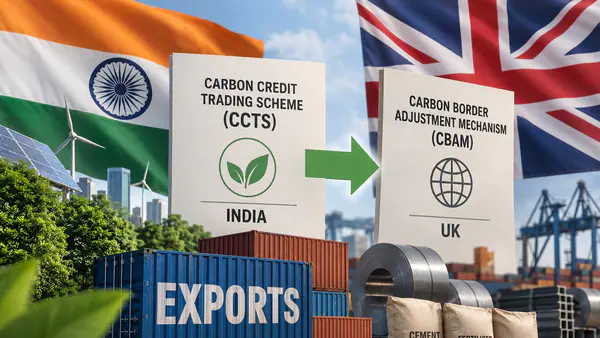
UK Recognises India's Carbon Credit Scheme Under CBAM, Easing Tax Burden For Exporters


The recognition was communicated by the UK's HM Treasury to the Bureau of Energy Efficiency (BEE), Ministry of Power. The CCTS has been included in the UK's published indicative list of overseas carbon pricing schemes that meet the qualifying criteria under the Carbon Border Adjustment Mechanism (Calculation of CBAM Rate and Determination of Carbon Price Relief) Regulations 2026, the official said.
Also Read | Delhi-NCR braces for 'heavy' rain as IMD issues alert for another spellThe development comes after the commerce ministry had been pursuing the issue with the UK government for an extended period.
What the recognition means for Indian exportersUnder the recognition, UK importers bringing eligible Indian goods covered by CBAM into the country can seek carbon price relief for the effective carbon price already borne by those goods under India's CCTS.
The relief, however, will not be automatic. UK importers will have to meet the evidence and verification requirements laid down under UK law.
"This will reduce the effective CBAM liability on Indian goods, directly benefiting Indian exporters to the UK," the official said.
The quantum of relief will depend on the effective carbon price applicable to the goods. A liable person under the UK CBAM will still have to comply with the prescribed evidence and verification requirements.
Also Read | Satya Niketan collapse: CJP lists 7 demands - What are they?The recognition is significant because it could help prevent carbon costs from being imposed twice on the same goods-once in India and again when they enter the UK.
How India's Carbon Credit Trading Scheme worksIndia notified the Carbon Credit Trading Scheme with the aim of reducing, removing or avoiding greenhouse gas emissions from the economy by putting a price on such emissions through the trading of Carbon Credit Certificates.
The financial support required to implement the CCTS will be met by the Bureau of Energy Efficiency through fees and charges collected from entities covered by the scheme, along with its own resources.
The UK government has now included India's scheme in its indicative list of carbon pricing mechanisms that qualify for relief under Britain's CBAM, the official said.
Recognition follows India-UK technical engagementThe decision follows sustained technical-level discussions between India and the UK on the design and implementation of the CCTS.
It also reflects the UK's stated CBAM principle of preventing double taxation of goods that have already been subject to an eligible carbon price in their country of origin.
Also Read | Delhi-NCR braces for 'heavy' rain as IMD issues alert for another spellThe two countries will continue working together on carbon market design and implementation through the UK-India Energy Memorandum of Understanding and the Partnership for Market Implementation.
India and the UK have also committed to continued discussions on carbon pricing, including how the CCTS will interact with UK CBAM rules.
Why UK CBAM matters for IndiaThe UK government decided in December 2023 to introduce its Carbon Border Adjustment Mechanism, or carbon tax, from 2027.
The mechanism will require importers of certain carbon-intensive products, including iron and steel, to pay a charge in the UK based on the emissions associated with those goods.
Experts have said India's exports of products such as iron and steel, aluminium, fertiliser, hydrogen, ceramics, glass and cement could be affected by the UK's carbon tax regime once it comes into effect.
India's CCTS now provides a domestic framework under which firms can incur a carbon-related cost. The UK's recognition of the scheme could allow that cost to be taken into account while determining the UK CBAM liability.
In practical terms, where the carbon price paid in India qualifies under UK rules, the corresponding amount can potentially be deducted as relief while calculating the UK CBAM charge.
India-UK tradeIndia and the UK implemented a comprehensive economic and trade partnership on July 15.
Merchandise trade between the two countries stood at USD 25.1 billion in 2025-26, while bilateral services trade reached USD 35.4 billion in 2024.

Legal Disclaimer:
MENAFN provides the
information “as is” without warranty of any kind. We do not accept any
responsibility or liability for the accuracy, content, images, videos,
licenses, completeness, legality, or reliability of the information
contained in this article. If you have any complaints or copyright issues
related to this article, kindly contact the provider above.
Comments
No comment