

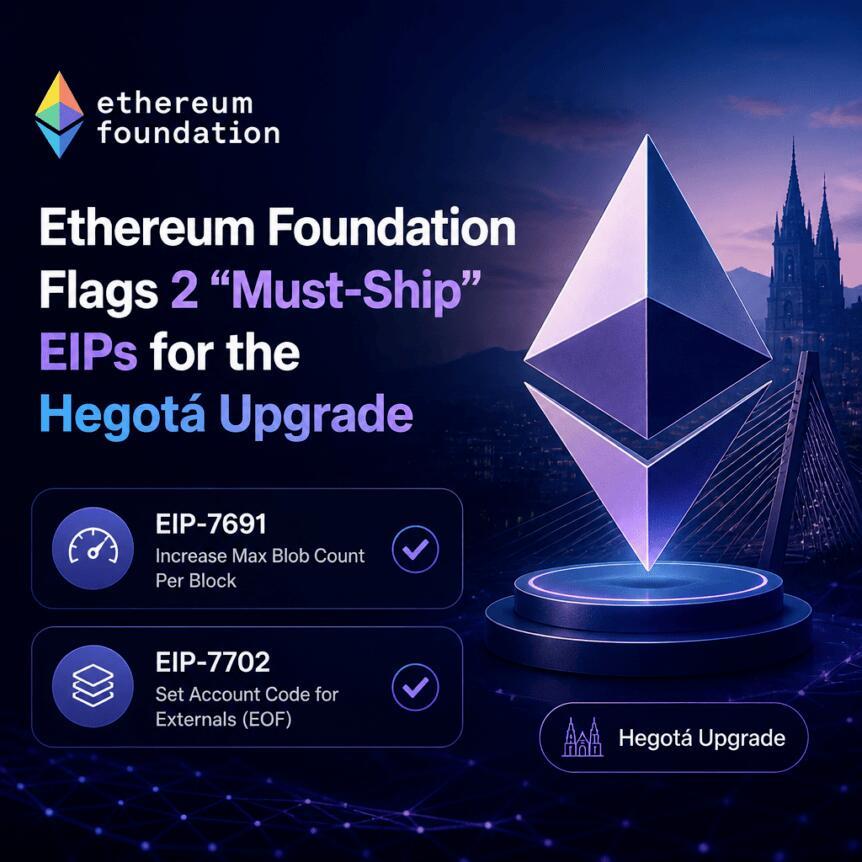
Ethereum Foundation Flags 2“Must-Ship” Eips For The Hegotá Upgrade


In a post released on September 7, 2026, the Foundation said it evaluated 62 proposed EIPs using input from roughly 60 researchers and engineers within its Protocol cluster. The update also marks a shift in how the Foundation presents priorities: rather than reflecting separate views from individual teams, it presents a single consolidated assessment for Hegotá's package of proposed changes.
Key takeaways- The Foundation's Hegotá“must ship” proposals are EIP-7805 (FOCIL) and EIP-8141 (Frame Transactions), positioned as the upgrade's consensus and execution-layer headliners. FOCIL is intended to reduce dependence on centralized block builders by giving users a way to have eligible transactions included, strengthening Ethereum's censorship resistance. Frame Transactions aims to introduce native account abstraction and lay groundwork for post-quantum authentication. While the Foundation published a priority ranking, the final upgrade scope is still under negotiation for the proposals outside the top tier. Two proposals remain unranked pending mainnet data from Glamsterdam, which the Foundation says could enable client teams to start Hegotá implementation in late 2026.
The Foundation's ranking designates EIP-7805,“FOCIL,” and EIP-8141,“Frame Transactions,” as the proposals that effectively define Hegotá. The“must ship” label comes with a practical implication: if either proposal faces risk, the Foundation says the Hegotá schedule should be adjusted before the proposal is dropped, reflecting how central these changes are to the upgrade's goals.
FOCIL (EIP-7805) focuses on how transactions can be included without relying on centralized block builders. The Foundation's framing centers on censorship resistance-specifically, giving users a path to ensure eligible transactions are included even when intermediaries attempt to filter or exclude them.
Frame Transactions (EIP-8141) targets a different layer of the stack. The proposal is described as introducing native account abstraction and creating a path toward post-quantum authentication. The Foundation also suggests that, together with two companion proposals, the changes could provide protocol-level building blocks that may support privacy-oriented applications.
How the rest of the EIPs were categorizedBeyond the two headliners, the Foundation distributed the remaining proposals into a structured pipeline of likelihood and readiness. It placed 15 proposals into an“A-tier,” describing them as expected to ship unless development or testing constraints force cuts.
Another eight proposals remain candidates for inclusion, while seven were placed below the line but not entirely dismissed. The rest-28 proposals-were declined. The Foundation's ranking approach gives teams a clearer sense of what's likely to make it into the upgrade versus what may be deferred or removed.
Still, the Foundation's process makes clear that Hegotá is not yet a finished shopping list. For readers and builders, this means the upgrade timeline and exact scope should be treated as conditional on engineering realities: testing results, implementation feasibility, and the outcome of earlier upgrade experiments.
Glamsterdam results expected to influence what gets finalizedTwo proposals were left unranked because they depend on mainnet data from Glamsterdam, the Ethereum upgrade that precedes Hegotá. Glamsterdam's focus is on improving scalability and strengthening Ethereum's base layer, according to earlier reporting from Cointelegraph, and the Foundation indicates that the results from that deployment will inform how Hegotá candidates should be assessed.
The Foundation also said client teams could begin implementing Hegotá in late 2026 following Glamsterdam. That timing matters because it links today's EIP prioritization to the practical feedback loop of mainnet experimentation: if Glamsterdam provides useful performance and reliability signals, teams can more confidently proceed with implementation work for Hegotá.
Where Ethereum's recent upgrade history sets expectationsThe Foundation's Hegotá planning arrives after Ethereum's prior major upgrade, Fusaka, which went live on Dec. 3, 2025. Fusaka delivered a set of scaling and usability improvements, and its headline feature, PeerDAS, changed how nodes handle rollup data. According to earlier coverage, the change reduced the amount nodes must download and upload while increasing data capacity for Ethereum layer-2 networks.
That background underscores why Hegotá's scoped approach is receiving attention. After a large-scale change like PeerDAS altered base-layer data handling, investors and developers tend to watch closely how subsequent upgrades balance infrastructure improvements with user-facing or ecosystem-level goals-such as the proposed enhancements to transaction inclusion and account capabilities.
In that context, FOCIL and Frame Transactions represent a noticeable emphasis shift: rather than only focusing on throughput and node efficiency, the two“must ship” proposals are oriented toward transaction inclusion mechanics and account authentication. If the Foundation's ranking holds, Hegotá's most visible effects could be felt in how transactions propagate and how account logic can be structured-especially as Ethereum continues to evolve toward broader programmability of accounts and stronger cryptographic assumptions.
Readers should watch the next round of testing outputs from Glamsterdam and the follow-on implementation decisions that the Foundation says could begin in late 2026. The key uncertainty remains which of the A-tier and candidate proposals ultimately survive constraints as teams translate the ranked EIPs into code, alongside the central question of whether FOCIL and Frame Transactions remain fully on track for Hegotá's final scope.
Risk & affiliate notice: Crypto assets are volatile and capital is at risk. This article may contain affiliate links.
Legal Disclaimer:
MENAFN provides the
information “as is” without warranty of any kind. We do not accept any
responsibility or liability for the accuracy, content, images, videos,
licenses, completeness, legality, or reliability of the information
contained in this article. If you have any complaints or copyright issues
related to this article, kindly contact the provider above.
Comments
No comment