


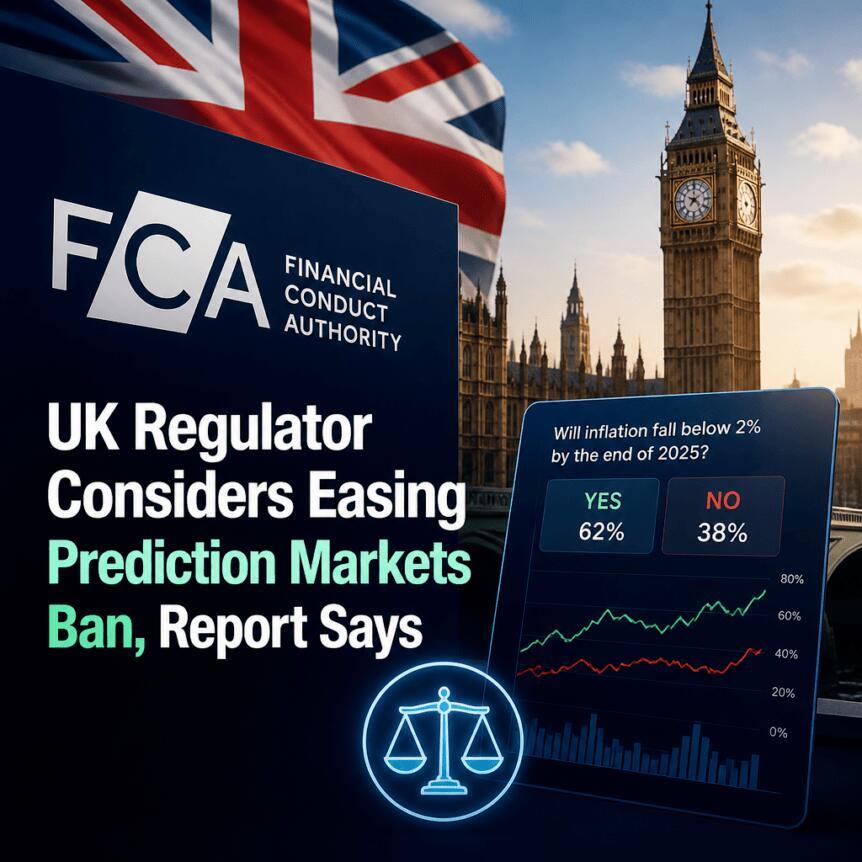
UK Regulator Considers Easing Prediction Markets Ban, Report Says


The FCA imposed the restriction in April 2019, arguing that many prediction markets resemble binary options-products it had prohibited from being sold to retail consumers. Now, if the FCA were to move away from that position, platforms that have been operating primarily outside the UK could see their compliance models and market access in the country change significantly.
Key takeaways- The FCA's retail ban on prediction market-style binary options dates back to April 2019. According to The Times, the FCA has contacted prediction market companies to discuss potentially lifting the restriction for UK-based retail investors. UK retail users have reportedly used VPNs to access platforms such as Kalshi and Polymarket, both operating in the US. Any UK regulatory shift could expose platforms to a similar regulatory patchwork risk that exists in the US.
The original FCA prohibition was tied to how prediction markets can be structured-often as event-based contracts that pay out based on whether a specific outcome occurs. In its April 2019 action, the FCA said companies were“prohibited from selling, marketing or distributing binary options to retail consumers,” a category that includes binary options offered to individuals outside a more restricted framework.
At the time, the FCA's executive director of strategy and competition, Christopher Woolard, described binary options as“gambling products dressed up as financial instruments.” That framing helped justify a permanent retail ban rather than a limited restriction or additional disclosure requirements.
Contact signals potential regulatory shiftIn Friday's Times report, the FCA is said to be weighing lifting the ban for UK retail investors and has reached out to prediction market companies as part of those discussions.
While the details of the proposal are not specified in the report, the fact that the regulator is engaging directly suggests the FCA may be re-evaluating whether prediction markets should remain grouped with binary options as retail products. For investors and traders, the practical implication would be the possibility of regulated or at least more clearly permitted access pathways in the UK, rather than relying on offshore services.
For platforms, regulatory engagement can be a turning point: it signals that market access could become less dependent on workarounds and more dependent on compliance with UK rules-if the FCA decides the product structure can be reconciled with its retail-protection framework.
UK users reportedly bypass restrictionsThe Times report also highlights how some UK retail participants may have already been finding ways around the FCA's limitations. It says many have used virtual private networks (VPNs) to access prediction market trading-executing trades on Kalshi and Polymarket, both of which operate in the United States.
That matters because a ban that prompts consistent circumvention can become harder for regulators to enforce in the real world. It can also create a compliance mismatch: retail users may be actively participating in markets that the UK regulator views as unsuitable, even if those users are technically accessing platforms from outside the UK's jurisdictional boundaries.
The report notes that market analysts have projected strong growth for the broader prediction market industry. Bernstein Research, as reported by CNBC, previously speculated that total prediction market trading volume could reach around $240 billion in 2026 and about $1 trillion by 2030.
If the FCA were to loosen the UK retail prohibition, the UK could become part of that growth story-though whether it does so through outright permission or a more restrictive licensing model would likely determine how quickly retail participation expands.
US legal pressure could foreshadow the next regulatory testAny UK relaxation would not necessarily eliminate legal uncertainty for prediction market operators. The main reason is that the industry's structure-event contracts that resemble wagers-has triggered a regulatory and legal debate in the US between state-level gaming authorities and federal oversight.
The article notes that US challenges are already unfolding through lawsuits. Last week, New Jersey officials petitioned the Supreme Court to hear their case against Kalshi, potentially leading to clarification over how state and federal authority apply to prediction markets.
That dynamic illustrates what could happen if the FCA revises its approach: even if the UK decides to allow retail participation, the global industry still has to contend with unresolved questions about classification-whether these contracts are best treated as financial instruments, regulated derivatives, or gambling products.
As a result, UK policy changes may shift where the compliance burden falls, but not necessarily remove it. Operators could still need to design products and distribution methods that satisfy multiple regulators across jurisdictions.
What to watch nextUK readers should watch for any formal FCA consultation, guidance, or policy statements that specify what changes-if any-would be required for platforms to offer prediction market products to retail investors. Until then, the key open question remains whether the FCA will distinguish prediction markets from binary options in practice, or keep the same underlying treatment while adjusting enforcement or access channels.
Risk & affiliate notice: Crypto assets are volatile and capital is at risk. This article may contain affiliate links.
Legal Disclaimer:
MENAFN provides the
information “as is” without warranty of any kind. We do not accept
any responsibility or liability for the accuracy, content, images,
videos, licenses, completeness, legality, or reliability of the information
contained in this article. If you have any complaints or copyright
issues related to this article, kindly contact the provider above.


Comments
No comment