

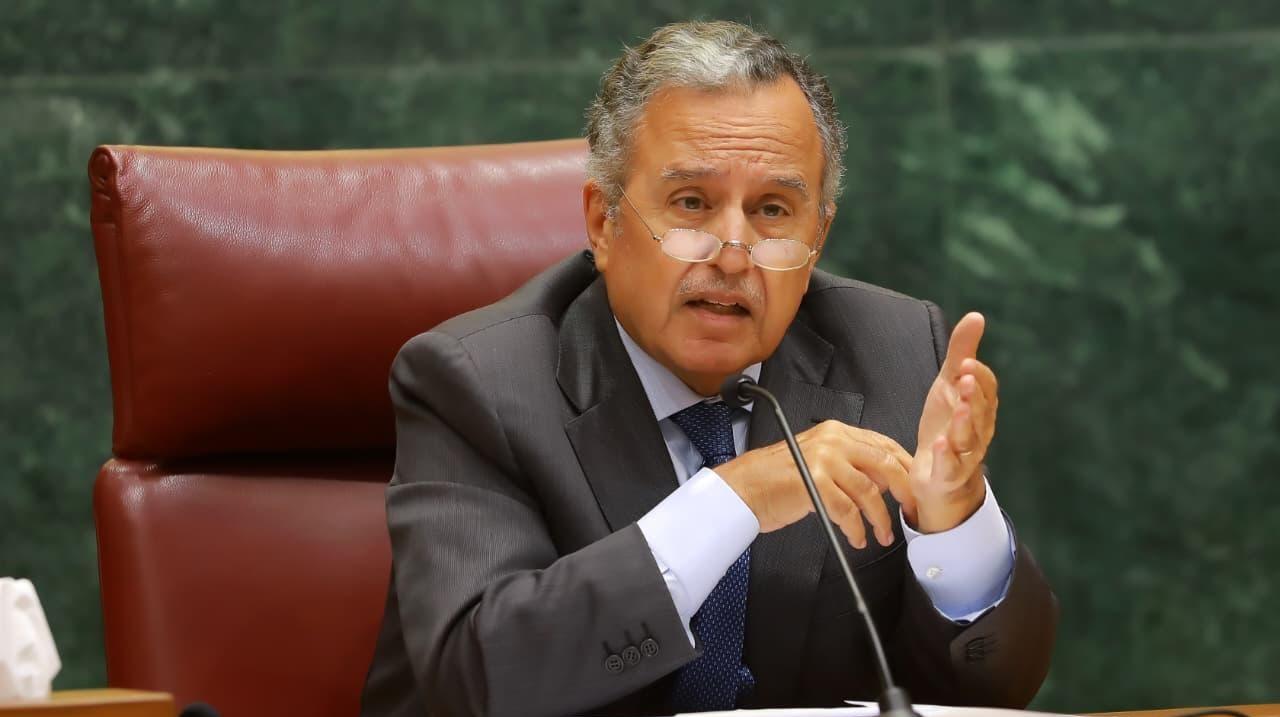
Arab League Chief Calls For Renewed Arab Agenda To Address Regional Challenges


Cairo, Sept. 7 (Petra) -- Arab League Secretary-General Nabil Fahmy said on Monday that the Arab region and the Middle East were going through a critical phase marked by growing violations of international law, attacks on civilians, expanding conflicts and arms races, declining confidence in multilateral institutions, and rising isolationist, extremist, and hateful sentiments.
Addressing the 166th session of the Council of the League of Arab States at the level of foreign ministers, Fahmy said the world was witnessing increased reliance on force to impose faits accomplis, seize the territories of others, interfere in internal affairs, use militias to attack state institutions, encourage separatist tendencies, and threaten freedom of navigation.
He said the defining feature of the international and regional landscape had become the prevalence of the law of force over the force of law.
The Arab world is facing a process of regional reshaping as well as existential challenges and risks that require the highest levels of vigilance, solidarity, and responsibility, Fahmy said.
He stressed that achieving Arab sovereign decision-making does not mean isolating the Arab world from global affairs or relying excessively on others, but rather strengthening Arab integration and cooperation while enhancing national capabilities and maintaining international engagement.
What unites Arab countries strategically outweighs what may divide them tactically, he said, noting that threats facing one Arab state have repercussions for others, while opportunities available to any one country can, through cooperation, become broader gains for all.
Fahmy outlined the main features of an Arab project based on three key pillars: addressing challenges and building and strengthening comprehensive national security capabilities at the national, regional, and international levels; sustaining human and institutional development in ways that strengthen Arab arrangements and enable Arab countries to participate in shaping regional and international arrangements; and achieving creative and sustainable development that respects the rights of citizens and societies and strengthens relations among Arab states.
He said he planned during the coming period to engage with Arab leaders and foreign ministers of member states to develop these elements, paving the way for the adoption of a "renewed Arab agenda" under the theme of "addressing challenges, development, and growth," backed by proactive and effective action rather than rhetoric.
Fahmy stressed that the Arab League represents the "home of all Arabs without exception" and that efforts to develop it and adapt its working mechanisms should focus on strengthening the national and regional capabilities of member states, anticipating risks before they materialize, managing crises when they occur, and supporting Arab decision-making with information, expertise, analysis, and forward-looking assessments.
He announced plans to establish a center of excellence as an Arab platform for expertise and strategic analysis of emerging threats, drawing on the capabilities of the General Secretariat and strengthening them when necessary, while prioritizing preventive diplomacy, early warning, crisis management, and support for settlement efforts.
He also said he intended to draw on the expertise of prominent Arab figures through an advisory council in selected fields, as well as appoint special envoys for certain priority issues, depending on the nature and requirements of each mission.
On the Palestinian issue, Fahmy said Palestine would remain the "foremost regional issue" and a "test of the Arab world's credibility" before its peoples and the international community.
He pointed to the continued loss of civilian lives in the Gaza Strip, saying continued intransigence and delays in implementing the commitments arising from the Sharm El-Sheikh Peace Summit agreement were undermining the transition from a ceasefire to genuine peace.
He also condemned continued violence in the West Bank and Jerusalem, the expansion of settlements, land confiscations, home demolitions, and repeated incursions into Al-Aqsa Mosque, warning that such practices were pushing the conflict towards more dangerous levels.
Fahmy also pointed to the extension of Israeli attacks to southern Lebanon and Syrian territory, as well as the Red Sea and Somalia, describing this as a violation of sovereignty and an undermining of efforts to de-escalate tensions.
Arab states seek peace and stability but will continue to defend Palestinian rights and uphold a just settlement that ends the occupation and enables the Palestinian people to establish their independent state, while preserving the sovereignty of Arab states, he said.
Fahmy announced plans to strengthen the monitoring and documentation of Israeli violations of international law and international legitimacy resolutions by launching a unified coordination mechanism linking Arab monitoring bodies with relevant General Secretariat departments.
The mechanism would aim to standardize monitoring and documentation methodologies and produce periodic outputs to support political, media, and legal action, he said.
Regarding Iran, Fahmy said targeting the territory and facilities of Arab countries was "unacceptable to the Arab League and has no justification," stressing that Arab states were not parties to the war and had not chosen to become a theater for it.
Arab countries are open to balanced relations with their neighbors based on respect for sovereignty and territorial integrity and an end to interference in internal affairs, he said. This openness, however, is accompanied by a clear position that "the security of the Arab Gulf states is part of Arab national security" and that any threat to it concerns the Arab League and its member states.
Fahmy warned of the repercussions of disrupting maritime routes, particularly the Strait of Hormuz and Bab el-Mandeb, stressing that any vulnerability or disruption affecting the two waterways would have direct consequences for Arab economies and security, as well as repercussions for the global economy.
Arab states will not accept the use of maritime routes as a bargaining tool in the calculations of others, he said, stressing that the rights of littoral states and freedom of navigation are governed by international law.
On internal Arab affairs, Fahmy said conflicts were draining the capabilities of a number of Arab states and threatening their territorial integrity and the cohesion of their national institutions, while forcing millions of people to flee their homes and seek refuge.
He renewed the Arab League's support for Sudan amid the continuing war and the widespread displacement and difficult humanitarian conditions it has caused, reaffirming support for Lebanon in preserving its unity and sovereignty and for Syria in restoring full control over its territory and supporting its recovery efforts.
The Arab League remains committed to Somalia's unity and rejects any arrangements that undermine its sovereignty, he said, stressing the importance of an active Arab role in Libya and Yemen amid rapid developments in both countries.
The Arab position is based on finding political solutions, ending fighting, expanding humanitarian assistance and ensuring its delivery, and preserving the unity and territorial integrity of states, Fahmy said.
He stressed that economic integration and sustainable development were key components of Arab countries' ability to protect their security and shape their future, particularly as young people make up a large proportion of Arab societies and seek better opportunities in education and employment, more competitive economies, and a future based on technology and knowledge.
Strengthening women's participation in leadership and the workforce is also an integral part of maximizing the capabilities of Arab societies, he said.
Fahmy said the Arab League was working to focus its economic and development activities on specific, actionable priorities, foremost among them trade and investment, food and water security, digital transformation and artificial intelligence, technology localization, recovery and reconstruction, joint Arab projects, education, and health.
He stressed the importance of following up on the implementation of decisions taken by member states, highlighting achievements and addressing obstacles that prevent their implementation.
The value of meetings and decisions, he said, lies in their ability to translate into tangible results felt by Arab citizens.
On efforts to improve the League's performance, Fahmy said he had begun from his first day in office to directly follow up on the work of the General Secretariat's sectors.
Some sectors are carrying out serious professional work and important initiatives and services that can be built upon, he said.
The follow-up process had also identified areas requiring development, overlaps in responsibilities that could be addressed, and resources that could be used more efficiently, including the League's external missions, in line with needs and priorities, Fahmy added.
Some areas would require restructuring, the creation of a limited number of positions, and the recruitment of additional expertise. These needs would be presented to member states in a specific and justified manner following consultations, he said.
He also announced plans to establish a performance incentive and evaluation system based on clear and fair criteria, providing a work environment in which every employee understands their responsibilities, rights, and duties.
Fahmy concluded by stressing that the challenges facing the Arab world were substantial, but the Arab world's capabilities were greater, particularly its young population, resources, strategic location, accumulated political and diplomatic expertise, and political weight.
He affirmed his determination during his term to ensure that the Arab League remains permanently present and effective in serving joint Arab action, addressing challenges, advancing development efforts, and achieving sustainable growth in a manner that contributes to building a better future for coming generations.
//Petra// AF

Legal Disclaimer:
MENAFN provides the
information “as is” without warranty of any kind. We do not accept any
responsibility or liability for the accuracy, content, images, videos,
licenses, completeness, legality, or reliability of the information
contained in this article. If you have any complaints or copyright issues
related to this article, kindly contact the provider above.
Comments
No comment