

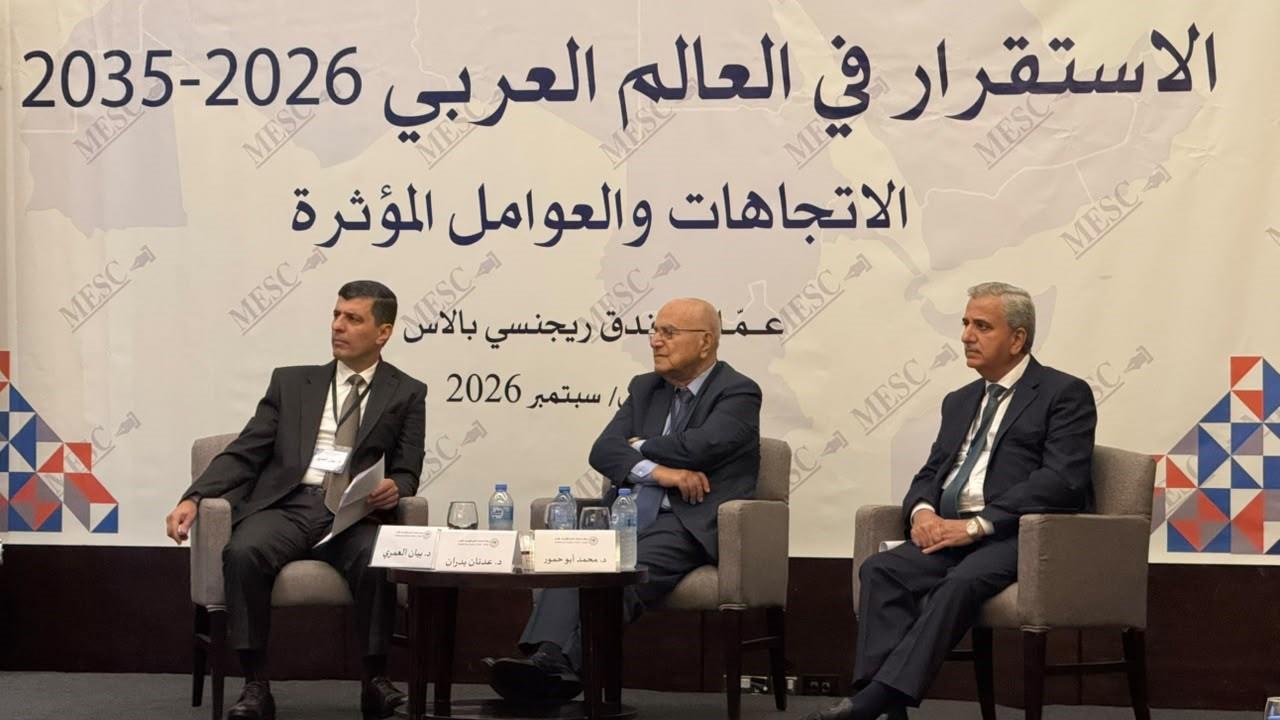
Arab Stability Conference Opens In Amman To Examine Challenges, Prospects Through 2035


Amman, Sept. 7 (Petra) -- A scientific conference entitled "Stability in the Arab World 2026-2035: Trends and Influencing Factors" opened in Amman on Monday, bringing together former prime ministers and ministers, diplomats, academics, and researchers from several Arab countries.
Organized by the Middle East Studies Center-Jordan, the conference aims to examine the state of stability across the Arab world according to scientific criteria and develop a realistic map by monitoring and analyzing its indicators.
It also seeks to study the key factors underpinning the preservation and achievement of political, economic, social, security, and geographical stability through cooperation among governments, peoples and other influential actors.
The conference will further examine major internal challenges, external threats, opportunities, and drivers affecting stability, and ways to protect it from future risks, to develop an Arab vision and strategy for achieving lasting and cohesive stability across Arab countries.
Former prime minister Adnan Badran said the Arab world was undergoing a rapid period of political, economic, social, technological, and environmental transformation.
He said the concept of strategic security and stability was no longer limited to protecting borders and confronting threats but had come to encompass the ability of states and societies to withstand challenges, adapt, and protect national and pan-Arab interests.
Badran said Arab stability over the coming decade should be built on an integrated system that includes political and institutional stability based on the rule of law and accountability, economic security capable of creating jobs and transitioning towards a knowledge economy, as well as science, technology, and artificial intelligence.
Other key elements include social cohesion, water, food, environmental, climate, and energy security, as well as regional and strategic security, he said.
He called for the development of a new Arab concept of comprehensive security combining state strength, social cohesion, resource security, and independence in decision-making.
"The real challenge through 2035 is not only to confront threats but also to build an Arab capacity to anticipate change and turn it into opportunity," Badran said, calling for a shift from a culture of reaction to one of anticipation and from individual Arab action to greater integration.
Former Arab League secretary-general Amr Moussa said the future of the Middle East required a clear Arab vision of the nature of the emerging regional order and called for addressing the region's issues objectively and candidly.
The region was undergoing rapid and comprehensive change, requiring a redefinition of the concepts of security, peace, stability, and regional relations, he said, while rejecting the continuation of attacks on Palestinian territories and Arab countries.
Syrian political sociologist and thinker Burhan Ghalioun said rebuilding joint Arab action had become "a matter of destiny" and an essential condition for achieving political, economic, and security stability in the region.
He called for drawing on the European experience to build a network of Arab economic, defense, and technological interests covering energy, defense industries, scientific research, technology, and trade.
Confronting regional challenges and achieving stability required institutional Arab cooperation that preserved the sovereignty and identities of individual states without proposing a project to abolish borders or states, Ghalioun said.
Mohammad Abu Hammour, chairman of the board of trustees of the Middle East Studies Center, said Arab stability was a central issue for strengthening sovereignty and leadership and protecting national and pan-Arab interests.
Achieving stability required a comprehensive vision, national and Arab integration, and dialogue among governments, elites, and political, social, and intellectual currents, he said.
National unity and strong internal fronts were the foundation of a strong Arab world capable of confronting external pressures, Abu Hammour added.
He said economic and political reform could create opportunities for young people and help curb unrest, stressing the role of universities and research centers in analyzing challenges and proposing policies that support stability and decision-making.
Center Director Bayan Al-Omari said the conference aimed to assess the reality of Arab stability and anticipate its future in order to build preparedness for the challenges ahead.
Stability was a comprehensive concept encompassing political, economic, social, security, cultural, and intellectual dimensions, he said, adding that the coming period required a practical Arab vision that strengthened sources of power, addressed challenges, and opened future prospects for Arab youth to play a leading role and enhance the Arab world's regional and international standing.
The two-day conference will feature six consecutive scientific sessions.
The first session will discuss the concept of stability, its areas, and its importance for comprehensive development, as well as scientific criteria for measuring it, with researchers from Iraq, Algeria, and Jordan.
The second session will examine existing threats and challenges to stability in the Arab world between 2015 and 2025, with participants from Jordan, Iraq, and Sudan, while the third will address opportunities, drivers, and dynamics affecting stability during the same period, with participants from Jordan, Tunisia, and Syria.
The fourth session, scheduled for Tuesday, will examine expected threats and challenges to stability in the Arab world over the coming decade, from 2026 to 2035, with participants from Jordan and Morocco.
The fifth session will explore expected opportunities, drivers, and dynamics for achieving stability during the same decade, with participants from Morocco, Palestine, and Yemen.
The conference will conclude with a sixth session presenting an Arab vision for preserving stability and confronting future threats and challenges over the next decade, with participants from Algeria, Jordan, Libya, and Iraq, followed by closing remarks and recommendations.
//Petra// AF

Legal Disclaimer:
MENAFN provides the
information “as is” without warranty of any kind. We do not accept any
responsibility or liability for the accuracy, content, images, videos,
licenses, completeness, legality, or reliability of the information
contained in this article. If you have any complaints or copyright issues
related to this article, kindly contact the provider above.
Comments
No comment