

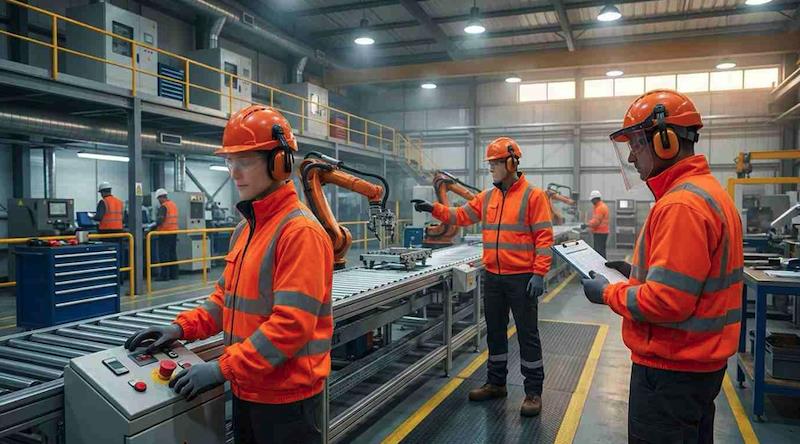
How Manufacturers Use AI Face Swap Tools To Anonymize Worker Training Videos


Higgsfield's AI Face Swap tool is becoming part of how safety and training teams protect individual worker identity while still getting full use out of genuinely valuable real footage.
Why Has Worker Privacy Become Such a Central Consideration in Safety Technology Adoption?This is a genuinely well-documented dynamic in current manufacturing safety analysis. Face blurring and anonymization features specifically allow deployment in unionized environments where surveillance technology has traditionally faced resistance, and current industry guidance emphasizes meaningful worker involvement in safety programs as a real prerequisite for adoption, not an afterthought or a box to check after the fact.
This means privacy protection isn't a limitation on safety technology, it's genuinely one of the features that makes broader, more effective use of that technology possible in the first place.
This dynamic plays out clearly across real manufacturing environments. A safety or training initiative that respects worker identity from the outset tends to earn genuine buy-in from workers and their representatives far more readily than one that treats privacy as an afterthought, and that buy-in is often exactly what determines whether a genuinely valuable safety program actually gets adopted enthusiastically or meets quiet resistance that undermines its real effectiveness across the workforce over time.
Why Does Good Training Content Matter So Much in Manufacturing Specifically?The stakes here are genuinely significant. Workplace injuries and illnesses drain roughly $167 billion annually from U.S. employers, and a single serious manufacturing injury can cost between $40,000 and $200,000 once medical costs, workers' compensation, downtime, and retraining are all accounted for.
Well-made training content that genuinely helps workers recognize hazards and follow correct procedures has real, measurable value, which makes it worth using and sharing as widely and effectively as the underlying footage actually allows.
This financial context matters for how a safety team should genuinely think about a single, well-produced piece of training footage.
Filming a clear, effective demonstration of a correct procedure represents a real investment of time and coordination, pulling workers away from production, arranging the right conditions, getting the framing and instruction genuinely right.
Once that investment has been made and the resulting footage is genuinely good, extending its reach and lifespan as far as reasonably possible represents real, additional value extracted from work already done and already paid for.
What Kinds of Training and Safety Content Actually Benefit From This Approach?Cross-facility training videos are a genuine, common use case, where footage recorded at one location gets shared across a company's other sites without needing to seek individual re-consent from every worker in the original footage for each and every new use.
Public-facing safety demonstrations and industry conference content round out the list, letting a company showcase genuinely effective safety procedures more broadly while keeping individual worker identity protected throughout.
Onboarding and refresher training libraries benefit similarly, since content built to be reused over months or years benefits from not being tied to any single identifiable individual's continued consent going forward.
Each of these use cases shares a common thread worth naming directly here. In every case, the actual value being extended is the quality of the demonstration itself, a genuinely clear, well-executed example of a correct procedure, rather than anything specific to the individual who happened to be performing it on the day of filming.
Recognizing that distinction is exactly what makes broader reuse feel like a genuinely reasonable, low-friction extension of the footage's real purpose over time.
What Happens When Genuinely Valuable Training Footage Can't Be Reused More Broadly?This is a real, practical limitation many safety and training teams encounter. A genuinely well-filmed demonstration of a correct procedure, recorded once with real workers on an actual production line, often can't be reused across other facilities, shared publicly, or kept in a long-term training library without ongoing consent management for every individual shown.
That constraint means genuinely valuable, hard-to-recreate footage sometimes stays limited to a single, narrow use rather than benefiting the wider organization it could genuinely help.
This limitation tends to be most frustrating precisely when the original footage is genuinely excellent. A demonstration that captured a correct, clear execution of a complex or nuanced procedure on the first attempt, exactly the kind of footage that's genuinely difficult to recreate on demand, is often the same footage most constrained by its original, narrow context of use, leaving a company's most valuable training asset underutilized relative to its actual potential.
What Are the Traditional Options for Addressing This Limitation?Reshooting content with actors or willing on-camera volunteers is one option, and some companies do this specifically to create broadly shareable training material from the start.
Managing ongoing, renewed consent from every individual shown in existing footage is the more common alternative, functional but genuinely time-consuming to maintain as footage gets reused across new contexts over time.
Both approaches carry genuine, real value depending on a company's specific circumstances and needs. Reshooting with actors makes sense when a company knows from the outset that a piece of content will need broad, long-term distribution, allowing that broader use to be planned for from day one.
Managing consent for existing footage works reasonably well for a small, stable set of training materials, but the administrative overhead compounds quickly once a company has built up years of genuinely valuable footage worth extending into new uses.
Where Do These Traditional Options Fall Short for a Busy Safety Team?The constraint is cost and administrative overhead together. Reshooting content with actors loses the genuine authenticity of real workers performing real procedures, while managing ongoing consent for existing footage becomes a real administrative burden that grows every time a safety team wants to reuse valuable content in a new context.
This overhead tends to grow in a way that's easy to underestimate at the outset. A single piece of training footage reused across five facilities, a public conference presentation, and an annual refresher program each represents a separate context requiring its own consent consideration, multiplying what started as a one-time filming effort into an ongoing administrative responsibility that competes for a safety team's genuinely limited time alongside their actual safety work.
1.png" alt="" width="946" height="511" srcset="
Legal Disclaimer:
MENAFN provides the
information “as is” without warranty of any kind. We do not accept any
responsibility or liability for the accuracy, content, images, videos,
licenses, completeness, legality, or reliability of the information
contained in this article. If you have any complaints or copyright issues
related to this article, kindly contact the provider above.
Comments
No comment