

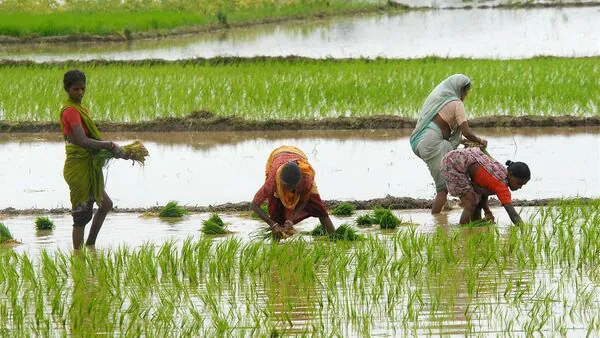
Kharif Sowing Gap Narrows To 1.6%, But Key Crops Lag


The headline number masks sharper declines in rice, maize, soybean and cotton, which together form the backbone of India's food and fibre supply. Rice acreage, at 42.18 million hectares, is down 3.7% from last year, raising concerns for government procurement and food-security programmes, including the Pradhan Mantri Garib Kalyan Anna Yojana, that feed 80 crore people.
Pulses have provided some relief, as acreage has risen 1.6% to 11.71 million hectares, led by gains in Uttar Pradesh, Jharkhand and Telangana. Coarse cereals and oilseeds have slipped marginally, while cotton and sugarcane are also trailing last year's levels.
Also Read | Mint explainer: how CCPA's consumer protection net has widenedThe uneven monsoon remains a risk. Rainfall is 13% below normal and patchy across regions, leaving crops at critical growth stages vulnerable. Analysts warn that while the overall acreage gap is small, the crop-specific shortfalls could weigh on foodgrain, edible oil and cotton supplies in the months ahead.
Karnataka, Telangana, Uttar Pradesh, Andhra Pradesh, Madhya Pradesh, Tamil Nadu, Jharkhand and Maharashtra led the decline in rice acreage. Assam and Odisha reported higher acreage, according to the ministry's statement.
“The 1.6% gap in overall kharif acreage by itself is not alarming, but the 3.7% decline in paddy acreage needs closer attention because of its implications for foodgrain availability and procurement. The increase in pulses acreage provides some comfort, but the final output will depend on rainfall during the remaining crop cycle,” said Binod Anand, agricultural economist and member of the Union government's high-powered committee on Minimum Support Price (MSP).
Uneven monsoon may hit yieldsIn pulses, the increase was led by Uttar Pradesh, Jharkhand, Telangana, Rajasthan and Madhya Pradesh, which more than offset declines in Maharashtra, Karnataka and Odisha.
Also Read | India plans greater participation of older people in workforceAcreage under Shri Anna and coarse cereals stood at 18.14 million hectares, down marginally from 18.25 million hectares a year earlier. The decline was mainly due to lower acreage in Karnataka and Maharashtra, as well as reductions in Andhra Pradesh and Tamil Nadu.
Oilseed acreage declined marginally to 19.20 million hectares from 19.31 million hectares last year. Lower acreage under soybean and groundnut offset gains in crops such as sesamum and sunflower.
Cotton acreage was also marginally lower at 10.92 million hectares, compared with 10.99 million hectares a year earlier. Rajasthan, Haryana and Punjab reported declines, while Telangana and Gujarat recorded higher acreage.
Sugarcane acreage at 5.85 million hectares was marginally below the 5.89 million hectares recorded a year ago, while jute and mesta acreage increased to 634,000 hectares from 624,000 hectares.
The narrowing sowing gap comes despite a below-normal monsoon season so far. India received 13% less rainfall than normal between 1 June and 4 September, according to the India Meteorological Department (IMD).
The rainfall distribution has also been uneven across regions. IMD has forecast subdued rainfall activity over peninsular India in the week ahead, while several parts of central and eastern India are expected to receive rainfall.
Also Read | GST Council meeting postponed to 7 October from 12 SeptemberThe uneven rainfall pattern could remain important for crops that are now at critical stages of growth. Rice, soybean, maize and cotton have all recorded lower acreage than last year, making the distribution of rainfall in the remaining monsoon period important for crop conditions and eventual yields.

Legal Disclaimer:
MENAFN provides the
information “as is” without warranty of any kind. We do not accept any
responsibility or liability for the accuracy, content, images, videos,
licenses, completeness, legality, or reliability of the information
contained in this article. If you have any complaints or copyright issues
related to this article, kindly contact the provider above.
Comments
No comment