

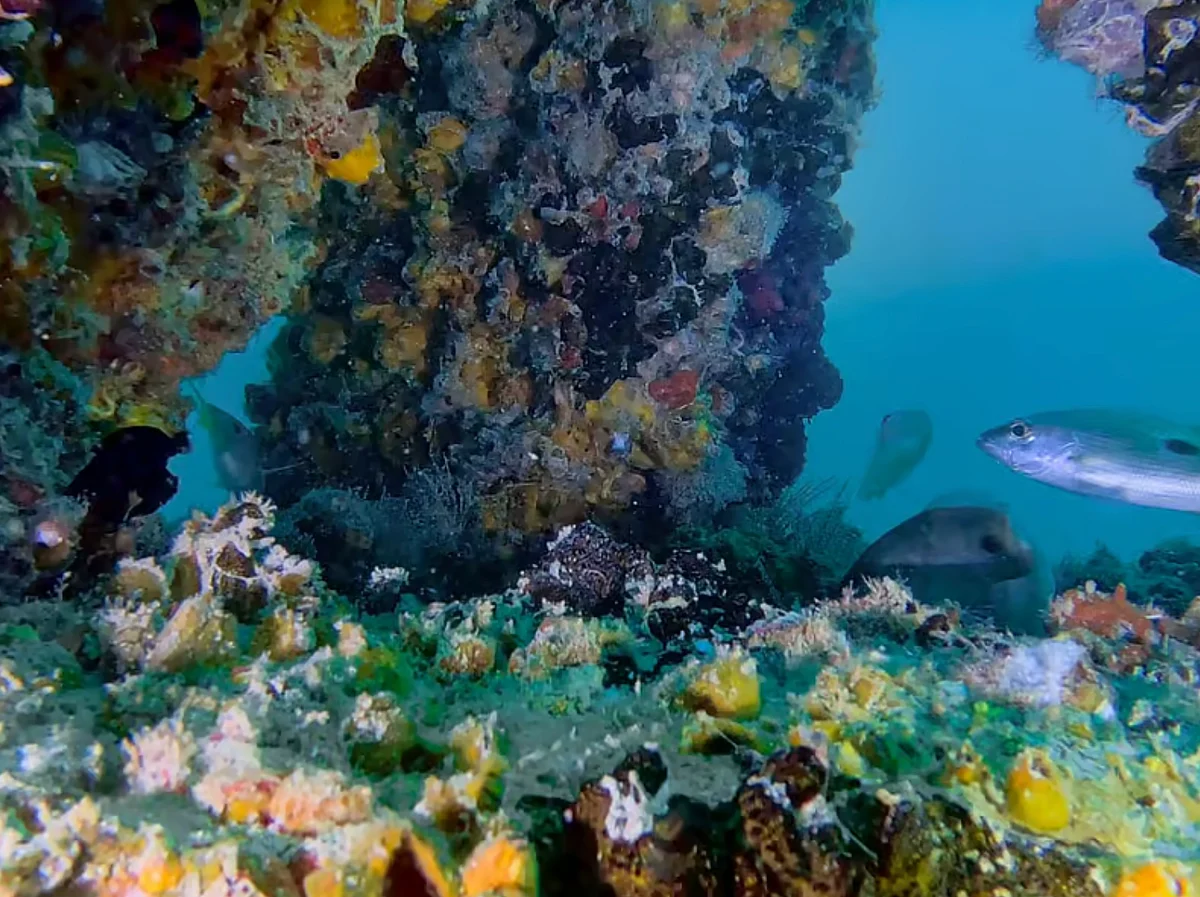
From AI To Underwater Robots: How UAE Is Protecting Coral Reefs, Marine Life


The issue took centre stage at a two-day event organised by the Dubai Environment and Climate Change Authority (DECCA), being held at the Grand Hyatt Dubai, where experts discussed how technology can help balance economic growth with the protection of fragile marine environments.
Recommended For YouFor the UAE, where desalination, shipping, coastal tourism, fisheries and offshore infrastructure are closely tied to the economy, the push towards blue technology has particular relevance.
Stay up to date with the latest news. Follow KT on WhatsApp Channels.
Hiba Alshehhi, Undersecretary, Biodiversity, Ministry of Climate Change and Environment, stressed that conservation must ultimately serve both nature and people.
“We don't just protect the environment for our cities; we protect and conserve it for our people. We need to make sure that with every step we take and everything we do, we are creating a living environment.”
She said the UAE's approach was increasingly focused on integrating environmental protection with national development, rather than treating conservation as separate from economic growth.
“In the UAE, we have a long-term biodiversity plan embedded in our national development policy. It is about creating that fabric of economic growth while protecting the integrity of nature.”
Alshehhi also highlighted the UAE's progress in protecting areas of critical importance to biodiversity, emphasising that the“country had achieved a 98 per cent level of protection for key biodiversity areas.”
From coral reefs to wildlife traffickingMarine conservation is also becoming a key area of investment, with projects focusing on coral reef restoration, fish stocks and nature reserves.
“When we look at our oceans and coastlines, we are funding many projects focused on core locations, including coral reef restoration. We are also working with fishermen and supporting efforts to protect fish stocks.”
The UAE is also seeking to make tourism more environmentally sustainable, with Alshehhi highlighting the country's newly announced ecotourism policy.
“We have just announced our ecotourism policy and are working on policies that will help sustain and protect the environment while ensuring that human activities can also be sustained in the future.”
Technology is meanwhile being deployed beyond conservation projects. As a major transit hub, the UAE has also been strengthening its ability to detect and prevent wildlife trafficking across its borders.
Alshehhi said enforcement capacity to identify and stop wildlife smuggling had increased significantly.
“Under the country's leadership, we have been able to increase our capacity to identify and stop people who are attempting to smuggle wildlife species by 40 times.” This she highlighted is a significant increase compared with where the country was 15 years ago.
Why 'blue tech' matters for the UAEAnuradha Bhattacharya, MENA Oceans Director, stressed that Artificial Intelligence (AI) should be viewed as one part of a much broader technological shift focused on the oceans.
“I think AI is probably one aspect of it, but the broader umbrella is blue tech. Looking at blue tech...that has different elements. And then AI is one of the strongest enablers.”
Blue tech covers technologies used to understand, monitor, protect and sustainably use marine environments. This includes sensors and satellites for ocean monitoring, underwater robotics, AI-powered coral reef monitoring, sustainable aquaculture, offshore renewable energy, smart shipping and technologies supporting desalination and water management.
But Bhattacharya cautioned that technology developed elsewhere cannot simply be transplanted into the Gulf without adapting it to local conditions.
“The solutions need to be localised. We see sometimes, robotics companies enabling solutions for reef monitoring, and they don't even recognize like the UAE reefs as reefs, because it's just not conditioned that way. So, you need a lot of localisation.”
AI is already being used for monitoring, disaster mapping and ecosystem tracking, she said, while its potential in sectors such as offshore energy and desalination could help reduce errors and improve efficiency.
“AI is used extensively from the monitoring aspect, but how we scale that is... collaboration in between how the scientists and the private sector and the government identify shared priorities.”
Bhattacharya said a major regional study was now examining how technology could strengthen resilience across 19 countries and five key sectors - shipping and ports, offshore energy, coastal tourism, fisheries and aquaculture, and desalination and water.
“We're developing a massive report on blue economies for coastal resilience. So, this spreads across 19 countries, and we are studying five sectors.”
ALSO READ- UAE tops Arab world in Yale 2026 environment index; here's how UAE focusing on building AI system to predict, prevent humanitarian crises How a marine scientist spent 25 years chasing an idea that could help rebuild fish populations

Legal Disclaimer:
MENAFN provides the
information “as is” without warranty of any kind. We do not accept any
responsibility or liability for the accuracy, content, images, videos,
licenses, completeness, legality, or reliability of the information
contained in this article. If you have any complaints or copyright issues
related to this article, kindly contact the provider above.
Comments
No comment