

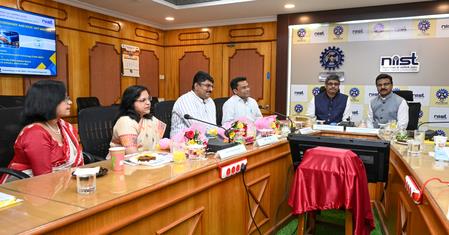
NIIST, Rubber Board Team Up To Cut Rubber Sector's Import Dependence


The collaboration was discussed at CSIR-NIIST in Thiruvananthapuram in a discussion between the Rubber Board's Executive Director M. Vasanthagesan, RRII Director Dr Debabrata Ray, and CSIR-NIIST Director Dr C. Anandharamakrishnan, along with scientists and officials.
The two institutions will work together to develop new materials, cleaner processing methods, and high-value rubber products.
The focus will be on some of the key technology challenges faced by the Indian rubber industry.
One major area will be the development of indigenous chemicals and cross-linking agents. These are now partly dependent on imports.
The institutions will also look at better ways to recycle rubber waste. This includes recovering and reusing carbon black from used rubber products.
Pollution from rubber processing will be another focus.
Researchers will explore the use of microbes to treat industrial effluents.
CSIR-NIIST will also provide technology to control the odour from rubber processing units.
The partnership will cover the testing and characterisation of raw materials and finished products.
Researchers will also work on new methods to de-vulcanise rubber.
Another area will be sulphur-free vulcanisation.
The ultimate aim is to develop high-performance rubber products that can generate greater value for the industry.
Anandharamakrishnan said Kerala's rubber sector needed indigenous and sustainable technologies to meet new challenges.
He said CSIR-NIIST had expertise in materials, chemical, biological and process technologies, while the RRII had close links with the rubber industry and expertise in the sector.
Vasanthagesan said the benefits of the partnership would extend beyond the two institutions.
"It is going to benefit the entire rubber sector," he said.
The benefits would reach stakeholders across the sector, including rubber farmers. The partnership will also support training for workers in rubber-based industries. Start-ups, entrepreneurs and research scholars will also be covered.
The programme will be implemented through the CSIR-NIIST Innovation, Technology and Entrepreneurship Hub at Bio 360 Life Science Park, Thonnakkal.
The hub is intended to provide research support, technology development, incubation and training for the rubber and allied sectors.
Its importance has grown with the establishment of the C-ITE Hub. Prime Minister Narendra Modi laid its foundation stone on February 23 this year.
The institutions hope the partnership will help build domestic technology, promote cleaner rubber processing, and create new business opportunities in the sector.

Legal Disclaimer:
MENAFN provides the
information “as is” without warranty of any kind. We do not accept any
responsibility or liability for the accuracy, content, images, videos,
licenses, completeness, legality, or reliability of the information
contained in this article. If you have any complaints or copyright issues
related to this article, kindly contact the provider above.
Comments
No comment