

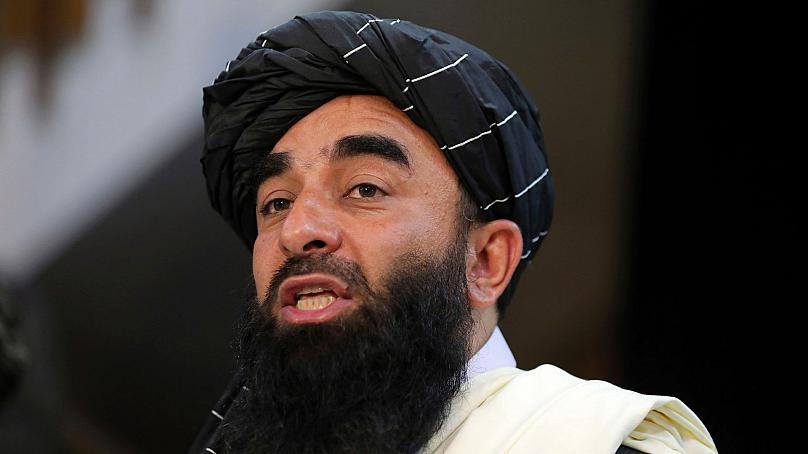
Mujahid Says Government Shares Similarities With Iran, Calls It An Advantage For Engagement


Speaking in an interview with Iran's state broadcaster, Mujahid said the Taliban is seeking stronger political, economic and regional cooperation with Iran and would not allow relations between Kabul and Tehran to be weakened.
Mujahid said Iran's Islamic identity gives it a unique position among Afghanistan's neighbors, arguing that shared religious, cultural and linguistic ties create a stronger foundation for engagement between the two sides.
“Being a Muslim country is an advantage in our interaction with Iran compared with other neighboring countries,” Mujahid said.
He added that the Taliban wants to deepen bilateral cooperation in areas including trade, security and regional connectivity, describing closer ties as beneficial for both countries and for the wider Muslim world.
Kabul seeks closer ties with TehranMujahid said the Taliban remains committed to preventing Afghanistan territory from being used against neighboring countries, including Iran, and insisted that the group's foreign policy prioritizes stable relations with regional states.
He also called for dialogue to resolve ongoing tensions between Afghanistan and Pakistan, saying disputes should be addressed through diplomatic engagement rather than confrontation.
Iran has maintained diplomatic and economic engagement with the Taliban since the group returned to power in August 2021, despite not formally recognizing its government. Tehran has kept its embassy in Kabul open, expanded trade with Afghanistan, and held regular high-level meetings with Taliban officials on border security, migration, water resources and regional stability.
Similarities and differences between the two systemsMujahid's comments reflect one of the clearest public acknowledgments by a senior Taliban official that the group sees ideological common ground with Iran's Islamic political system.
However, the two governments are founded on different schools of Islamic jurisprudence. The Taliban says its rule is based primarily on the Sunni Hanafi school of Islamic law, while Iran's political system is built on Shia Ja'fari jurisprudence and the doctrine of Wilayat al-Faqih (Guardianship of the Islamic Jurist).
Despite those religious differences, both governments place Islamic law at the center of governance and give religious authorities a significant role in state institutions.
International human rights organizations and the United Nations have repeatedly criticized both governments over restrictions on civil liberties, freedom of expression and the treatment of women.
Since returning to power, the Taliban has imposed sweeping restrictions on women and girls, including bans on secondary and higher education, limitations on employment and severe restrictions on public life. UN officials have described those policies as one of the main obstacles to Afghanistan's normalization with the international community.
Iran has also faced sustained criticism over crackdowns on protests, arrests of activists and restrictions on women's rights following nationwide demonstrations in recent years.

Legal Disclaimer:
MENAFN provides the
information “as is” without warranty of any kind. We do not accept any
responsibility or liability for the accuracy, content, images, videos,
licenses, completeness, legality, or reliability of the information
contained in this article. If you have any complaints or copyright issues
related to this article, kindly contact the provider above.
Comments
No comment