

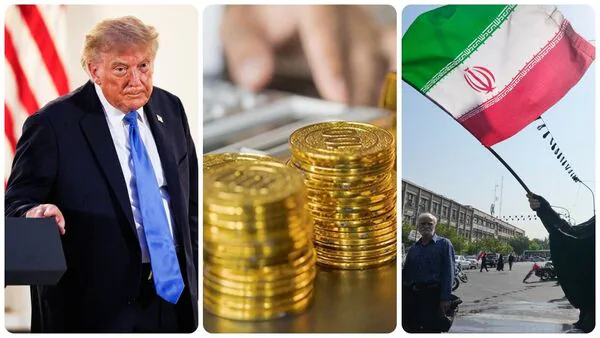
US-Iran War: Could 'Gold On Lease' Cost Iranians Heavily? What Expert Warned As Trump Steps Up Economic Campaign


According to Iran International, Mohammad Saeed Jafari, the head of the Gold and Jewellery Union in Kermanshah, told ISNA that under the 'gold on lease' arrangement, jewellery businesses use or trade the gold and pay the owner what is described as rent or a return.
Also Read | US-Iran war LIVE: Abbas Araghchi holds calls with Saudi, Turkish counterpartsJafari did not specify exactly how the gold is used after it is handed over by owners. As per the report, such arrangements can effectively allow a jewellers to use gold as part of its business inventory. This could mean that the owner's gold may not necessarily be kept aside in its original form.
What's the problem?Jafari said, "We have received numerous complaints. He alleged that in some cases operators initially paid attractive returns to gain customers' trust but later failed to return their gold.
The head of the union urged people to avoid such arrangements where possible.
Also Read | US-Iran war: American forces 'permanently disabled' 3 IRGC-linked oil tankersIf people still choose to lease out their gold, Jafari advised them to obtain strong documentation and deal only with licensed, established jewellers.
He also cautioned investors buying melted gold or bullion to avoid online sellers where possible and instead use licensed gold and jewellery businesses, Iran International reported.
US-Iran war and economic pressureIran has been reeling under a deep economic crisis, with the US launching 'Operation Economic Outcast' this month, pressuring the Islamic Republic to extract concessions in any future negotiation that six months of conflict have so far failed to secure.
Iran's economy was already deep in crisis before the conflict, with a cratering currency and spiralling inflation. And now, a months-long war with the US has run up a massive bill to rebuild damaged industry and infrastructure.
The Iranian rial fell to a record low of about 2.2 million to the US dollar this week, while inflation was running at about 66% in July, according to Iran International
One senior source told Reuters that Iran only has another two months' supply of gasoline, which has to be imported despite domestic oil production because of limited refining capacity.
Also Read | Trump plans 'much bigger' Middle East reset after Iran war: What's on the table?Besides, three senior Iranian sources told Reuters last week that the US campaign to throttle Iran's economy by blockading its oil exports and stopping sanctions evasion is growing increasingly difficult to withstand.
Although Iran's clerical rulers managed to bypass sanctions for decades, the latest US moves have left them in a far more sensitive position, with few remaining channels to secure foreign currency or buy goods, the sources were quoted as saying.
In particular, the effort to stop Iran accessing international financing networks in other countries poses a real and urgent threat, the sources said.
Any sign the economic campaign may break a months-long deadlock in the conflict will likely cheer US planners, though Iran has also warned it could respond to the pressure with military escalation, raising the stakes at a key moment.
Also Read | Oil Heads for Biggest Weekly Gain Since July on Iran War RisksThe war revived this week, with the US attacking along Iran's Gulf coast , prompting retaliatory Iranian strikes at US bases in Arab states.
Neither side has signalled yet it is ready to make the concessions demanded by the other, leaving the war in a costly stalemate - though one that may be shifting.
While more energy is flowing to international markets through the Strait of Hormuz despite Iranian efforts to continue disrupting the seaway, the U.S. blockade of Iranian oil exports has entirely cut off Tehran's main source of revenue.
Also Read | Trump claims US has 'virtually unlimited' ammunition for Iran warIran's rulers are keenly aware of the potential risks of an economic meltdown and the possibility of it reigniting the nationwide mass protests it put down in January by killing thousands of demonstrators.
"They are under very, very severe economic pressure. They're losing control of the Straits. It's really a question of if they choose to negotiate and I think they'll have to," Ali Ansari, modern history professor at St Andrews University in Scotland told Reuters.
(With inputs from agencies)

Legal Disclaimer:
MENAFN provides the
information “as is” without warranty of any kind. We do not accept any
responsibility or liability for the accuracy, content, images, videos,
licenses, completeness, legality, or reliability of the information
contained in this article. If you have any complaints or copyright issues
related to this article, kindly contact the provider above.
Comments
No comment