

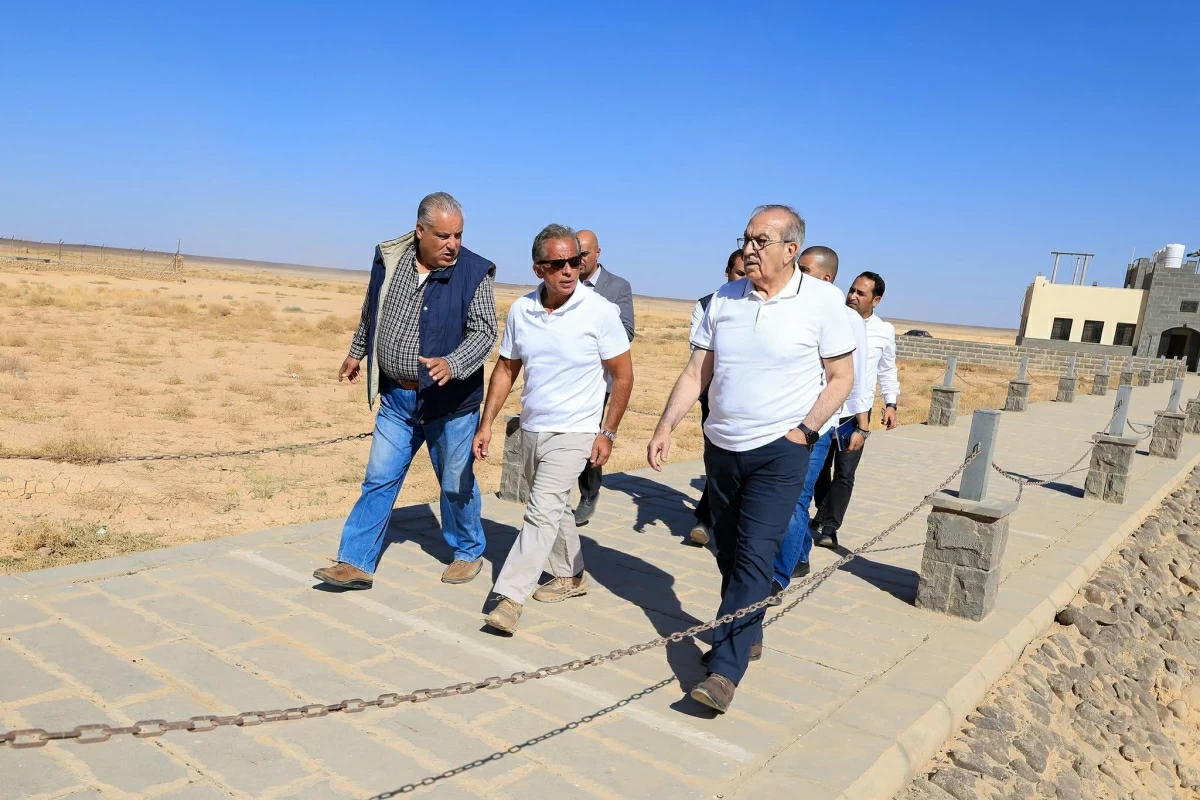
Prime Minister Visits 'Blessed Tree' Site, Azraq Wetland Reserve Revitalisation Project


- Project falls within government efforts to enhance tourism, maximise benefits from Kingdom's unique natural, environmental diversity
- It also seeks to establish integrated tourist destination in eastern JordanAMMAN - Prime Minister Jafar Hassan on Saturday visited the "Blessed Tree" site in Safawi in eastern Jordan and the Azraq Wetland Reserve Revitalisation Project.
Hassan instructed the launch of a comprehensive project to develop tourist, ecological and historical locations in the Kingdom's eastern region to bolster their position on the country's tourism map.
According to a Prime Ministry statement, the project falls within government efforts to develop the national tourism product and maximise benefits from the Kingdom's unique natural and environmental diversity, alongside its rich historical, archaeological, religious and cultural assets.
The initiative aims to enrich the visitor experience, foster local community development, and enhance the tourism sector's contribution to the national economy and across the governorates.
The development project in the eastern region encompasses the Shaumari Wildlife Reserve, the Dahik Nature Reserve in the northeastern Badia, Quseir Amra, Qasr Al Kharanah and Azraq Castle, in addition to the Azraq Wetland Reserve, the Azraq Oasis Revitalisation Project implemented through the Royal Society for the Conservation of Nature (RSCN), and the "Blessed Tree" site in Safawi.
The project seeks to establish an integrated tourist destination in eastern Jordan, connecting the oasis, natural reserves, desert castles, and historical, religious and geological sites through new, integrated tourist trails and experiences.
Developing these sites will expand and diversify the Kingdom's tourism routes, transforming them into viable development and investment opportunities that serve local development and directly benefit surrounding communities, the statement said.
At the Azraq Reserve, the Northern Azraq oases were revitalised through four new naturally designed pools replicating the original oases, where native fish species will be reintroduced.
Plans also feature an eco-camp managed by the RSCN and an eco-park for local residents and visitors, offering recreational activities, arts and crafts within the reserve's boundaries.
The palm grove near the castle area is being restored and reconnected to the wetland oasis following Cabinet approval to expand the reserve, which included planting 1,200 palm trees. The RSCN has been tasked with developing and managing this project, the statement said.
The government adopted the Azraq Oasis Revitalisation Project based on the Azraq Master Plan formulated in 2015, which was recently updated and executed by the government.
The initiative includes expanding industrial, artisanal and commercial opportunities in the area, alongside broadening the eco-tourism product to generate income and employment for over 15,000 local residents.
The project is expected to open to visitors before the end of next March, the statement said, adding that the government will rehabilitate the road leading to the "Blessed Tree" to facilitate access for tourists and visitors and equip the site with essential services.
The government has also illuminated all desert castles at night to enhance their attraction to travellers, particularly along the Omari–Saudi Arabia highway.
Eastern sites have drawn international attention for decades due to their immense heritage value. This is demonstrated by Quseir Amra's inclusion on the UNESCO World Heritage List in 1985, Azraq's placement on the UNESCO World Heritage Tentative List in 2007 as a mixed natural and cultural site, the designation of "North Azraq Village" among the Best Tourism Villages for 2025, and the Azraq Oasis being named the first Ramsarwetland reserve in the Arab region and the 13th globally.
The development of tourism sites in the east coincides with ongoing government efforts to implement other tourism projects across the Kingdom.
Key projects include the Jerash Eco-Tourism Village, the rehabilitation and development of the Umm Qais archaeological site and Tall Irbid in the north, the Yarmouk Eco-Tourism Project and Birkat Al Arais, alongside tourism development projects in Karak, such as the cable car project, Wadi Bin Hammad, Al Birkeh site, Karak Gate, and the fully completed restoration of Qatrana Castle in addition to ongoing procedural steps for the Amman Cable Car project.

Legal Disclaimer:
MENAFN provides the
information “as is” without warranty of any kind. We do not accept any
responsibility or liability for the accuracy, content, images, videos,
licenses, completeness, legality, or reliability of the information
contained in this article. If you have any complaints or copyright issues
related to this article, kindly contact the provider above.
Comments
No comment