

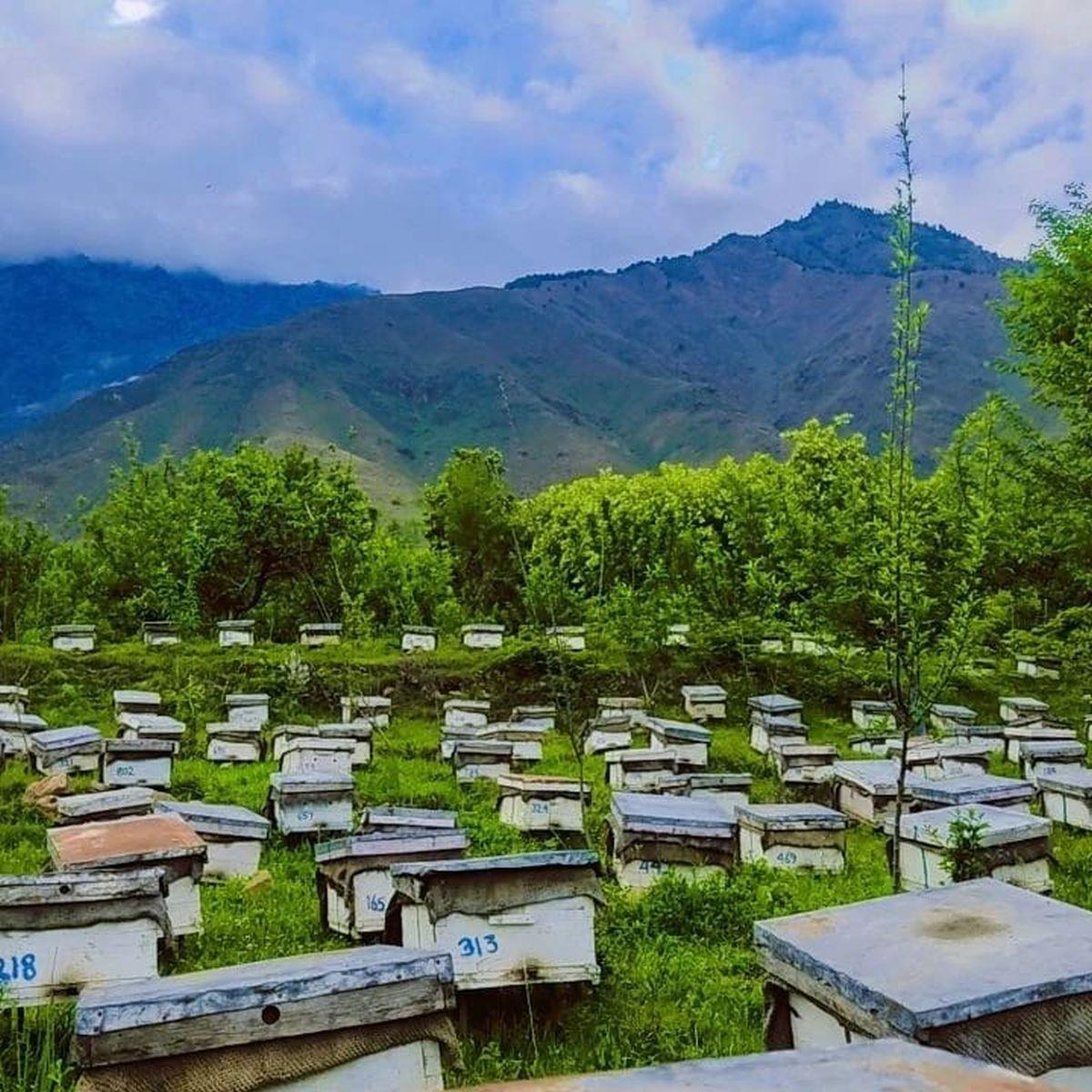
Pesticides, Wild Weather And War Are Emptying Kashmir's Hives


Rahul Rathore remembers when his hives hummed with 350 colonies, stacked in neat rows outside Batote, each box producing honey he could sell with confidence and pride.
ADVERTISEMENTSeven years later, only about 100 colonies remain.
The rest died somewhere between here and Rajasthan, poisoned by pesticide-laced fields, battered by strange temperature swings, and picked apart by a beetle that science still cannot control.
ADVERTISEMENT“We started strong,” Rathore said, describing the winter migrations that once sustained his operation.
Now those same journeys, undertaken so bees can find forage during Kashmir's frozen months, have become the biggest threat to his livelihood.
Farmers spraying chemicals may never see the bees feeding nearby. Season after season, the exposure weakens Rathore's colonies. He wants a minimum support price for honey, calling it the lifeline that could keep beekeepers like him from ruin.
His story is playing out across Kashmir, in Ramban, Udhampur and Kishtwar, where thousands of small beekeepers depend on honey as supplementary income.
Heavy pesticide, fertilizer and herbicide use in orchards has thinned bee populations, while unpredictable weather, hailstorms one month and blistering heat the next, keeps disrupting the flowering cycles bees depend on for nectar.
Small hive beetle infestations, a destructive parasite scientists have yet to fully treat, are killing eggs and adult bees on top of everything else.
A 2022-2023 study found fifteen pesticides in honey samples pulled from migratory apiaries in Kashmir, with organophosphates showing up prominently near intensive apple orchards.
Pollen samples tested positive for dozens of additional chemicals, mostly fungicides and herbicides, echoing what researchers have documented globally about the toxic burden bees now carry in their bodies.
Hari Prasad manages roughly 1,400 colonies across Sud Mahadev, Kishtwar, Bhaderwah and Punjab, moving them seasonally in pursuit of better forage. Transport costs, he said, consume most of what he earns.
He is pushing state officials to introduce a subsidy for migratory beekeepers, and he wants agrochemical-free buffer zones established around flowering crops and vegetable belts to give pollinators room to survive.
Wholesale honey prices have collapsed in recent months, a decline Prasad connects partly to the ongoing war disrupting exports to Gulf countries. He also blames adulteration, alleging that large brands are cutting corners to undercut small producers.
A closer look tells a more precise story: rather than surfactant chemicals, several companies appear to be using sophisticated imported sugar syrups, engineered specifically to slip past standard purity tests. The effect on local producers is the same either way. Genuine honey struggles to compete on price against a product built to imitate it.
The stakes extend well beyond the beekeepers themselves. Bees pollinate the apple, cherry, almond and vegetable crops that define Kashmir's agricultural economy, and researchers value that pollination service at roughly ₹12,656 crore annually, with managed pollination boosting apple yields by about 19 percent.
Read Also AI Could Become a Game Changer for Kashmiri Beekeepers The Bee Crisis in KashmirApiculture officials estimate that 30 to 40 percent of migratory colonies die during the winter shift south, and some beekeepers describe production drops as steep as 90 percent in bad seasons.
In response, a handful of officials and growers have begun testing“warm womb” wintering methods, an attempt to keep hives in Kashmir through the cold months instead of risking the journey.
The valley counts more than 2,100 registered beekeepers and produces over 1,200 metric tonnes of honey annually, but bad years can wipe out 70 to 90 percent of that output, translating into losses running into crore rupees.
Ramban, Udhampur and Kishtwar, where beekeeping supplements thousands of rural incomes, have seen output fall by 50 to 80 percent, leaving small operators barely breaking even once migration and input costs are paid.
The apple economy, worth an estimated ₹8,000 to ₹10,000 crore a year, has absorbed pollination-related losses estimated at ₹300 to ₹400 crore in particularly harsh seasons.
Government figures show registered colonies climbing from 1.23 lakh in 2019 to 2.27 lakh in 2024-25, with honey production rising 77 percent to 3,895 metric tonnes, numbers officials point to with pride even as beekeepers on the ground describe how quickly one bad season can erase those gains.
Amid the losses, one product has found room to grow.
Sulai honey, drawn from wild Plectranthus rugosus blossoms around Banihal, earned a Geographical Indication tag in 2023. Prices have climbed from ₹800-1,200 per kilogram to nearly ₹2,000 following the recognition, nearly double what many plain-land honeys command.
Acacia honey from the valley and multiflora varieties from Udhampur and Poonch have followed a similar, if smaller, path upward.
Akhtar Wani, who leads a farmer producer company in Baramulla and has helped establish two others in Kupwara, described members maintaining thousands of bee boxes between them, all facing the same pesticide exposure during winter migrations to Jammu, Gujarat, Rajasthan and Madhya Pradesh.
He wants chemical-free flowering zones designated by the government and broader awareness of federal food-processing schemes that could help beekeepers build small honey-processing units of their own.
Wholesale prices in Baramulla can fall as low as ₹200 per kilogram even as retail prices hold between ₹600 and ₹1,500, a gap Wani said justifies a minimum support price.
Orchard surveys across Kashmir show farmers applying seven to twelve pesticide sprays a season, some during bloom itself, a practice many growers now admit has thinned pollinator populations and degraded their habitats.
Researchers are calling for tighter regulation of high-risk chemicals, protected buffer zones around bee forage, and a shift toward integrated pest management that reduces spray frequency without sacrificing crop yields.
Mushtaq Ahmad, who runs a farmer collective in Banihal with about 160 members and 1,700 colonies, watched output fall from an initial peak to hives numbering closer to 1,000.
Annual production of around 60 metric tonnes once fetched ₹800-1,600 per kilogram depending on quality, before pesticide exposure, beetle infestations and unstable weather began eating into both colony strength and price.
What remains constant, across every district and every beekeeper interviewed, is the demand for a floor beneath their prices and a barrier between their bees and the chemicals killing them.
Kashmir's mountains still produce some of the finest honey in the country, amber and herbal and rare.
Whether the bees survive long enough to keep making it depends on decisions still waiting to be made in Srinagar and New Delhi.
- The author is an environmental advocate and policy writer, and can be reached at [email protected].

Legal Disclaimer:
MENAFN provides the
information “as is” without warranty of any kind. We do not accept any
responsibility or liability for the accuracy, content, images, videos,
licenses, completeness, legality, or reliability of the information
contained in this article. If you have any complaints or copyright issues
related to this article, kindly contact the provider above.
Comments
No comment