

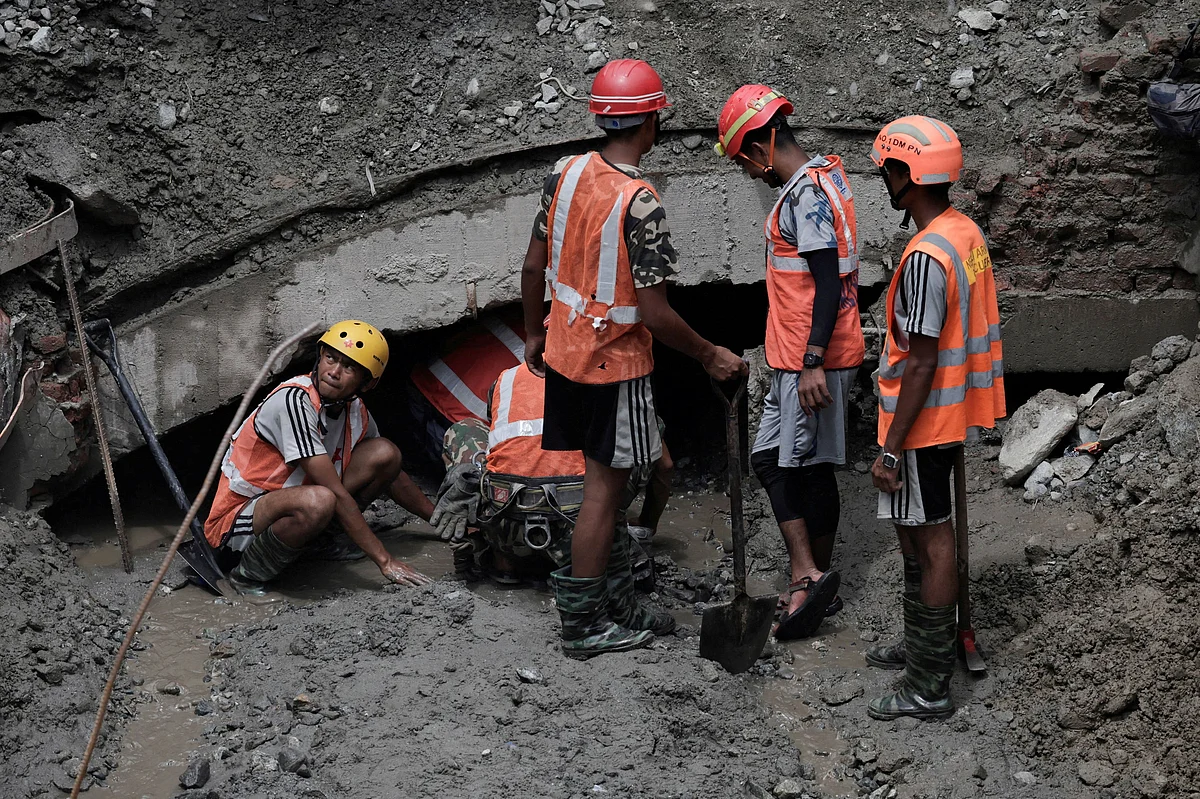
Nepal Flood: Survivor Recounts Escape From Hydropower Tunnel Hundreds Still Missing


Under the industrial floodlights, dust started to rise, the 32-year-old recalled, "Something was coming."
Recommended For YouNobody in the tunnel was prepared for what was about to hit them: a flood wave that had by then already flattened entire settlements upstream on the Trishuli river and was rolling down the valley with immense destructive power that killed at least 1,259 people in Nepal.
Stay up to date with the latest news. Follow KT on WhatsApp Channels.
Tamang, who had been hired by the project as a support worker, said hundreds may have been on site by the time the disaster struck last week.
"Suddenly, people started running, shouting, and scrambling," Tamang said. "By the time I could have realized anything, I was over a top of a tanker (truck). Once I was up, the vehicle began moving," he said. Water began rushing into his section of the tunnel. "I felt again and again that I was going to die."
Tamang held on to anything he could grab, climbing on pipes and trying to keep his head above the raging water. He suffered injuries to one of his legs. When the velocity of flood water receded, Tamang was still alive. So were others, he noticed with relief.
As the tunnel entrance was blocked, they had to move to the deeper end in near-complete darkness. "It was a long, exhausting fight through darkness, water, wreckage, and bodies," he said.
Then, he recalled, there was a burst of light. "When we finally came out, the outside brightness felt unreal." The shaking group of survivors was soon surrounded by other people, who supplied dry clothes.
Rescue teams in Nepal have recovered more than 1,250 bodies, and more than 5,000 are missing, after the gigantic wave triggered by a rock and ice avalanche roared down the China-Nepal border.
An army officer, who spoke on condition of anonymity as he is not authorised to speak to the media, told Reuters that the search was continuing with experts from India, South Korea and China for at least 900 survivors believed to be trapped in the tunnels related to hydropower projects.
Families descend on Nepal in search of missing tourists
Desperate families of missing foreigners were clinging to hope as they combed hospitals and morgues in search of clues, a week after the catastrophic floods.
Outside Kathmandu's tourist police headquarters, Sanjeev Rai was trapped in agonising uncertainty. The 53-year-old American flew to Nepal after learning that his wife, Jiwan Jyoti, was untraceable while returning from a pilgrimage to Mount Kailash, the sacred peak revered by Hindus and Buddhists.
"The day I arrived I said, let's find a helicopter, I'm going to look for her," Rai told AFP. Jyoti, an engineer at Intel, had embarked on the journey as a spiritual quest and an adventure to mark her 50th birthday. Now Rai says he has all but abandoned hope of finding her alive.
According to Nepali police, some 294 foreigners have been rescued, most of them Chinese and Indian nationals. But 583 foreigners remain unaccounted for, many of them pilgrims who had spent months preparing for the demanding trek around Mount Kailash.
Nepal's death toll rose to 1,259 people on Thursday, their disaster authority said, reporting a sharp rise in the number of missing, at 5,083. Chinese state media reported 21 people killed in Tibet and 541 missing, taking the total toll to 1,280 dead and 5,624 missing.
Delivering aid remains a challenge
The United Nations warned Thursday of the immense challenge of reaching Nepal flood survivors, with destroyed roads forcing aid workers to consider using cargo drones and porters to reach isolated Himalayan communities.
Communities near the epicentre remain cut off, with the UN working alongside Nepal's government to get emergency supplies into devastated areas.
"Access has been very, very, very difficult," UN Resident Coordinator Lila Pieters Yahia said, noting that UN agencies had delivered water and and sanitation kits, as well as food and medicine.
Foreign ministry spokesman Lok Bahadur Poudel Chhetri said Nepal needed specialised international assistance, including heavy-lift drones and temporary bridges, as well as body bags and DNA testing kits to help identify the dead.
UAE sends aid, specialist team for relief and rescue
An Emirati relief mission has departed for Nepal to provide urgent humanitarian support to those affected by floods and landslides, under the directives of UAE President Sheikh Mohamed bin Zayed Al Nahyan.
The dispatch of the mission comes as part of the UAE's ongoing relief efforts in Nepal.
The UAE allocated $10 million to support those affected and dispatched two aid aircraft. The first carried 83 tonnes of food supplies and various shelter materials, while the second carried 45 tonnes of relief supplies, including basic food items, essential supplies and power generators.
The mission includes a specialist team comprising members from the Joint Operations Command, the Dubai Police Search & Rescue Team, and the UAE Aid Agency. It includes experts in disaster relief operations, medical evacuation and first aid to strengthen humanitarian response efforts in affected areas, provide urgent medical assistance to the injured, and support search and rescue operations in coordination with the Nepalese authorities.
[With inputs from AFP, Reuters and WAM]
ALSO READ- At least 2,500 buildings destroyed in Nepal valley, data analysis shows At least 586 killed, over 2,400 missing in deadly Nepal floods: Disaster authority UAE announces $10 million aid for flood, landslide victims in Nepal

Legal Disclaimer:
MENAFN provides the
information “as is” without warranty of any kind. We do not accept any
responsibility or liability for the accuracy, content, images, videos,
licenses, completeness, legality, or reliability of the information
contained in this article. If you have any complaints or copyright issues
related to this article, kindly contact the provider above.
Comments
No comment