

Do You Need To Worry About The Sun Turning Into A Black Hole?


At the end of their lifespans, some massive stars collapse under their own weight until they turn into a black hole that sucks up everything around it.
It's a dramatic conclusion to a star's billions of years of existence, but it's not the finale that our own Sun will have. Our solar system's star is not big enough to have that kind of outcome, so worrying about the Sun becoming a black hole doesn't need to be on your list of anxieties. Whatever happens to the Sun will happen very slowly, over billions of years. By that time, you'll be long gone. Humans might not be there to witness it at all.
As an astrophysicist, I am fascinated by black holes and how they form. The universe is filled with different kinds of stars, and each has a distinct tale to tell about its life.
Birth, life and death of a starJust like humans, stars have a life cycle. A star is born when a giant gas cloud collapses in on itself and then grows, shining light by burning fuel.
In its core, the baby star fuses four atoms of hydrogen together to form the element helium, which releases energy in the form of starlight. This fuel-burning process also exerts outward pressure against gravity, which is pulling in on the star. These competing forces give stars their round shape.
As the star grows older, it eventually burns up all the hydrogen inside it. At this point, it can't maintain the same outward push, so gravity squeezes the star, shrinking it smaller and smaller. The helium atoms inside are pushed closer together, and they start to fuse into heavier elements such as carbon, oxygen, iron and more.
The star keeps burning its fuel and shining on until most of the helium in its core has fused into iron. But fusing together multiple atoms of iron requires taking in energy instead of releasing it, so at this point, the fuel burning stops.
Gravity then takes over, and the core of the star collapses rapidly in a dramatic explosion. The cores of heavier stars are extremely dense, so any material falling toward the collapsing star bounces off, producing shock waves. This phenomenon drives what is called a core-collapse supernova explosion. The star explodes, shooting elements like oxygen and other heavy elements off into space. What remains is a dead star with a small, dense core.
Which stars will become black holes?The type of dead star the collapse forms depends on how much mass the star started with. If the mass is less than roughly eight times the mass of the Sun, the collapse will leave behind a white dwarf. This is a star so dense that all the electrons inside it are squeezed extremely close together, until they are no longer bound to individual atoms.
If the star was about eight to 20 times the mass of the Sun, it would leave behind a neutron star, which is an even denser star. In a neutron star, the electrons and protons crush together to produce neutrons.
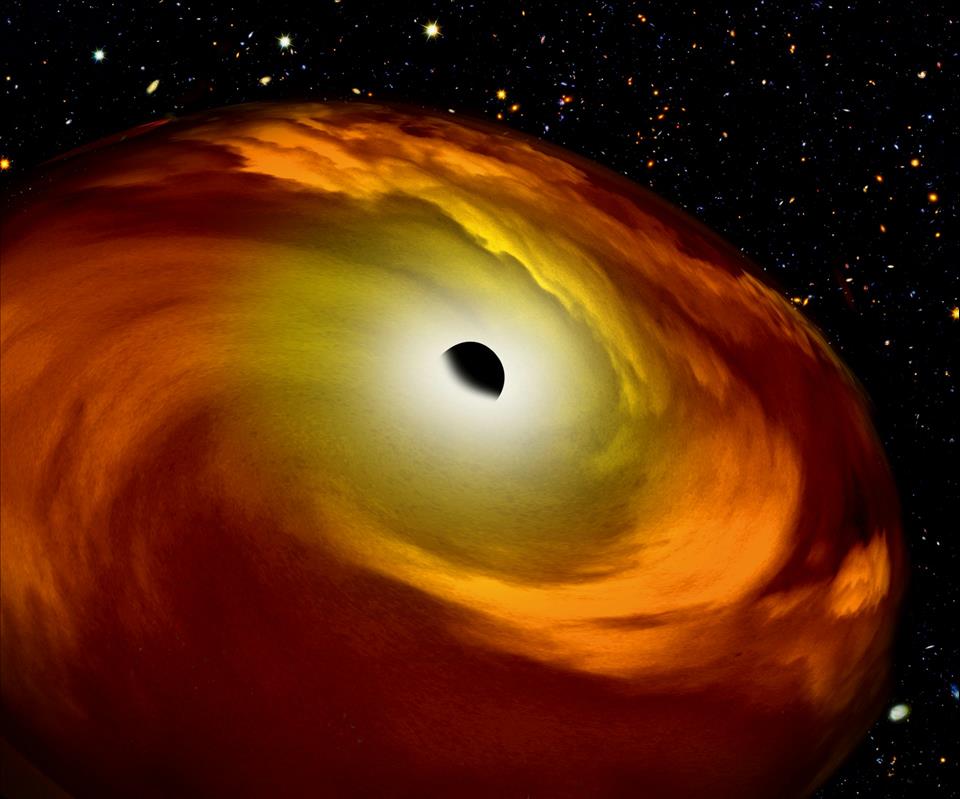
If the star is heavier than 20 times the mass of the Sun, the end product will be a black hole with gravitational pull so strong that nothing, not even light, can escape past its boundary.
Because our Sun is on the smaller side for a star, when it dies it will collapse into a white dwarf, roughly the same size as Earth. It will still shine some light at first, but over time it may slowly cool down, to eventually become a cold, dark object called a black dwarf.
Should you worry about the Sun's future?In about 1 billion years from now, the Sun will start to grow hotter and brighter than it is today. As it shines more brightly, the sunlight it casts on Earth will increase, which will make the Earth hotter. The oceans will evaporate, and it will become very difficult to sustain life as we know it on Earth.
In about 5 billion years, all the hydrogen in the Sun's core will run out. The core will then contract under gravity, while the hydrogen continues to fuse in a shell around it. This will cause the outer layer of the Sun to expand enormously and enter a phase known as the red giant. During this phase, the Sun will grow so big that it could potentially run into Earth's orbit.
Scientists don't yet know if Earth will be swallowed by the Sun at this point. But even if Earth evades being gulped up, the Sun's heat will toast everything on Earth, and no complex life will be able to survive.
This may sound scary, but you don't have to worry, because humans will probably be long gone by the time the Sun starts consuming Earth's atmosphere.
Earth was formed about 4.6 billion years ago, and if you imagine its entire lifespan up to now as a single day, then all of human history happened in the last six seconds. There's still about 26 hours to go before the Sun becomes a red giant.
Is there any danger of being near a black hole?Suppose the Sun were to become a black hole today, all of sudden. Assuming the black hole had the same mass as the Sun, humans would not be in immediate danger. Earth and all other planets would feel the same gravitational pull as from the Sun.
Only objects very close to the black hole – within a few miles or so – would be sucked in. Mercury, the closest planet to the Sun, has an orbit of about 36 million miles (58 million kilometers).
This means there is no immediate danger from the Sun turning into a black hole, even hypothetically.
Hello, curious kids! Do you have a question you'd like an expert to answer? Ask an adult to send your question to .... Please tell us your name, age and the city where you live.
And since curiosity has no age limit – adults, let us know what you're wondering, too. We won't be able to answer every question, but we will do our best.


Legal Disclaimer:
MENAFN provides the
information “as is” without warranty of any kind. We do not accept any
responsibility or liability for the accuracy, content, images, videos,
licenses, completeness, legality, or reliability of the information
contained in this article. If you have any complaints or copyright issues
related to this article, kindly contact the provider above.
Comments
No comment