

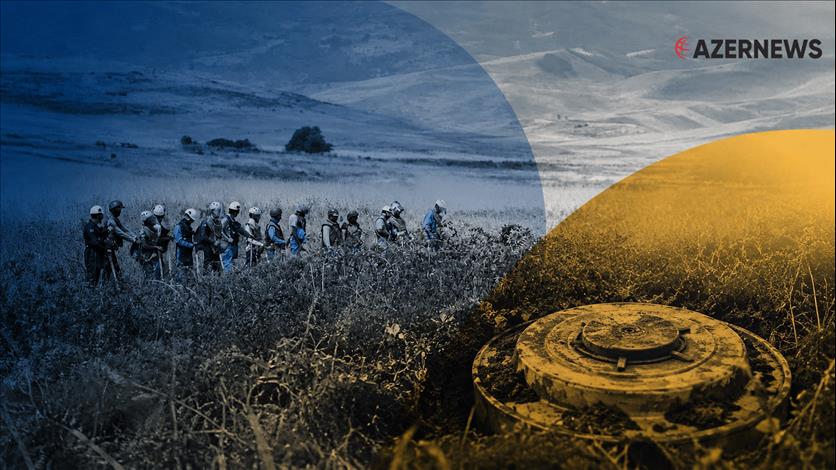
Azerbaijan's Battle For A Safe Return Begins Beneath The Ground


Wars end with ceasefires, declarations, and, at last, with peace agreements. Landmines never end. They lie waiting – in fields, on roadsides, in riverbeds, and under the ruins of homes that once stood, ready to attack long after the political conflicts that spawned them are settled. In Azerbaijan, where liberation from occupation lasting for more than thirty years has resulted in one of the most daring reconstruction attempts in the post-Soviet space, the war happening underground has never been declared, and no one has ever won it yet.
The magnitude of the problem is exceptional by any worldwide standard. Around 11,667 square kilometers of Azerbaijani territory, almost 13% of its territory, have been contaminated by landmines and unexploded ordnance. There are more than one million explosive devices buried in Azerbaijani soil. After the 2020 war, 437 citizens of Azerbaijan became victims of mine and unexploded ordnance accidents: 73 dead and 364 seriously wounded people. Those casualties include deminers, reconstruction workers, journalists, and civilians coming back home to their ancestral lands. In total, more than 3,500 people have been victims of mines since the conflict started in the late 1980s. This is the latest known information.
It was in this context that the 4th International Mine Action Conference was held in Baku this week, attended by experts in mine action, diplomats, UN organisations, the EU, NATO, ASEAN and delegates from China, Israel, Türkiye and a dozen other mine-affected nations. The philosophy behind the conference was carefully thought out and, compared to similar conferences, quite ambitious – it was not a technical conference focused on clearance rates and coverage.
The underlying theme that characterized the sessions during the conference could be summarized concisely. A mine is more than a weapon. A mine is a barrier. Clearing a mine does not immediately mean safety; it means making a precondition for safety. What comes next is housing, roads, agricultural land, schools, hospitals, jobs, community- involves an entirely different set of steps, investments, and time that demining cannot accomplish on its own. A cleared area is not necessarily farmland. A surveyed road is not an operating village.
This has long been the position taken by Azerbaijan internationally, and it came across clearly through the conference's agenda. The first session of the conference directly linked mine action to urban renewal, reconstruction plans and economic development opportunities. And the message was clear to donors and other international stakeholders. Funding mine action separately from the reconstruction that the process is designed to make possible is insufficient. The two must go hand in hand, or they will work against each other. Removing a mine is a prerequisite to all that follows. It is not an end in itself but rather a gateway.
Political dimension
Farid Shafiyev, chairman of the Center of Analysis of International Relations, made a point on the conference's sidelines that cut through the technical discussions with unusual directness. "Yes, this is actually a political problem," he told AzerNEWS. "The mine issue has several dimensions, including casualties and technical challenges, but what interests us in this context is its political dimension."
"After the Second Garabagh War, Armenia had time to withdraw from the territories, yet mines were planted during that period. In 2021 and 2022, mines were laid in some areas as well. This was not 30 years ago, it was only two, three, four or five years ago. When those mines were laid, the people who carried out those operations were in Armenia or had knowledge of these activities. Therefore, if this information is not provided, I believe there is a lack of political will to resolve the issue."
Maps produced by the Armenian side have proved to be mostly inaccurate according to Azerbaijan's perspective as well as third-party assessments. Mines have been detected where the maps stated they had been removed, and vice versa. Although the Armenian side argues that maps were recorded with imprecision during the mining operation period, which might technically be true, it does not satisfy the politics behind the situation, especially considering the information about planting new mines in the territory in question during the withdrawal period from 2021 to 2022. The problem of the mine is an integral part of the normalization process between the two countries, and solving it will be impossible without information exchange.
What AI can and cannot do
Technology was the conference's second major theme, and the ambitions expressed were genuine. And indeed in that regard, the AI trend appears as the latest addition to that. Tim Lardner, Director for Europe and Central Asia at UNOPS, did not understate the potential.
"I think AI is going to bring a revolution in the demining world. I think that we've seen over the last two years particularly how technology has brought incredible advances in our ability to locate, to destroy and to move on from some of the landmines. I think we're only at the beginning of the ability and the opportunity to use AI and advanced technologies to improve demining."
Lardner has spent three decades working on mine action, and his evaluation of the rate of change made it clear that "what we're doing now is so different to what we were doing before." Technologies such as AI-assisted surveying, drone mapping, advanced detection systems, and data platforms have already enabled faster identification and clearing of contaminated territories. However, the question remains of how to use them on a scale corresponding to Azerbaijan's needs – and whether there is financing available for this purpose.
SDG 18 initiative: Azerbaijan has developed the National Sustainable Development Goal No. 18 on mine action, which is a truly unique step and recognizes demining as an accelerator for all other 17 SDGs and the UN 2030 Agenda. As Erfan Ali, Director of UN-Habitat's Regional Office for East Europe and Central Asia, said, this is "a very important example to be shared with other contexts," including Ukraine, Syria, and Lebanon.
The international community's role, and its limits
Duncan Norman, the UK Ambassador to Azerbaijan, spoke on the sidelines about the nature of international commitment. The UK was the first country to support ANAMA, Azerbaijan's mine action agency, back in 2020, and has continued to do so. But his language was careful.
"There is, of course, an enormous amount to do, and it's right that the international community plays a part in this. The mines are a constant reminder of the past, and what we all want to do is put the conflict behind us and look to move forward. And mine action work is an important part of that."
The financing issue is always the most politically sensitive in any mine-action meeting. Azerbaijan's mine issue, according to different measures, can be regarded as one of the largest and most complicated in the world. However, the country's own efforts have reached a considerable level. Yet, Erfan Ali of UN-Habitat was very clear about the situation. "The volume of contamination in Azerbaijan is massive," he remarked. "The efforts are extremely important and extremely advanced and nationally led." The other truth is that "further progress will need greater international partnership and engagement," he continued. Development banks, private financiers, and bilateral donors' involvement in funding the clearance and reconstruction efforts are not marginal but structural. Efforts in clearing mines without investing in reconstruction are fruitless. Likewise, reconstruction efforts that outpace mine clearance pose a danger to the process.
Now, what recovery actually looks like, and has there been any improvement?
The conference itself provided at least two specific answers to this question. On the margins of the conference, ANAMA and the ASEAN Regional Mine Action Center have signed a Memorandum of Understanding on collaboration in humanitarian demining, thus extending Azerbaijan's mine action network to include Southeast Asia where there is already considerable experience accumulated in Cambodia, Laos, and Vietnam. The MOU, signed by ANAMA chairman Vugar Suleymanov and ARMAC executive director Rothna But, concerns exchanges of experience, good practices, and joint activities. Meanwhile, Salem Al-Qahtani of the Saudi Foreign Ministry stated that Riyadh will provide $3 million for humanitarian demining in Azerbaijan, specifically for“creation of a safe environment for the civilian population and repatriation of displaced persons.”
The conference's final statement gave this idea an institutional form. Its participants called for humanitarian mine action to be fully integrated into urban recovery, reconstruction, safe return and sustainable development, rather than treated as a standalone technical exercise. They also stressed that demining is among the first conditions for restoring safe settlements, rebuilding destroyed cities and villages, and enabling displaced populations to return to their places of origin.
But perhaps, the conference's most important contribution may have been conceptual rather than operational: establishing, in a room of international experts and donors, that the right question to ask about Azerbaijan's mine crisis is not "when will the last mine be cleared?" but "when will people be able to live here again?" Clearance is a technical operation with a measurable endpoint. Recovery is a social and economic process whose endpoint is a functioning community, with schools, health services, livelihoods, and the intangible quality of a place that feels safe enough to build a life in.
The point remains distant for most of the liberated territories. The Great Return program of resettlement of hundreds of thousands of displaced Azerbaijanis in their native places is being implemented; however, the speed of implementation is limited by the same chain of dependencies that was identified at the conference: first comes clearance, then housing construction, after which there should come services, sustainable community. Everything takes time and money. Every step is dependent on the previous one. And under it all, in the soil of Garabagh and East Zangezur, the mines wait.
The ultimate criterion to assess the meaning of this conference cannot be found either in its statements or in the partnerships that it established. The criterion would be whether the people, displaced from these lands, could someday walk across them without fear. This is the objective that cannot be substituted by any technology or declaration made by the international community alone. It demands political will, financial resources, clearance works, and a hard-to-promote process of reconstruction. They have to make the ground beneath their feet once more a place of life.

Legal Disclaimer:
MENAFN provides the
information “as is” without warranty of any kind. We do not accept any
responsibility or liability for the accuracy, content, images, videos,
licenses, completeness, legality, or reliability of the information
contained in this article. If you have any complaints or copyright issues
related to this article, kindly contact the provider above.
Comments
No comment