

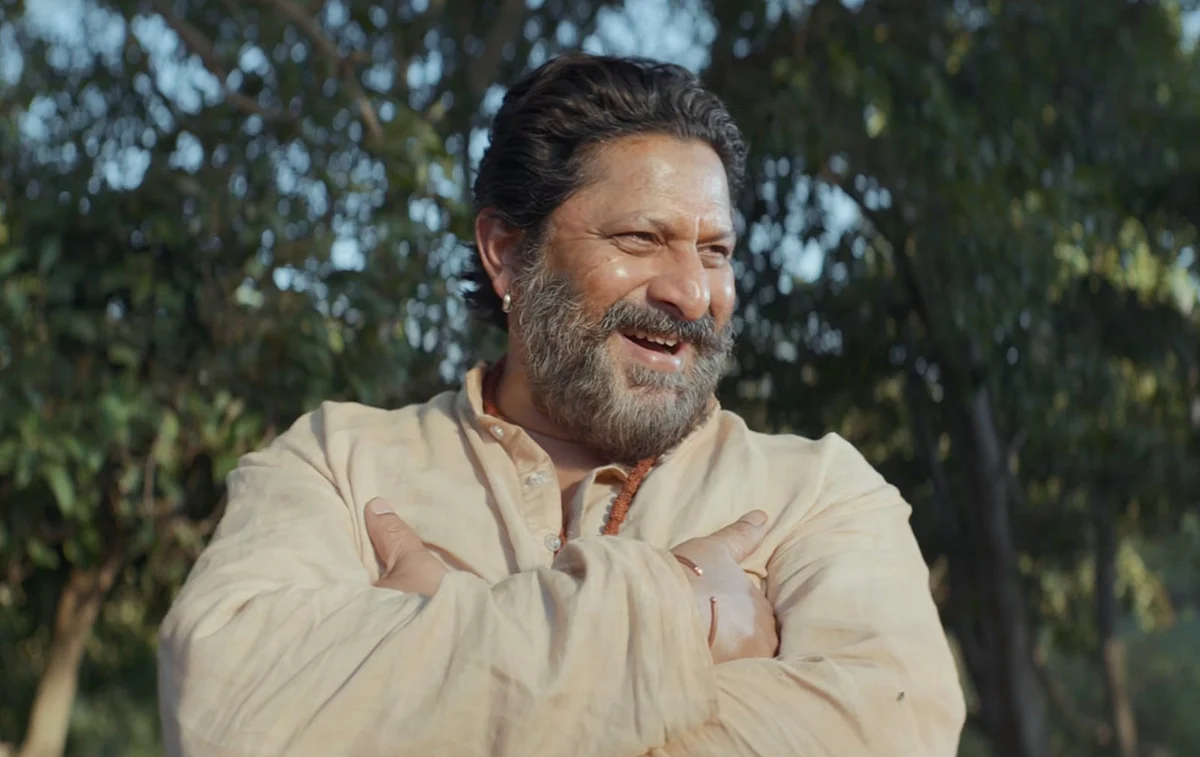
Arshad Warsi, Pratik Gandhi On 'Ghamasaan': 'Courage Is Not In The Shape Of Muscles'


In Ghamasaan, the actor steps far away from the wisecracking, loveable Circuit that made him a household name to play Maharaj, a feared outlaw whose grip over the dusty, unforgiving landscape of Bundelkhand is absolute. He is menacing, unpredictable and, as Warsi puts it, a“really, really fierce, horrible man”.
Recommended For YouOn the other side of this high-stakes chase is Pratik Gandhi as Aditya, an IPS officer determined to find Maharaj - not through the usual larger-than-life cop swagger, but through calculated restraint and strategic thinking, perhaps characteristics less explored with the oversized demeanor of cops one usually encounters in Bollywood.
Directed by Tigmanshu Dhulia, the filmmaker behind Paan Singh Tomar, Saheb Biwi Aur Gangster and Haasil, Ghamasaan looks like a gritty battle of power as well as the systems that allow men like Maharaj to flourish.
Ahead of its release, we caught up with Warsi, Gandhi and Dhulia to talk about filming in the heartland, the art of crafting meaningful silences and why this is not a battle where cars fly in the air and tanks roll in.
'Half your acting is taken care of'One of the things that immediately stands out in Ghamasaan is its world. It does not look like a dressed-up version of rural India created on a studio floor. It feels lived-in, dusty, raw and deeply rooted in the terrain it is trying to capture. That, Dhulia says, is because the film was shot entirely on location. "Maharaj's den and all that was created there at a real location," he says. "It was not shot in Bombay or inside a studio. That is why you get this raw quality.”
This comes at a time when many Hindi films and shows on OTT platforms seem increasingly confined to indoor locations and carefully recreated sets. While that may be necessary at times, it cannot quite replace the raw texture that a real location brings to storytelling and world-building, away from the now-familiar blue-and-red-lit interiors that have become a visual shorthand across many streamers.
And actors Warsi and Gandhi are quick to admit that being placed in a real setting made slipping into their characters that much easier.“It helps big time,” Warsi says.“You have everything proper and real, how it's supposed to be. You feel like you're in that place. It's like half of your acting is already taken care of by the whole atmosphere.”
Gandhi agrees.“You just have to be there and be the character,” he says.“Most of the things are already taken care of. The energy of the real location actually helps elevate your performance.”
Arshad Warsi, but make him dangerous
Warsi has done dark roles before, but there is something particularly striking about seeing him embrace Maharaj's menace after years of being loved for the warmth and comic chaos he brings to the screen. For the actor, though, this is the fun part.“As an actor, I enjoy playing different roles,” he says.“Fortunately, I get to do that. I get to do comedy and then I get offered a film like Ghamasaan, where I'm playing a dacoit and a really, really fierce, horrible man. This is where I get to act (laughs).”
He is also very clear about one thing: he does not take the Method route.“I don't believe in method,” he says, in his trademark no-filter fashion. Instead, his process begins with the people who know the character best, the writer and the director.“They have conceived this character,” Warsi says.“So, they know what this person is like, how he talks, thinks, behaves. Instead of me deciding for myself, I'd rather get it from them."
The result, he hopes, is a Maharaj who feels terrifying not because he is constantly shouting or performing villainy, but because cruelty feels natural to him.“Whatever he says may sound terrifying to a layman,” Warsi says.“But for Maharaj, if you're in that zone, it sounds very correct.”
A cop who thinks before he shootsThen there is Pratik Gandhi's Aditya, who's a cop, yes, but not the kind Hindi cinema has routinely given us over the years. There are no six-pack abs, no invincible action-hero moments, and no sense that a gun alone can solve the problem.“These are IPS officers,” Gandhi says.“When you talk about IPS, they go through a certain kind of training. It is more of a mind game that they play every day.”
For Aditya, courage is not physical, says Gandhi.“The courage is not in the shape of their muscles,” he adds.“The courage is inside them, in the way they think, in the way they approach the whole case.”
That also makes the battle at the centre of Ghamasaan more interesting. Maharaj may be the target, but Aditya is also fighting a system that has allowed Maharaj to exist in the first place.“The biggest problem is that Aditya is a part of the system,” Gandhi says.“The same system has created Maharaj and being in the system, he wants to fight it.”
In fact, Gandhi also points out how Aditya understands that Maharaj is bigger than just one man.“Maharaj is not one person. He's a thought process,” he says.“If he kills one, there will be another Maharaj. The system will immediately create another one.”
The cast has already imagined the sequel and part two, they joke, could be about Aditya taking on the system itself.
Crafting silences in scenesOne thing Warsi and Gandhi have in common is their ability to make silence feel like powerful. In Ghamasaan, that seems especially important. A film about a manhunt cannot possibly explain everything out loud.
Warsi's response to how an actor creates powerful silences is... straightforward.“You've got to be a good actor for that,” he laughs.“Those moments when there is no dialogue, that is the part I love about a film."
Gandhi, on the other hand, sees it as the space between the written lines.“Between those two moments, when there is nothing being said, whatever is happening on the inside is communicated,” he says.“That creates layers. That helps your audience explore something which is not written down.”
But silence, he adds, does not mean emptiness.“A blank actor can easily be caught,” he says.“But if I'm thinking of something and processing it inside, it will always be there.” For Dhulia, those silences are equally important.“Over-the-top performance has no suspense. A character who is real will always be very unpredictable.”
What comedy teaches an actorFor all the darkness that Ghamasaan promises, both Warsi and Gandhi also come with a strong comic instinct, one that, perhaps, informs even the most serious of performances.
Warsi, who's given Hindi cinema some of its most memorable comic characters over the years, says comedy really allows an actor to let go of their inhibitions.“Comedy opens you up as an actor because you really need to let go of your inhibitions, your personal self, to do comedy."
For Gandhi, comedy teaches you its most technical aspect: timing. And not just broad timing, but an almost mathematical precision that determines whether a joke lands or falls flat.“The most important thing we learn through comedy is precision,” he adds.“There is a little amount of elasticity between two lines. If it is stretched too much, it is broken. And if you don't stretch it enough, it doesn't land.”
He likens it to finding the exact right measure,“5.2”, he says, means“5.2”, not“5.25” or“5.1”. Other emotions may allow an actor some room to play around with pace and expression, but comedy is far less forgiving.“It has to be just right,” Gandhi says.
Perhaps, a lesson that may seem far removed from the grim world of Ghamasaan, but one that is at the heart of creating an authentic performance. Whether it is a joke or a threat delivered without raising one's voice, both comedy and drama depend on knowing exactly how much to give away. And in Dhulia's world of fear, greed and power, that restraint may well be its most potent weapon.
The film, also starring Ishita Dutta and Rajpal Yadav, premieres on ZEE5 on September 11.
ALSO READ- 'My grandfather saved a girl': Sunny Deol opens up about a partition memory Dubai: Raghav Juyal, Niharika NM on why 'Bhai Tera Star Hai' will feel 'like therapy' Jim Sarbh on acting with Naseeruddin Shah and the 'pleasurable torture' of the craft

Legal Disclaimer:
MENAFN provides the
information “as is” without warranty of any kind. We do not accept any
responsibility or liability for the accuracy, content, images, videos,
licenses, completeness, legality, or reliability of the information
contained in this article. If you have any complaints or copyright issues
related to this article, kindly contact the provider above.
Comments
No comment