

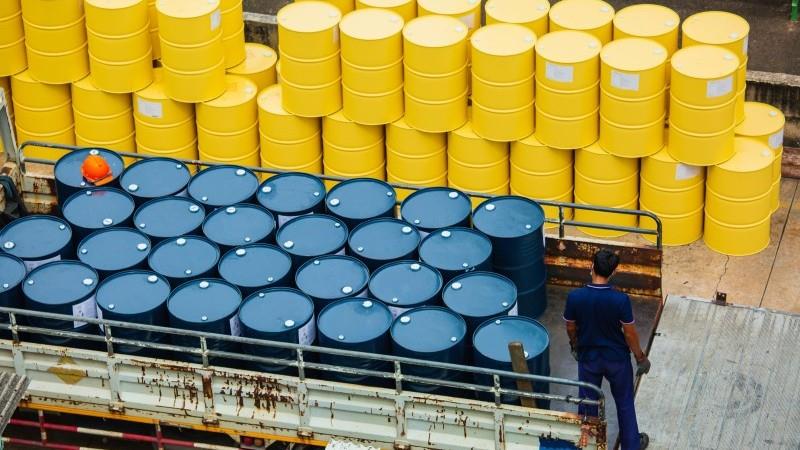
Energy Price Forecasts Revised Higher Amid Stalemate


The US-Iran Memorandum of Understanding (MoU) proved short-lived, and mediation efforts have yet to restart negotiations. Oil prices have consequently risen from late-June and early-July levels, with ICE Brent trading back around the $90/bbl level. Meanwhile, the brief flurry of Strait of Hormuz flows during the MoU period has eased.
Nevertheless, Persian Gulf producers appear increasingly willing to move oil through the Strait and offer more barrels outside it. Tracking remains difficult because vessels often switch off transponders during transit. US officials estimate flows near 10m b/d, while shipping trackers put them at 4-8m b/d, with estimates recently edging higher. Because a very large crude carrier can hold about 2m barrels, missing one or two vessels can materially distort daily estimates.
We assume Hormuz flows of around 5m b/d. Including pipeline bypass volumes, total Persian Gulf oil exports are roughly 50% of pre-war levels.
China continues to provide relief to the oil market in the form of weaker imports. While imports appear to have bottomed in June, they remain well below year-ago levels. Crude oil imports in July averaged 8.45m b/d, up 1.3m b/d MoM, but down 2.7m b/d year-on-year. Given strategic reserves in excess of 1.2bn barrels, China should be able to sustain these lower imports for the remainder of the year.
Updated oil price scenariosBase case: Stalemate persists until shortly before the November US mid-term elections, followed by a limited stabilisation agreement covering Hormuz, military de-escalation and possible sanctions relief. Persian Gulf oil flows remain near 50% of pre-war levels in October, then recover to about 90% by December, including bypass volumes. Brent averages $80/bbl in the fourth quarter, up from our previous forecast of $74/bbl.
Optimistic case: A September agreement restores flows to pre-war levels by year-end, with Brent averaging $75/bbl in the fourth quarter.
Pessimistic case: Escalation increasingly disrupts Hormuz and bypass routes, leaving year-end flows near 50% of pre-war levels and lifting fourth-quarter Brent to an average of $104/bbl.
Diesel tightness is more acuteDiesel and gasoil cracks have reached record highs as Persian Gulf disruptions coincide with reduced Russian supply. Following Ukrainian drone attacks on refineries, Russia has banned diesel exports until the end of September amid domestic supply concerns. This matters because Russia is the world's second-largest diesel exporter. Combined disruptions are equivalent to around 20% of global seaborne diesel trade. With little spare refining capacity, meaningful relief requires a recovery in Persian Gulf and/or Russian flows.
US refiners have been operating at near capacity this summer amid tightness in global diesel marketsUS refinery utilisation rate (%)
Source: EIA, ING Research"> European gas market increasingly vulnerable
European gas prices have recently exceeded EUR70/MWh, their highest since March. Lower Persian Gulf LNG supply has tightened the global market, while strong Asian spot buying pushed EU LNG imports down about 16% year-on-year between April and July. We believe imports should stabilise and recover on a month-on-month basis because freight economics now favour sending spot cargoes to Europe.
Slower injections left EU storage around 65% full at the end of August, versus a five-year average of 82% and below 2021 levels. Our balance points to inventories of 72-73% at the start of the heating season, well below the headline 90% target and potentially below the flexible 75% threshold. Some member states may therefore need to accelerate purchases, supporting prices as winter approaches. Low storage limits the downside for European gas prices under any of our Persian Gulf scenarios.
Three scenarios for energy markets Source: ING"> Three scenarios for inflation Source: ING"> Three scenarios for central banks Source: ING
"> Three scenarios for markets Source: ING">
Legal Disclaimer:
MENAFN provides the
information “as is” without warranty of any kind. We do not accept any
responsibility or liability for the accuracy, content, images, videos,
licenses, completeness, legality, or reliability of the information
contained in this article. If you have any complaints or copyright issues
related to this article, kindly contact the provider above.
Comments
No comment