

Saturn Has A New Mystery: Scientists Discover Giant 10-Sided Shape At South Pole


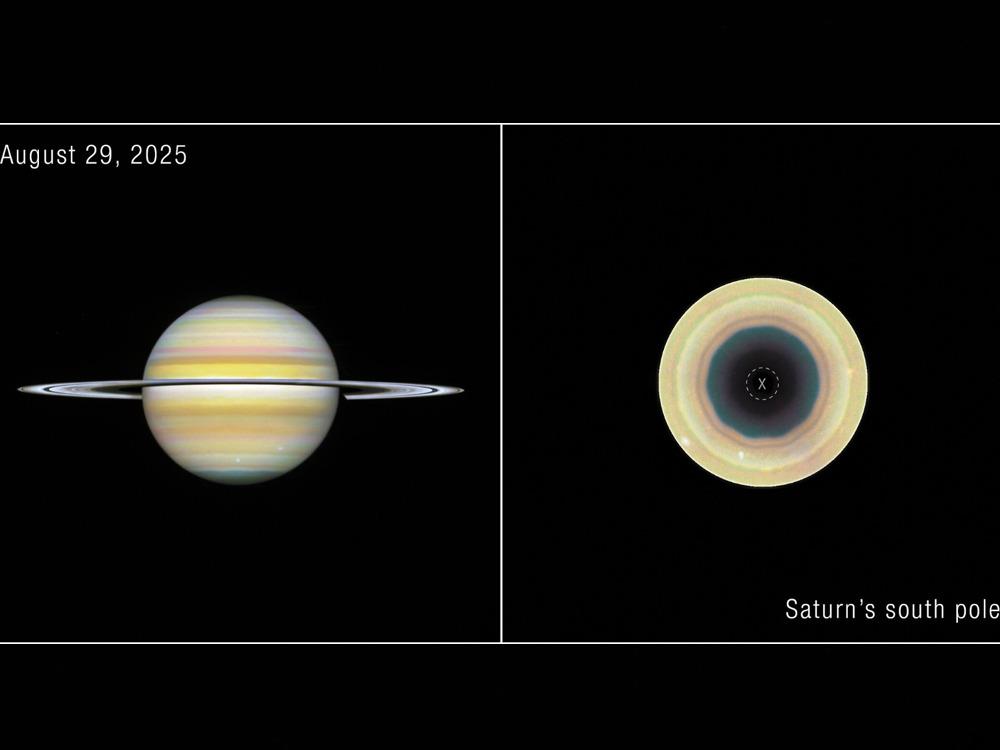
Doha, Qatar: Scientists have discovered an enormous 10-sided atmospheric pattern swirling around Saturn's south pole, adding a new mystery to a planet already famous for a strange six-sided formation at its opposite pole.
The giant structure, known as a decagon, was discovered by an international team led by Agustín Sánchez-Lavega of the University of the Basque Country in Spain using observations from the NASA/ESA Hubble Space Telescope.
The discovery marks the first time scientists have observed a large, regular-sided atmospheric pattern in Saturn's southern hemisphere, according to NASA and the European Space Agency (ESA).
The decagon is enormous. A single side of the 10-sided formation stretches more than 16,700km, according to the researchers.
The feature is embedded within one of Saturn's powerful jet streams at around 63 degrees south latitude and extends through several layers of the planet's atmosphere, indicating that it is more than simply a pattern visible at the cloud tops.
Scientists believe the structure formed relatively recently.
By examining Hubble observations taken over several years, researchers confirmed that the feature was already present in 2023 and became increasingly distinct in subsequent observations.
Earlier images from NASA's Cassini spacecraft, which orbited Saturn between 2004 and 2017, showed no sign of such a long-lived formation.
"We've never seen anything quite like this in Saturn's southern hemisphere," study co-author Amy Simon, principal investigator of Hubble's OPAL programme at NASA's Goddard Space Flight Center, said in a statement released by NASA.
Simon said the northern hexagon has been observed for more than 40 years, while the newly discovered southern feature appears to be strengthening, giving scientists a rare opportunity to watch such a huge atmospheric pattern develop.
Saturn's northern hexagon was first spotted by NASA's Voyager spacecraft in the 1980s and has remained remarkably stable.
The newly identified southern decagon, however, behaves differently. While the northern hexagon is practically stationary, the decagon moves eastward at around 10km per hour and appears to be less stable.
Exactly what created the unusual 10-sided formation remains unknown.
Sánchez-Lavega said possible explanations include instability in the powerful jet stream containing the structure or a wave generated deeper inside Saturn's atmosphere.
The discovery also raises another question: why does Saturn appear capable of producing such enormous geometric atmospheric patterns when similar formations have not been observed on other planets?
Scientists hope further observations using Hubble and the James Webb Space Telescope, combined with computer modelling, will help explain how the decagon formed and whether it will eventually become as stable and long-lasting as Saturn's northern hexagon.
For now, Sánchez-Lavega confirmed that the mysterious formation remains visible.
"Saturn still has the ability to surprise us," the University of Leicester planetary scientist Leigh Fletcher, who participated in the research by measuring winds in the decagon using the European Southern Observatory's Very Large Telescope in Chile, said.

Legal Disclaimer:
MENAFN provides the
information “as is” without warranty of any kind. We do not accept any
responsibility or liability for the accuracy, content, images, videos,
licenses, completeness, legality, or reliability of the information
contained in this article. If you have any complaints or copyright issues
related to this article, kindly contact the provider above.
Comments
No comment